
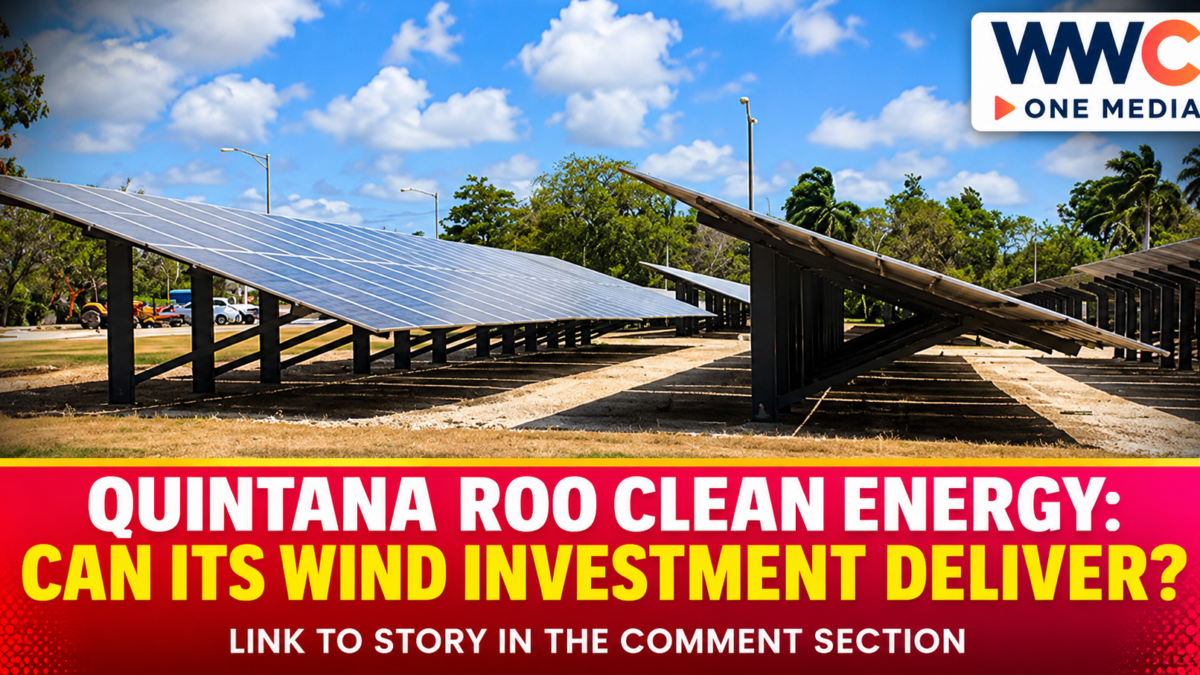
Nov. 22, 2026 — Mexico’s Quintana Roo government is advancing its clean-energy strategy around a proposed wind farm in Othón P. Blanco, where officials have identified 208 megawatts of planned generating capacity. An Oct. 7 state announcement put the expected investment for Vientos del Caribe at approximately 4.4 billion Mexican pesos, making project delivery—not the announcement alone—the next test of its energy ambitions.
The plan matters because new renewable generation could strengthen the region’s electricity options, but a proposed plant does not yet supply power. Permits, grid arrangements, financing and construction remain distinct steps. Public announcements also describe a wider strategy of energy coordination and solar financing, although those initiatives should not be counted as completed generating capacity.
Quintana Roo clean energy has a documented wind project
The state government identified Vientos del Caribe as a planned wind facility in Othón P. Blanco in southern Quintana Roo. Its stated 208-megawatt capacity is a measure of how much power the facility could generate at a particular moment under suitable operating conditions; it is not a promise of continuous output.
The government put the project’s anticipated investment at roughly MXN 4.4 billion. That is a proposed capital requirement, not proof that the full sum has been spent, that funding has closed or that turbines are operating.
Governor Mara Lezama Espinosa discussed the proposal when Quintana Roo’s participation in a national process for solar and wind developments was announced on Oct. 7. The government also said the proposed plant’s electricity would be equivalent to the consumption of more than 200,000 homes. That equivalence is a projection, not a verified record of electricity already delivered.
The distinction is familiar to energy investors. WWC’s examination of Philippine renewable energy targets and what actually gets built likewise separates development plans, approvals and operating supply. The comparison is about project milestones, not a claim that Mexico and the Philippines follow identical rules.
A national approval process sets the framework
Mexico has established federal processes covering proposed renewable-electricity generation and connection to its national power system. Federal energy authorities have published a dedicated portal for applications, notices and results of these processes.
That structure matters because a state-level endorsement cannot substitute for every federal requirement. Developers need to establish whether a project qualifies under applicable rules, how it will connect to the electricity network and whether the environmental and other reviews relevant to its location are satisfied.
A publicly described investment therefore falls into a different category from a completed, permitted and connected power station. Even if several proposed projects are discussed together, the timetable and approvals must be checked for each one rather than assumed for the entire group.
The official records reviewed for this article do not provide a complete matched register proving that four separate Quintana Roo projects together represent US$400 million to US$450 million in newly committed capital. That reported aggregate is consequently not being presented here as a confirmed government investment total.
Solar financing forms another part of the strategy
Quintana Roo’s renewable-energy effort extends beyond the planned wind farm. In July, the state’s ecology and environment secretariat, SEMA, signed a cooperation agreement with Serfimex Capital to encourage clean-energy projects, efficiency improvements and financing for solar and storage equipment.
The official announcement identifies Óscar Rébora Aguilera, the state’s ecology and environment secretary, and Carlos Kamkhaji Ambe, Serfimex Capital’s board chair, as signatories. It describes cooperation on technical and financial training, specialised forums and financing mechanisms offered through Serfimex Solar.
That is a financing and coordination initiative; the agreement should not be treated as evidence that a new utility-scale plant has been completed. Its eventual effect depends on whether prospective users secure financing, install equipment and generate useful electricity.
In the Philippines, WWC has covered Citicore Renewable Energy’s installed-capacity milestone and further expansion plans. The relevant analytical lesson is the difference between an existing operating portfolio and a target that still requires delivery.
Why investment figures need careful reading
A renewable-energy announcement can contain several different numbers: planned capacity, capital expenditure, expected annual output and future customer demand. They answer different questions. A megawatt measures power capacity, while energy actually produced over time is measured in megawatt-hours.
An investment estimate is similarly not the same as a binding financing agreement. Prices can change before procurement, and actual construction costs may differ from the figures disclosed when a project is introduced. Public disclosure of an estimate is useful, but it does not establish the final amount spent.
For prospective electricity consumers, the outcome ultimately depends on functioning projects and the arrangements for delivering the electricity. For investors, the relevant questions include regulatory progress, financing, construction exposure and grid access.
WWC has also examined regional solar and battery-storage cooperation for island communities. That coverage highlights a parallel distinction: new energy partnerships can be promising without immediately changing electricity supply or bills.
What this could mean for Mexico’s energy transition
Analysis: Vientos del Caribe offers a more measurable benchmark than an undifferentiated investment headline. Its named location, stated planned capacity and estimated capital requirement give the public specific items to check against future project records.
Success would not be established by another announcement alone. It would require observable progress through the relevant approvals, installation work, network connection and commercial generation. If those milestones are delayed, the benefits would also arrive later than hoped.
The state’s cooperation with a solar-finance company could widen participation by businesses interested in smaller systems, but no immediate reduction in electricity prices can be inferred from the agreement. Equipment choices, financing terms and actual generation would influence results.
What happens next
The next useful disclosures would identify the wind project’s current authorisation status, any confirmed construction timetable, financing arrangements and expected connection date. Comparable records would also be needed for any other proposed Quintana Roo wind or solar facilities before their costs and capacities could responsibly be combined.
Until those documents are available, the clearest conclusion is narrower than the investment speculation: Quintana Roo has publicly backed a substantial planned wind facility and launched complementary renewable-energy cooperation. Whether that translates into dependable new supply remains a project-execution question.
Frequently asked questions
What is the Vientos del Caribe project?
It is a proposed wind-power development in Othón P. Blanco, Quintana Roo. The state’s Oct. 7 announcement described 208 MW of planned capacity.
How much investment has the state announced for the wind farm?
Quintana Roo’s government estimated the planned Vientos del Caribe investment at approximately 4.4 billion Mexican pesos. This is not a verified amount already spent.
Is Quintana Roo’s US$450 million clean-energy total confirmed?
Not from the primary records reviewed for this report. The full four-project total requires matching official project-level documentation before it can be published as confirmed.
Will the wind farm immediately supply homes?
No immediate supply has been established. The government’s household-equivalence figure describes projected output, not electricity already being delivered.
What must happen before the benefits are measurable?
Project-specific approvals, financing, construction, grid connection and operating data are needed to establish when proposed generating capacity becomes actual electricity supply.










