
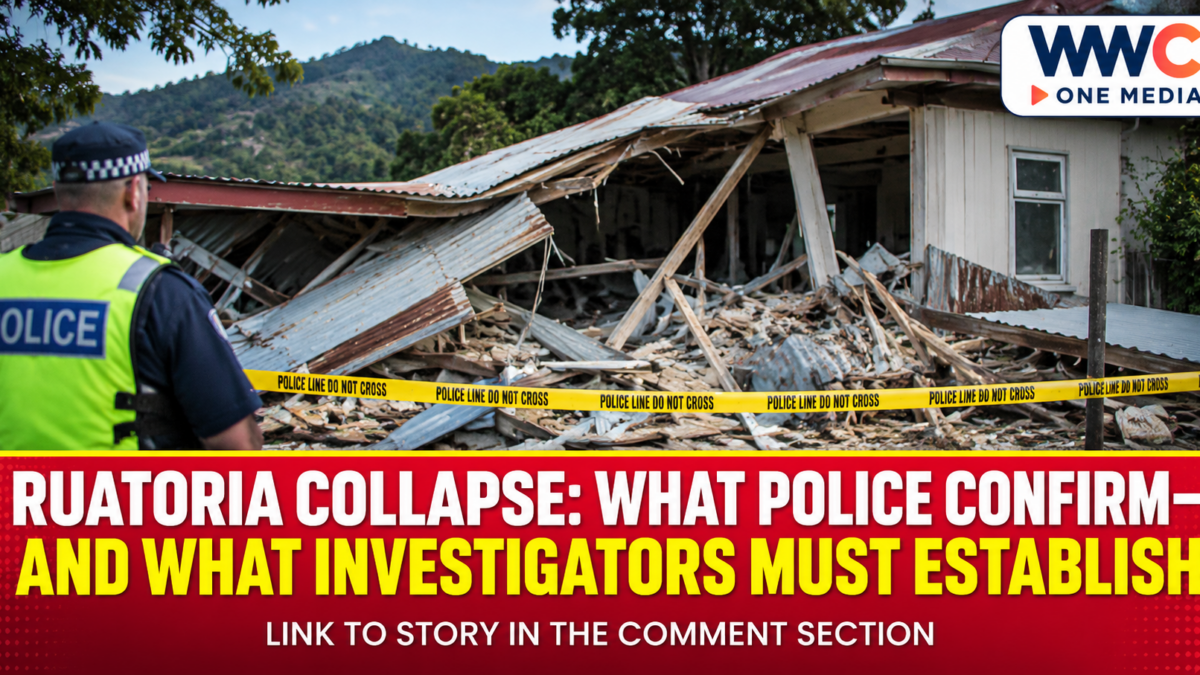
A housing structure partially collapsed at a construction site in Ruatoria, New Zealand, on Sunday, Nov. 22, leaving one person dead and four others injured, police confirmed. Emergency services were called to the Te Huinga Avenue site at about 10:15 a.m., while authorities referred the fatality to the Coroner and notified WorkSafe.
The incident is now subject to ongoing police enquiries, with the official record confirming the casualties and the involvement of workplace-safety authorities. The immediate facts are clear, but the circumstances surrounding the collapse and the factors that led to it have not yet been established publicly.
The incident highlights the importance of distinguishing between the confirmed consequences of a construction accident and the technical findings that investigators still need to determine.
Ruatoria Collapse: What the Official Record Confirms
New Zealand Police confirmed that one person suffered critical injuries and died while being transported to hospital. Four other people sustained moderate-to-minor injuries.
Emergency services were called to Te Huinga Avenue at approximately 10:15 a.m. on Nov. 22. Police said the death had been referred to the Coroner, WorkSafe had been notified, and enquiries were continuing.
Fire and Emergency New Zealand’s incident log also recorded a rescue response in Ruatoria on the same date. The log lists the Ruatoria station and classifies the call as a rescue.
These records establish the response to the incident, but they do not provide a complete technical account of the collapse. The public information reviewed does not identify a confirmed structural failure mechanism, establish fault or explain precisely how the housing structure came to collapse.
Why the Investigation Matters Beyond the Immediate Incident
A construction-site collapse can raise questions involving design, materials, temporary supports, installation procedures, site conditions and how work is managed. Those are possible areas of examination—not findings about what happened at Te Huinga Avenue.
The purpose of an investigation is to determine which factors, if any, contributed to the incident using evidence rather than assumptions. Depending on the circumstances, that can require technical examination of the structure, relevant work records and the sequence of activities before the collapse.
The notification of WorkSafe is particularly relevant because workplace incidents can involve legal duties to report, preserve evidence and cooperate with safety investigations. However, notification alone does not establish a breach of workplace law or identify who may be responsible.
That distinction is important in reporting construction accidents. An incident may trigger regulatory scrutiny without immediately proving negligence, unsafe conduct or a particular engineering failure.
What Construction Safety Rules Are Designed to Address
New Zealand’s WorkSafe guidance for small construction sites outlines responsibilities for managing risks to workers and people who may be affected by work activities.
The guidance discusses matters such as site management, worker training, supervision, equipment, personal protective equipment, contracting arrangements and the need to manage hazards. It also explains that businesses and individuals conducting work may have responsibilities under the Health and Safety at Work Act 2015.
These requirements reflect a broader principle: construction safety is not limited to the condition of the final building. Risks can arise while structures are being built, moved, altered, supported or handled during work.
For a collapse investigation, the relevant safety questions must be matched to the actual activities and conditions at the site. Investigators would need evidence to determine which requirements applied, what arrangements were in place and whether any failures contributed to the incident.
The Difference Between a Confirmed Casualty Report and a Cause
The police statement provides a confirmed casualty update. It does not establish the engineering cause.
A structure can fail for different reasons, and determining the cause generally requires evidence about its physical condition and the work being performed. It would be premature to attribute the Ruatoria collapse to a specific design problem, construction method, equipment failure or human action without a formal finding.
The same principle applies when discussing construction companies, site managers, contractors or property owners. Their involvement in a project does not automatically establish liability for an accident.
WWC has previously examined the wider questions raised by a deadly construction-site collapse in Brooklyn, where the investigation into the building’s failure and the activity at an adjoining site required separate questions to be addressed. The circumstances of that incident are different, and no findings from one case should be assumed to apply to another.
Construction Accidents and the Importance of Accountability
The Ruatoria incident also underscores why workplace investigations must be transparent and evidence-led. When people are killed or injured at a worksite, the public interest extends beyond the immediate emergency response to understanding whether risks were identified, whether safeguards were adequate and whether responsibilities were properly fulfilled.
WWC’s coverage of the Angeles City building collapse and workplace-safety findings shows how investigations can later establish specific safety violations and liabilities. Those conclusions, however, depended on records and findings from that separate case. They cannot be transferred to Ruatoria.
Likewise, the collapse of an NGCP transmission tower in Cavite raised questions about engineering and contractor oversight that require evidence specific to that project.
The lesson is not that every collapse has the same cause. It is that public accountability depends on establishing the facts of each incident independently.
What Happens Next
Police enquiries remain ongoing, and the fatality has been referred to the Coroner. WorkSafe has also been notified, creating a separate workplace-safety dimension to the incident.
Further official information may clarify the sequence of events, the work being undertaken at the site and whether any safety or technical issues contributed to the collapse.
Until those findings are made public, the verified information remains limited to the incident location, emergency response, casualty figures and the fact that authorities are investigating.
Frequently Asked Questions
Where did the building collapse happen?
The incident occurred at a construction site on Te Huinga Avenue in Ruatoria, New Zealand.
How many people died?
Police confirmed one person died after suffering critical injuries.
How many people were injured?
Four other people sustained moderate-to-minor injuries, according to Police.
Is the collapse being investigated?
Yes. Police enquiries are ongoing. The fatality was referred to the Coroner, and WorkSafe was notified.
Has the cause of the collapse been confirmed?
No cause has been publicly established in the official Police statement reviewed. The technical circumstances remain subject to investigation.










