
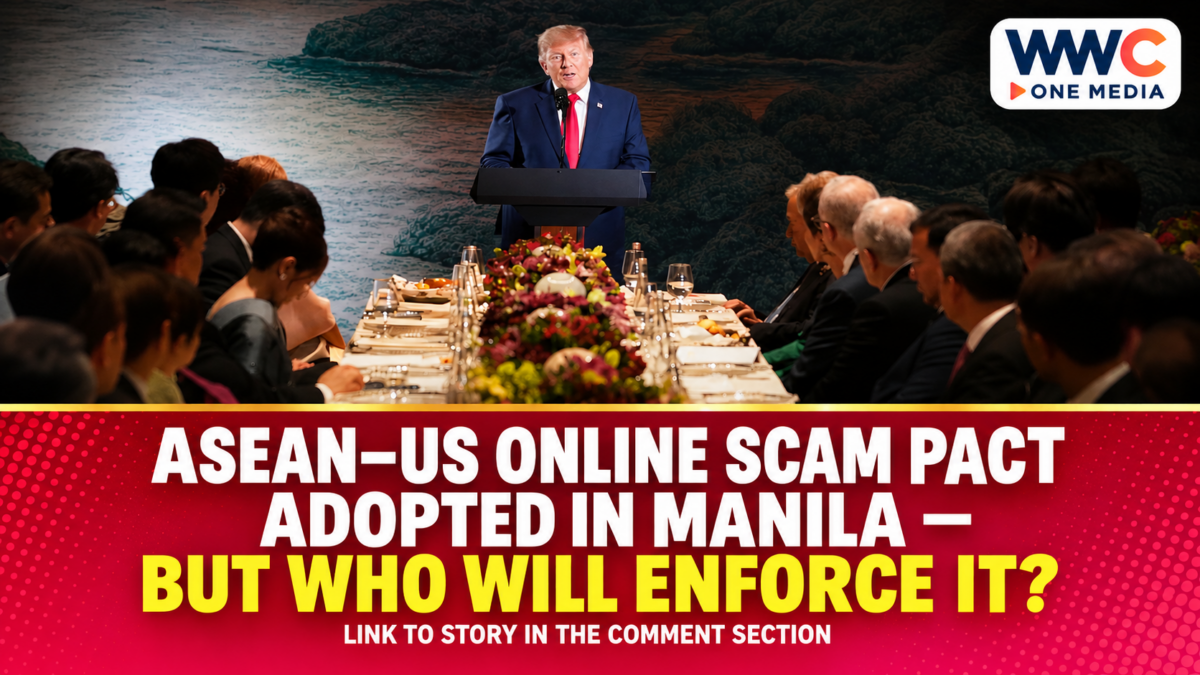
MANILA, Philippines — ASEAN member states and the United States adopted a ten-point statement against online scams at their special summit in Manila on Nov. 17, 2026. President Ferdinand R. Marcos Jr. announced the outcome while welcoming US President Donald Trump, alongside a broader plan for ASEAN–US cooperation through 2030.
The ASEAN online scam pact offers a framework for governments, banks, technology firms and other organisations to cooperate against fraud that crosses national borders. But the document also makes a crucial distinction: adopting principles is not the same as creating enforceable obligations, providing money or guaranteeing recovery for victims.
What the ASEAN online scam pact actually commits to
The statement places online scams on the regional security agenda and calls for cooperation across the public and private sectors. It recognises that suspected fraud schemes can involve multiple countries, financial systems and online services, making a response limited to one jurisdiction inadequate.
Its ten principles cover priority-setting, international coordination, criminal-network disruption, financial monitoring, information sharing, public education, policy development, ASEAN coordination, technology and accountability.
Several provisions are deliberately conditional. Cooperation must respect domestic laws, confidentiality requirements, data protection and the capabilities of participating countries. That language matters because an agreement to cooperate is not an automatic authorisation to exchange anyone’s banking or personal records.
The statement builds on principles discussed by ASEAN and US digital representatives and industry participants in January 2026. The November adoption moved the framework to the leaders’ level; it did not, by itself, produce a single regional anti-fraud law.
Banks and platforms are central to the response
The text encourages banks and financial technology firms to consider exchanging information about suspicious transactions and reviewing customer-identification and due-diligence practices. It also identifies fraudulent websites, phishing domains and mule-account identifiers as potential information-sharing priorities.
Social media services, search engines, app stores, telecommunications providers and virtual-asset service providers are among the industries encouraged to improve detection and disruption. This is broader than a police-only approach: fraud can involve advertising, messaging, account access and movement of money before investigators receive a complaint.
For Philippine readers, the issue is practical. WWC has previously examined WWC coverage of a bank-backed anti-fraud application and its limits, illustrating why consumer warnings and technical tools are different from a guarantee that every scam will be stopped.
What this could mean: Shared warning signals may help organisations identify recurring fraud infrastructure sooner. However, their usefulness will depend on lawful access to reliable data, response speed, technical capacity and whether each participant actually acts on the warnings.
Victim protection must go beyond announcements
The statement also addresses protection for people exploited by organised criminal networks, including those subjected to trafficking and forced criminal activity. It encourages cooperation on investigations, assistance to victims and asset recovery, but ties those steps to applicable legal procedures and decisions by competent authorities.
That distinction matters in cases involving people in suspected scam facilities. WWC’s earlier coverage of an alleged scam-hub operation in Pasay provides local context for why a regional response must consider both potential fraud victims and people who may have been compelled to participate in criminal operations. The separate case is not evidence that the newly adopted pact has already produced an enforcement outcome.
For a customer who loses money, the pact does not establish automatic reimbursement, a single international claims office or a guaranteed timeline for recovering funds. Authorities would still have to identify the relevant transactions, secure cooperation and follow the law in each jurisdiction.
Who will enforce the agreement?
The document points to existing national authorities and ASEAN mechanisms rather than naming a new regional police force. It specifically identifies the ASEAN Working Group on Anti-Online Scams as a possible channel for information exchange, dialogue and practical cooperation.
It also refers to possible US resources and support under relevant procedures, while making clear that additional arrangements and resource commitments must be separately decided. Its implementation clause says the principles do not themselves establish new institutions, staffing obligations or financial commitments.
Why this matters: The principal test is whether existing institutions translate an agreed framework into operational practice. Governments could report more effectively on cooperation requests, platform interventions, suspicious-account referrals and victim-support outcomes, while safeguarding privacy and due process.
Public confidence also depends on sound information handling. WWC’s reporting on personal-data breach notifications involving Philippine government agencies highlights the separate importance of protecting sensitive records. Anti-scam cooperation should not become an excuse for uncontrolled circulation of personal information.
What the Manila summit added—and what it did not
Marcos presented the adoption as an immediate outcome of the ASEAN–US special summit. The broader comprehensive work plan for 2026–2030 sets out cooperation priorities across security and other fields and calls for coordination, monitoring and review through existing mechanisms.
A separate East Asia Summit leaders’ statement on Nov. 17 also addressed online scams and related offences, giving the problem attention beyond the ASEAN–US format. These documents show overlapping diplomatic priorities, not proof that criminal networks have been dismantled or losses reduced.
It would be misleading to describe the ten principles as a completed regional enforcement system. The official language is a starting point for cooperation; national measures and later decisions determine what authorities and companies can actually do.
What happens next
The next questions are measurable ones. Which agencies and industries will take responsibility for each line of work? Will countries agree on workable routes for reporting suspected fraud, preserving evidence and requesting assistance? How will victim protection be assessed without compromising legal safeguards?
The November statement contains no universal launch deadline for a shared reporting platform, no guaranteed amount for a new funding programme and no promise that losses will fall by a specified percentage. Those are gaps to watch, not commitments to assume.
For the Philippines, the opportunity is to connect diplomatic cooperation with everyday consumer protection. The credibility of the ASEAN online scam pact will ultimately rest on documented follow-through, not the number of principles adopted in Manila.
Frequently asked questions
What is the ASEAN online scam pact?
It is a ten-principle ASEAN–US statement adopted in Manila on Nov. 17, 2026, promoting public-private cooperation against online fraud.
Did Donald Trump and ASEAN establish a new anti-scam police agency?
No. The statement supports cooperation through existing institutions and says any new arrangements require separate decisions.
Will banks automatically share customers’ personal data?
No. The document makes potential information sharing subject to applicable national laws and privacy, confidentiality and data-protection safeguards.
Can scam victims automatically recover stolen funds under the pact?
No. The principles encourage assistance and asset recovery where lawful, but do not guarantee reimbursement or establish an automatic recovery mechanism.
What should governments do next?
They need to define responsibilities, agree on practical cooperation methods and report outcomes while respecting privacy, due process and national law.










