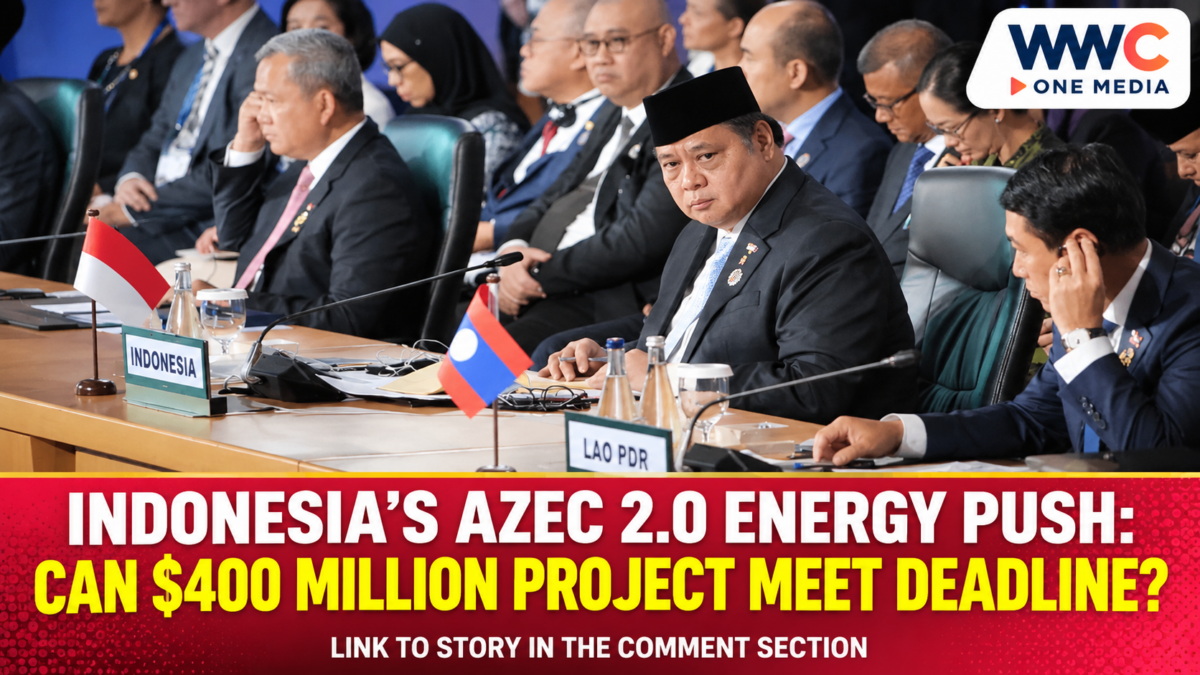
MANILA, Nov. 22, 2026 — Indonesia has put a roughly US$400 million waste-to-energy investment and several electricity projects on the agenda of its expanded regional energy partnership with Japan. At the fourth Asia Zero Emission Community (AZEC) Leaders’ Meeting in Manila on Nov. 17, Coordinating Minister for Economic Affairs Airlangga Hartarto identified project financing and implementation as priorities for the AZEC 2.0 energy programme.
The immediate test is the Legok Nangka waste-to-energy project, for which Indonesia is targeting financial close by the end of 2026. That deadline is a financing milestone, not a promise that a power plant will begin generating electricity this year.
AZEC 2.0 energy strategy shifts towards delivery
Indonesia participated in the meeting as Japan and the Philippines co-chaired the regional gathering. Hartarto represented Indonesian President Prabowo Subianto. The expanded AZEC agenda places climate action alongside inclusive economic development and energy security, rather than treating emissions reduction as an isolated objective.
The distinction matters for countries that need dependable electricity while investing in lower-emissions infrastructure. A project cannot help factories, households or electricity networks merely because it appears in a regional cooperation announcement. It must secure investment, complete technical preparation and progress through construction and operation.
Japan’s Ministry of Economy, Trade and Industry describes AZEC as a cooperation platform involving 11 partner countries, including Indonesia and the Philippines. The initiative already had an established programme before the latest meeting. WWC’s earlier coverage of Japan’s broader ASEAN economic resilience agenda provides context for why energy security has become central to regional discussions.
What the $400 million Legok Nangka target means
Indonesia identified the Legok Nangka waste-to-energy facility as one of the projects it wants to advance with Japan and other AZEC partners. Its indicated investment value is approximately US$400 million, with financial close targeted by the end of 2026.
Financial close generally means the necessary financing agreements and conditions have been settled so that committed funding can become available under the agreed terms. It is not interchangeable with project completion, commercial operation or the physical delivery of electricity.
That makes the remaining weeks of 2026 important for assessing the announced schedule. A confirmed close would be measurable progress. Without an official closing announcement and financing documentation, however, the target should remain a target.
Waste-to-energy projects also have several moving parts. Their effectiveness depends on the availability and composition of waste, processing technology, environmental safeguards, operating arrangements and the ability to sell or use the energy produced. The reviewed government release did not provide a verified opening date or a final electricity-output figure for Legok Nangka.
Geothermal projects and the missing grid connection
The government’s priority list also includes the proposed 220-megawatt Rajabasa geothermal plant in Lampung and the 110-megawatt Hululais project in Bengkulu. It separately identified an expansion of the Sarulla geothermal facility in North Sumatra, without specifying the additional capacity in the same statement.
The named Rajabasa and Hululais capacities total 330 MW. That is a combined project capacity figure, not evidence that 330 MW has already been constructed, connected to the grid or placed into service.
Indonesia also highlighted a Java–Sumatra electricity transmission initiative that was undergoing a joint feasibility study. A feasibility study examines whether a project can be technically, economically and practically developed. It does not establish that a power line has been approved, financed or built.
Taken together, these proposals show why generation and transmission have to be considered together. Additional power capacity has limited value if electricity cannot be moved reliably to the consumers and businesses that need it.
A 100 GW solar ambition faces a separate execution test
Beyond the named AZEC cooperation projects, Indonesia is promoting a solar development programme with peak capacity of up to 100 gigawatts. Hartarto said the government wants to accelerate implementation over the next three years.
A 100 GW ambition is not the same as 100 GW of installed or operational capacity. The official statement did not provide a complete plant-by-plant construction schedule, secured financing total or commissioning timetable that would justify describing the entire amount as ready to deliver electricity.
Indonesia also outlined domestic fuel-blending initiatives: B50 biodiesel and proposed bioethanol blending through E10 in 2027 and E20 in 2028. These plans concern transport fuels rather than the electricity capacity represented by the solar and geothermal projects. They should not be combined into a single power-generation number.
The government continues to state a national net-zero emissions objective for 2060 or sooner. The challenge is determining which individual investments can advance that objective while supporting reliable and affordable energy.
Why financing matters across Southeast Asia
The latest Indonesian announcement is part of a wider regional question: can cooperation produce working infrastructure rather than only declarations of intent? Investors will look at project economics, contractual obligations, permitting, construction risks and the credibility of the proposed revenue model.
For the Philippines, the same distinction between an agreement and an operational energy asset appears in WWC’s coverage of the Philippines–Japan petroleum reserve framework. That arrangement concerns emergency fuel storage, not Indonesia’s electricity projects, but both demonstrate why implementation details matter.
The regional conversation also extends to emergency supply arrangements. WWC has examined the proposed ASEAN joint oil stockpiling initiative, another effort where announced plans must be distinguished from an operational system.
For Indonesia’s clean-energy investments, the most useful indicators will be verified financing, clear project responsibilities, completed technical studies and published construction or operating milestones. Those provide a stronger basis for judging progress than aggregate targets alone.
What happens next
The first deadline to watch is the targeted end-2026 financial close for Legok Nangka. Further official updates may clarify whether that financing has been completed and what implementation schedule follows.
The Java–Sumatra feasibility work and the development status of Rajabasa, Hululais and Sarulla are other important checkpoints. Indonesia’s 100 GW solar ambition will also need more granular evidence of funded and deliverable capacity.
AZEC 2.0 has given Indonesia a platform to pursue regional investment and technical cooperation. Whether it produces a meaningful expansion of usable cleaner energy will depend on the projects moving beyond planning and into measurable delivery.
Frequently asked questions
What is AZEC 2.0?
AZEC 2.0 is the expanded Asia Zero Emission Community cooperation agenda, which Indonesia describes as combining climate action, inclusive growth and stronger energy security.
Has the $400 million Legok Nangka project reached financial close?
The reviewed Nov. 17 government statement sets financial close as a target for the end of 2026. It does not confirm that the milestone has already been achieved.
Which geothermal projects did Indonesia identify?
The government named Rajabasa at 220 MW, Hululais at 110 MW and a planned capacity expansion at Sarulla. The statement did not specify an additional MW figure for Sarulla.
Is Indonesia already generating 100 GW of solar power?
No such conclusion can be drawn from the announcement. The government described a solar development ambition of up to 100 GW peak capacity and an effort to accelerate implementation over three years, not an already operating 100 GW fleet.