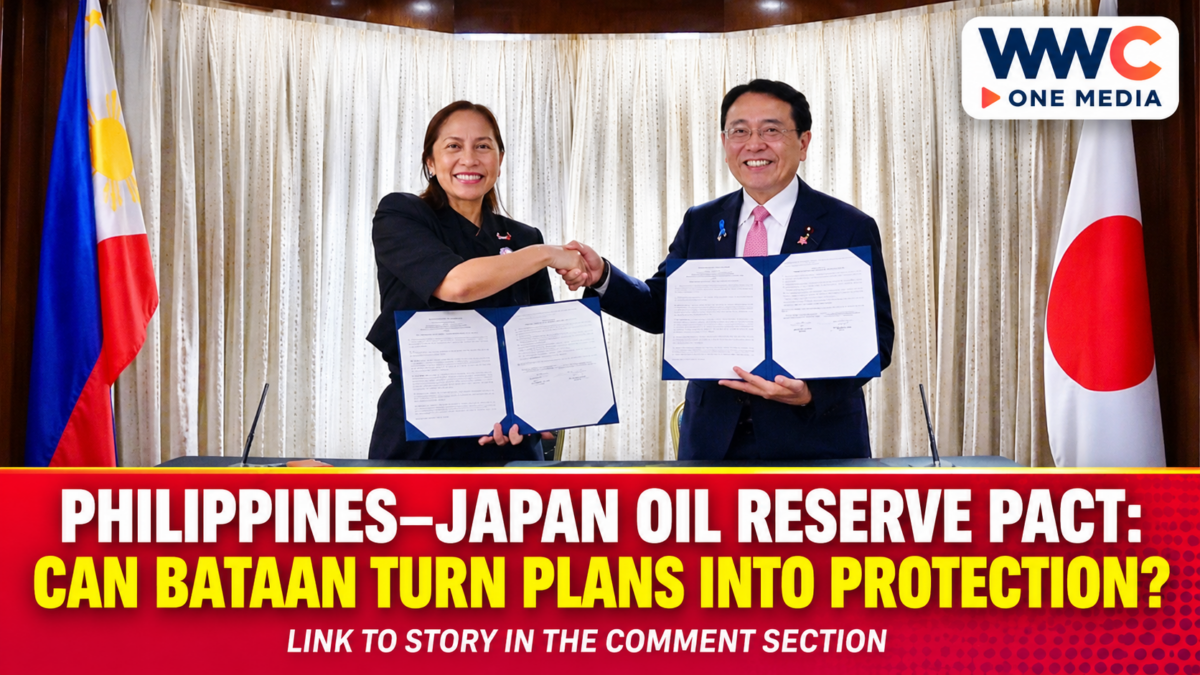
MANILA, Philippines — The Philippines and Japan signed a memorandum of cooperation on Nov. 16, 2026, to help develop Philippine strategic petroleum reserves. The agreement, signed in Manila by Energy Secretary Sharon S. Garin and Japan’s Minister of Economy, Trade and Industry Ryosei Akazawa, sets out cooperation on storage, management and emergency release systems.
For the Philippines–Japan oil reserve pact, the immediate test is not the signing ceremony but the work required to turn a framework into fuel that can actually be accessed during a disruption. A Philippine National Oil Company (PNOC) procurement notice for environmental assessment of a proposed Bataan storage facility makes that distinction particularly timely.
Philippines–Japan oil reserve pact: What was agreed?
The memorandum sets a framework for identifying the infrastructure, policies and institutions necessary to build and operate strategic petroleum reserves. It also covers the circumstances in which emergency inventories could be released, with planning to reflect domestic fuel requirements and market conditions.
The Department of Energy (DOE) and Japan’s Ministry of Economy, Trade and Industry are expected to coordinate the next steps, including priority activities, schedules and responsibilities. The arrangement provides for three years of cooperation, but that term begins only after domestic procedures are completed and written diplomatic notifications are exchanged. The published announcement does not establish that those steps have already occurred.
The memorandum is therefore not itself a construction contract, a purchased oil inventory or an announcement that a government-run fuel reserve is operating. It is a framework under which those more concrete decisions can be developed.
Bataan offers a measurable project milestone
PNOC’s public procurement register lists a Nov. 13 request for expressions of interest for an environmental impact assessment covering a proposed initial one-million-barrel strategic petroleum reserve facility in Bataan. The entry identifies an approved budget for the consultancy contract of ₱7 million and a submission deadline of Nov. 20, 2026.
That ₱7 million is the budget for the environmental assessment procurement, not the cost of constructing the storage facility or buying one million barrels of petroleum. The procurement entry does not by itself confirm that a consultant has been awarded the work, that environmental approvals have been issued or that construction has started.
PNOC also includes a Strategic Fuel Reserve Program among its 2026 plans and projects. Taken together, its programme listing and procurement notice show an identifiable planning track. They should not be read as evidence that the proposed facility has already been built.
A storage project would still require decisions on engineering, environmental safeguards, capital, ownership, operations and eventual procurement of fuel. Those requirements matter because unused tanks and tanks containing accessible emergency inventory are two different levels of readiness.
Japan’s role extends beyond building tanks
The November framework envisages exploring Japanese corporate participation in PNOC-led commercial stockpiling projects, possible financing structures and reserve facilities informed by feasibility studies. It also references technical work involving the Japan Organization for Metals and Energy Security, the Japan International Cooperation Agency (JICA) and the Economic Research Institute for ASEAN and East Asia.
That collaboration had already begun to take shape before the signing. A May 28 joint statement by the two governments addressed Philippine strategic reserves and potential ASEAN-wide stockpiling under the POWERR Asia framework. On Oct. 8, JICA and the DOE signed a separate statement on oil security cooperation.
JICA’s stated programme includes analysing Philippine oil supply and stockholding arrangements, considering suitable legal and administrative systems, building technical capacity, and identifying potential projects. These are important foundations: storage cannot serve its emergency purpose without rules specifying who holds the stock, when it can be released and how it reaches customers.
Regional cooperation could complement domestic reserves
Japan’s Nov. 17 proposals also placed oil security within a wider Asian effort. Official Japanese documents describe an Asia Oil Security Task Force, work with the International Energy Agency, and possible use of idle Japanese storage capacity for Asian partners. These proposals complement, rather than replace, the national planning described in the bilateral memorandum.
The distinction between domestic tanks and contractual access to fuel elsewhere is also central to WWC ONE MEDIA’s previous examination of ASEAN fuel-sharing pilots. Overseas access could provide flexibility, but only if contracts, transport and emergency procedures make the product obtainable when needed.
Other economies are examining related choices. WWC’s reporting on Thailand’s Oil Plan 2026 discusses how stockholding, fuel choices and import diversification can form different parts of one energy-security strategy.
What this could mean for motorists and industry
Analysis: A functioning strategic reserve could give policymakers another option when imported fuel deliveries are interrupted. Its value would be measured by available volumes, the types of products held, release procedures and the speed at which supplies can reach the market—not merely the nominal capacity of a proposed tank farm.
A reserve would not automatically make petrol or diesel cheaper. Buying, storing and maintaining emergency supplies carries costs, while pump prices depend on broader supply conditions and market decisions. An emergency buffer is principally a tool for managing physical availability, not a promise of permanently lower prices.
The infrastructure challenge also has a regional commercial dimension. WWC’s coverage of PetroVietnam’s refining and energy infrastructure programme explores a related question: whether announced energy investment becomes operating facilities that deliver dependable supply.
For the Philippines, the most useful public indicators will be procurement awards, approved studies, financing commitments, construction progress, inventories acquired and published operational rules. Without those milestones, the agreement should be judged as cooperation in development rather than completed protection.
What happens next
The DOE and its Japanese counterpart must identify activities and responsibilities under the memorandum. PNOC’s proposed Bataan facility needs further project-level disclosure, including the result of its environmental assessment procurement and the status of permitting and financing.
The three-year period should not be described as already running unless the required diplomatic notification process is confirmed. As of Nov. 22, 2026, the official announcements examined for this report establish the agreement and planning activity, but do not establish that the proposed Bataan facility is operational.
Frequently asked questions
When was the Philippines–Japan oil reserve agreement signed?
Energy Secretary Sharon S. Garin and Japanese industry minister Ryosei Akazawa signed the memorandum of cooperation in Manila on Nov. 16, 2026.
Is the Bataan strategic petroleum reserve already operating?
The PNOC procurement record describes a proposed initial one-million-barrel facility and an environmental assessment consultancy. It does not confirm an operating storage site or purchased emergency inventory.
How much does the Bataan oil reserve project cost?
The identified ₱7 million figure is an approved budget for environmental assessment consultancy, not a verified total construction or fuel-purchase cost.
Will the agreement lower Philippine fuel prices?
No price reduction is guaranteed. The primary purpose is to improve emergency fuel security; any price effects would depend on implementation and market conditions.
How long will the cooperation agreement last?
The stated cooperation period is three years, starting after required domestic procedures and diplomatic notifications, with an option for extension by mutual written consent.