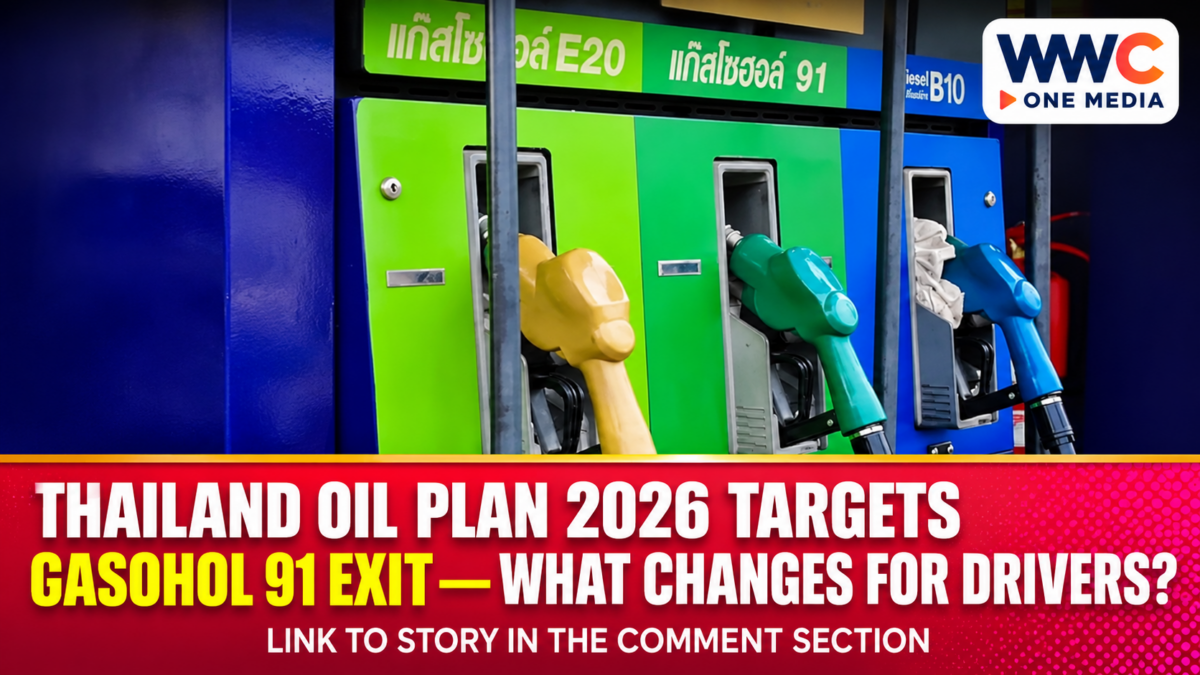
BANGKOK, Thailand — Nov. 22, 2026. Thailand’s proposed Oil Plan 2026 would discontinue gasohol 91 during 2027 while moving E20 petrol towards a larger role in the country’s fuel market. The Government Public Relations Department outlined the proposals on Nov. 20, setting out a long-term strategy that also covers diesel blends, petroleum reserves and changes in transport demand.
The central question is not simply which pump label disappears. Motorists will need reliable information about vehicle compatibility, retailers will need to manage product availability, and policymakers will need to distinguish proposals from rules that have actually taken effect.
Thailand Oil Plan 2026: What would change at petrol stations?
The government’s published summary identifies 2027 as the intended year for discontinuing gasohol 91. It proposes expanding E20, an ethanol-blended petrol, while retaining gasohol 95 E10 and E85 as alternative products. The document also describes a longer-term study of whether unblended 95-octane petrol could be withdrawn by 2032.
The distinction matters: these are different fuel products, and ending sales of one does not automatically prohibit all other petrol grades. Nor does publication of the draft mean that retailers have already been instructed to remove gasohol 91 immediately.
Officials want E20 to account for 50% of the petrol market by 2032. The government summary places the share of gasohol 91 being targeted for transfer at approximately 18%. Even if those purchases move to E20, the final result will depend on vehicle suitability, supply, retail prices and consumer choice.
Why vehicle compatibility matters more than a headline deadline
E20 contains a higher ethanol share than E10. That makes vehicle approval an essential part of any switch, rather than a detail motorists should assume away. Owners should consult their manufacturer’s fuel specifications before using a different blend, especially in older vehicles or equipment.
The government plans more retail outlets offering higher biofuel blends, quality standards and information identifying compatible vehicle models. Its summary also discusses possible tax support and incentives for replacing certain components, including filters and fuel lines, where changes may be necessary.
These measures are plans, not evidence that every motorist will qualify for a subsidy or need a modification. A practical transition would require clear public guidance well before any final withdrawal date.
For context, WWC has examined fuel-price pressure in Thailand. The proposed fuel mix is a separate policy issue: changing the blend sold at the pump does not, by itself, guarantee a lower bill for drivers.
E20 and B20 form part of a wider agricultural strategy
The draft keeps B7 as the standard diesel blend while seeking greater use of B20. Thailand’s government summary sets a 2032 target of 20% for B20’s diesel-market share, compared with approximately 10% at the time of the policy presentation.
The rationale extends beyond motorists. Officials want increased domestic use of palm-oil-derived biodiesel and are considering an energy-crops law and a national biofuels committee. Those proposals would connect fuel policy more closely with cultivation, processing and blending.
A larger guaranteed market for biofuel could create additional demand for agricultural inputs. But the economic benefit would depend on feedstock costs, production capacity, land use, environmental safeguards and whether the resulting fuels remain affordable. Those outcomes cannot be established from a policy target alone.
Tax changes are already real, but temporary
One related measure has moved beyond the planning stage. Thailand’s Excise Department said the Cabinet approved temporary excise reductions on Oct. 27, 2026, for E20 and B20, effective from Oct. 28, 2026, through Jan. 27, 2027.
The official announcement lowered the E20 excise rate from 6.000 baht to 0.358 baht per litre and the B20 rate from 5.953 baht to 0.431 baht per litre. Those are changes to tax rates, not a promise that every filling station will cut its pump price by an identical amount.
The department described a limited three-month measure, linked to household and business costs as well as support for agricultural products. It also said the existing carbon-pricing component would remain. Longer-term tax settings under Oil Plan 2026 are separate and still subject to policymaking.
Oil security is another test of the transition
The draft examines petroleum stockpiles and import diversification alongside biofuel development. The government’s account says statutory reserves are equivalent to roughly 22–23 days, or approximately 40–50 days when working stocks are included. It identifies a possible move towards a 90-day benchmark as an area for study, not a completed reserve expansion.
The department also discusses tracking fuel distribution and studying underground storage in northeastern Thailand. These are distinct projects, with different financing, legal and engineering requirements from changing the grades available at filling stations.
The regional dimension is relevant to the Philippines. WWC has reported on proposed ASEAN fuel-sharing pilots and on regional energy-security cooperation. Those initiatives concern emergency supply access; Thailand’s domestic biofuel strategy addresses a different but complementary problem of dependence and resilience.
What happens next
Public feedback on the draft remains open through Nov. 27, 2026. The department can then revise its proposals before the relevant policy review and approval process. Until those steps are completed, a target to end gasohol 91 in 2027 should not be presented as an enforceable national ban.
The key details to watch are a final implementation timetable, published vehicle-compatibility guidance, filling-station coverage and any new tax or incentive rules. Thailand’s longer-term model also envisages lower petroleum demand under an accelerated net-zero pathway, with demand peaking around 2029 rather than 2034 under a current-trends scenario. Those are projections, not observed outcomes.
For the wider region, the transition is a reminder that energy security involves both how much fuel a country can access and what fuel its vehicles and infrastructure can actually use. WWC’s coverage of Thailand’s energy-supply discussions with Russia illustrates the separate question of sourcing petroleum rather than changing domestic fuel blends.
Frequently asked questions
Is gasohol 91 already banned in Thailand?
No. The government’s Nov. 20 summary describes a proposal to discontinue gasohol 91 in 2027. Publication of the draft is not the same as immediate implementation.
Will all Thai drivers have to use E20?
No such universal requirement is established by the official summary. The proposal retains other petrol grades and makes compatibility information an important part of the transition.
What are Thailand’s targets for E20 and B20?
The draft aims for E20 to represent 50% of petrol sales and B20 to account for 20% of diesel sales by 2032.
When does the public consultation close?
The government’s published deadline is Friday, Nov. 27, 2026.