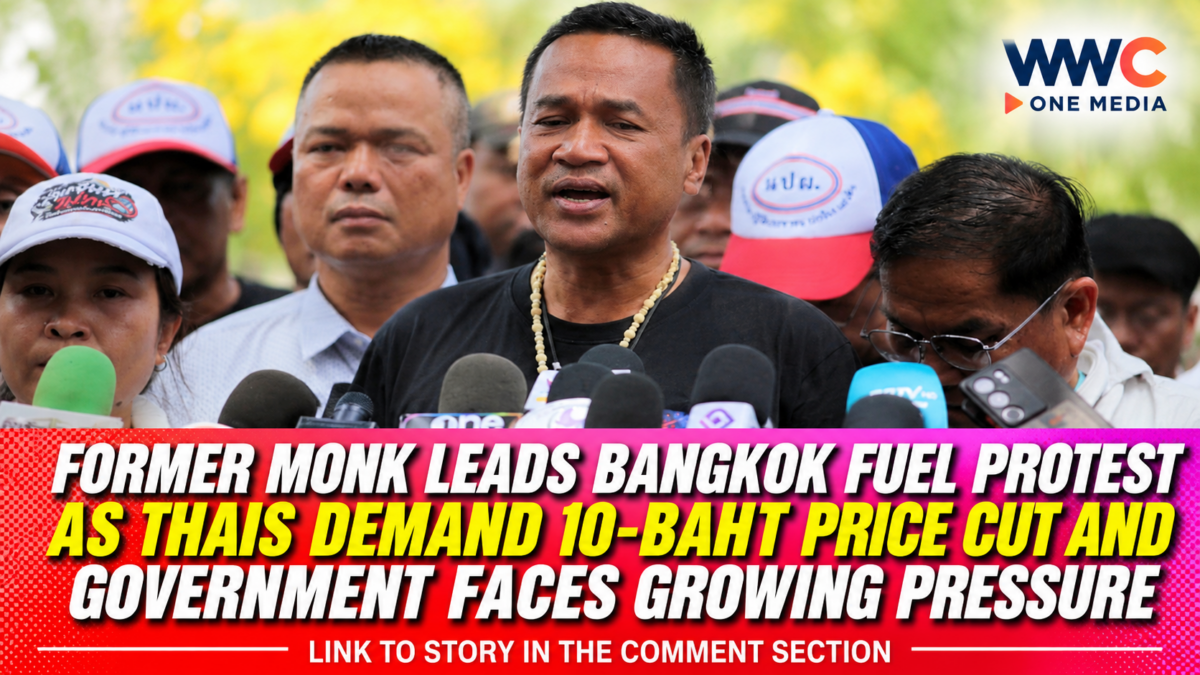
A former monk turned local community leader has brought a major fuel-price protest to the heart of Bangkok, leading a convoy from southern Thailand to demand an immediate reduction of 10 baht per litre in fuel prices.
The demonstration, led by Mano Khrueakaew, widely known as Kamnan Mano, has drawn attention to growing frustration over fuel costs, household expenses and the government’s energy-pricing policies.
The convoy travelled from southern Thailand to Government House after a four-day journey, arriving in Bangkok on November 8, 2026. Around 200 demonstrators and approximately 82 vehicles gathered near the government compound, according to reports from the protest site.
The protesters are demanding cheaper fuel, a review of Thailand’s fuel-pricing structure and stronger action against drug trafficking and corruption.
What began as a regional convoy has developed into a broader challenge for Prime Minister Anutin Charnvirakul’s administration, particularly as transport operators, farmers and households continue to complain about the impact of high energy costs.
Who Is Mano Khrueakaew, the Former Monk Leading the Protest?
Mano Khrueakaew, known as Kamnan Mano, is a local administrative leader from Krabi Noi subdistrict in Krabi province and a leading figure in the People’s Revolutionary Alliance to Protect the Land.
He has become the public face of the campaign, arguing that high fuel prices are placing an unreasonable burden on ordinary people.
During the protest, Mano questioned why fuel prices in Thailand remained significantly higher than those in neighbouring Malaysia. He also challenged the country’s fuel-pricing arrangements, particularly the use of Singapore-linked refined petroleum prices as a reference.
Mano has argued that Thailand’s energy costs should be examined more transparently, including refinery charges and other components that contribute to pump prices.
He has also called on village and subdistrict leaders from across the country to support the campaign, insisting that local officials should stand up for residents rather than serve political interests.
Protesters Demand a 10-Baht Reduction in Fuel Prices
The campaign’s central demand is an immediate reduction of 10 baht per litre across fuel products.
Mano argues that cheaper fuel would provide relief to households, farmers, transport operators and businesses facing rising operating expenses.
The protesters also want the government to review the way domestic fuel prices are calculated, including refining margins and the costs associated with international pricing references.
Their argument is that fuel prices affect far more than motorists. Higher diesel costs can increase the expenses of transporting food, operating agricultural machinery, delivering goods and running commercial vehicles.
The group has also demanded stronger action against illegal drug trafficking, suspected corruption and other activities it believes are damaging communities.
Mano has denied that his campaign is being controlled by a political party, presenting it as a public movement focused on economic hardship and accountability.
Four-Day Convoy Travels From Southern Thailand to Bangkok
The convoy began its journey on November 5, departing from Nakhon Si Thammarat before travelling through southern provinces towards the capital.
Supporters gathered along the route, with some residents providing food, drinking water, encouragement and financial contributions.
The procession passed through areas of Surat Thani, Chumphon, Prachuap Khiri Khan and other provinces before continuing towards Bangkok.
The campaign originally aimed to mobilise approximately 1,000 vehicles. However, the number of vehicles reaching the capital was considerably lower, with reports placing the gathering at around 82 vehicles and approximately 200 protesters.
Despite the smaller turnout, Mano maintained that the movement had attracted support from people concerned about fuel costs and the wider cost of living.
The journey also highlighted how fuel expenses affect communities outside Bangkok, particularly farmers, fishing businesses and people whose livelihoods depend on transportation.
Seven Arrested? No — Police Detain Protest Leader’s Brother Over Handgun
The convoy also encountered a police incident before reaching Bangkok.
On November 7, police stopped a pickup truck associated with the procession in Cha-am district, Phetchaburi province.
Officers reportedly discovered a 9mm handgun and ammunition inside a bag in the vehicle. The person arrested was identified as Manit Khrueakaeo, the 47-year-old younger brother of protest leader Mano.
Mano acknowledged the incident and said the weapon was registered, while maintaining that he had instructed supporters not to bring firearms to the demonstration.
Police investigated the circumstances surrounding the weapon’s possession and carriage.
The arrest brought additional attention to security arrangements for the protest, but it is important to distinguish the two individuals: the person detained over the firearm was Mano’s brother, not the protest leader himself.
Prime Minister Anutin subsequently warned that demonstrators must not carry firearms and that violations would be dealt with under the law.
Bangkok Police Enforce Restrictions Around Government House
The approaching convoy prompted Bangkok police to strengthen security around Government House.
The Metropolitan Police Bureau imposed a 50-metre restriction on public gatherings around the government compound under Section 7 of Thailand’s Public Assembly Act 2015.
The restriction was scheduled to remain in effect until midnight on November 20.
Police also introduced road closures and traffic controls around the area, including sections of Phitsanulok Road, Rama V Road and Nakhon Pathom Road.
Officers were deployed to manage traffic, monitor the gathering and prevent possible confrontations.
The restrictions became a point of disagreement because protesters wanted to establish a gathering area near Gate 4 of Government House.
Police maintained that the measures were intended to protect public safety and ensure access to government offices. The demonstrators, meanwhile, questioned whether the restrictions limited their right to assemble.
Donations Pass 1.6 Million Baht as Protest Organisers Prepare for Extended Demonstration
Financial support for the movement also attracted attention.
Reports indicated that donations exceeded 1.6 million baht as the convoy reached Bangkok, with contributions helping cover transportation, fuel and other protest expenses.
The support reflected the campaign’s ability to attract contributions from people beyond the immediate group travelling from Krabi.
Mano also received backing from veteran political activist Sondhi Limthongkul, who pledged financial assistance for the convoy.
Organisers threatened to maintain a prolonged presence near Government House if their demands were not addressed.
The demonstration was initially expected to continue for an extended period, potentially until December 7, although the duration and precise arrangements remained subject to developments and discussions with authorities.
Protesters Refuse Talks Unless Government Agrees to Fuel Reduction
The dispute intensified after the protesters reached Bangkok.
On November 9, Mano said the group would not negotiate with the government unless officials agreed to reduce fuel prices by 10 baht per litre.
The protesters argued that discussions without a clear commitment to a price reduction would not address the financial pressures driving the campaign.
They also questioned refinery margins and the role of international pricing references in Thailand’s domestic fuel costs.
The position placed additional pressure on the government to respond to the demand while balancing the financial implications of fuel-price intervention.
Energy Minister Promises Faster Fuel Price Reductions
The government’s response began to take shape on November 10, when Energy Minister Akanat Promphan pledged to reduce fuel prices as quickly as possible.
According to reports, the minister said the government was reviewing the fuel-pricing structure and examining refining charges as part of efforts to bring down costs.
He also pointed to recent reductions involving E20, B20 and diesel, with further gradual price adjustments expected.
The minister said changes to the pricing system could remove costs he described as inflated or unjustified, including components linked to Singapore-based reference prices.
He added that reductions worth more than 35 billion baht had been achieved through measures introduced since April and that the government intended to continue reviewing the system.
However, the minister’s pledge should not be confused with an agreement to grant the protesters’ full demand. No confirmed commitment to an immediate 10-baht-per-litre reduction across all fuel types had been announced.
Why Thailand’s Fuel Prices Have Become a Major Public Issue
Fuel prices have a direct influence on Thailand’s economy because petroleum products are essential to transportation, agriculture, manufacturing and distribution.
When diesel becomes more expensive, transport operators face higher operating costs. Those expenses can eventually affect the prices of food, consumer goods and other services.
Farmers also depend on fuel to operate machinery, transport crops and move agricultural products to markets.
For small businesses and households, repeated increases can reduce disposable income and make everyday expenses more difficult to manage.
The debate is therefore not simply about the price displayed at petrol stations. It also concerns how energy costs are distributed throughout the economy and whether the government can make pricing more transparent.
WWC ONE MEDIA has previously examined the wider fuel-price pressure affecting consumers and transport operators in the region:
Thailand’s Fuel Protest Could Become a Bigger Test for Anutin’s Government
The demonstration has exposed the growing frustration surrounding energy costs and the public’s demand for greater transparency in fuel pricing.
Although the government has begun discussing price reductions and structural changes, protesters remain focused on their demand for a 10-baht cut.
The Energy Ministry’s latest pledge could create an opening for negotiations, but the disagreement over the size and timing of any reduction remains unresolved.
For Anutin’s administration, the challenge is to demonstrate that it can respond to public concerns without creating additional pressure on government finances or disrupting the country’s energy system.
For Mano and his supporters, the protest is about securing tangible relief rather than receiving another promise of future action.
The coming negotiations could determine whether the convoy’s four-day journey leads to meaningful changes in fuel pricing or becomes the beginning of a much larger campaign against the government’s energy policies.