
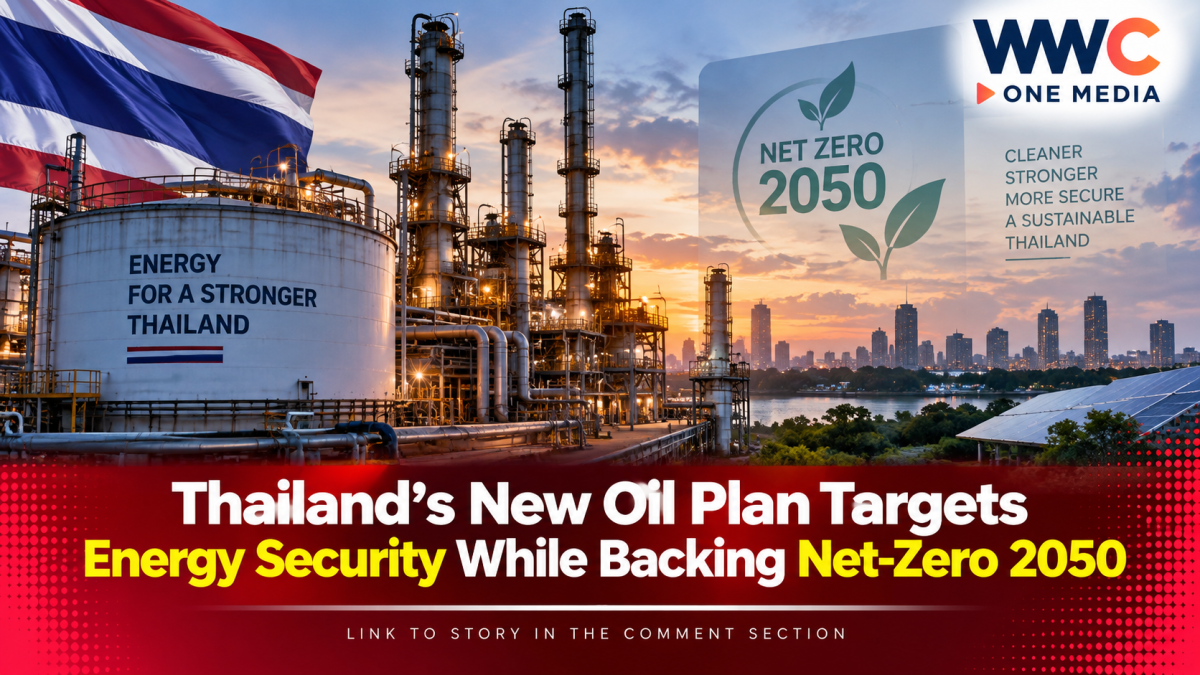
BANGKOK — Thailand is preparing a new National Oil Plan that aims to keep the country’s fuel system secure while aligning oil policy with its accelerated push toward net-zero greenhouse-gas emissions by 2050.
The plan is now in the final stage of preparation, according to the Bangkok Post, and is being developed as part of Thailand’s broader National Energy Plan.
The challenge is increasingly complex: Thailand still needs reliable petroleum supplies for transport and industry, while government policy is simultaneously pushing the country toward lower-carbon energy.
Oil Policy Meets a Faster Climate Target
Thailand significantly strengthened its climate ambition in 2025 by moving its net-zero emissions target forward from 2065 to 2050.
Krungsri Research says the revised target requires Thailand to cut net greenhouse-gas emissions by 47% from 2019 levels by 2035, with the energy and transport sectors among the areas facing the greatest pressure to transition.
That makes the new Oil Plan more than a traditional fuel-supply document.
It must increasingly account for how demand for petroleum products could evolve as electric vehicles, renewable energy and other lower-carbon technologies expand.
Why Thailand Still Needs an Oil Strategy
A net-zero target does not mean petroleum demand disappears overnight.
Oil products remain important to Thailand’s transportation system and parts of its economy. Previous revisions to the country’s oil policy have dealt with issues including gasoline and gasohol demand, fuel standards and the changing vehicle fleet.
The Bangkok Post previously reported that the new Oil Plan would proceed despite PTT Oil and Retail Business (OR) ending sales of E85 gasohol, illustrating how changing consumer and vehicle demand is affecting Thailand’s fuel mix.
The new plan therefore has to address two objectives at once: maintaining adequate fuel supplies while preparing for a gradual structural shift in energy consumption.
EVs Could Change the Fuel Market
One of the biggest long-term variables is transportation.
Thailand has been promoting electric-vehicle manufacturing and adoption as part of its wider industrial and climate strategies. Krungsri Research identifies transport and energy as major sources of emissions and says their transition toward renewable energy and EVs will be central to achieving Net Zero 2050.
As more vehicles switch from internal-combustion engines to electric power, demand patterns for gasoline and diesel could change.
But the transition is unlikely to happen uniformly across every sector or at the same pace, meaning petroleum products are expected to remain part of Thailand’s energy mix during the transition.
The Oil Plan Is Part of a Bigger Energy Puzzle
Thailand’s National Energy Plan brings together several major policy components, including the Power Development Plan, Alternative Energy Development Plan, Energy Efficiency Plan, Gas Plan and Oil Plan.
The OECD identifies the Oil Plan as one of the sector-specific plans within Thailand’s broader energy-policy framework.
That means the future of Thailand’s oil market cannot be considered separately from electricity generation, renewable energy, natural gas, energy efficiency and transportation policy.
The government’s revised climate strategy also requires emissions reductions across multiple sectors rather than relying on changes in the oil industry alone.
Energy Security Remains a Critical Concern
The transition also comes at a time when energy security has become increasingly important.
Thailand remains exposed to international energy prices and geopolitical disruptions because part of its energy supply depends on imports and international markets.
Recent energy-market volatility has reinforced the importance of maintaining reliable supplies even as governments pursue decarbonisation.
That creates a delicate policy balancing act: Thailand must reduce emissions over the long term without undermining the reliability and affordability of energy in the short term.
What Happens Next?
The new Oil Plan is expected to provide a framework for Thailand’s petroleum sector as the country moves toward 2050.
Its significance will ultimately depend on how its targets translate into fuel policy, infrastructure investment, vehicle adoption, energy efficiency and coordination with Thailand’s other national energy plans.
The bigger story is therefore not simply whether Thailand will use less oil.
It is whether the country can manage the transition from an oil-dependent transport and industrial system toward a lower-carbon economy without sacrificing energy security.
With Net Zero 2050 now the national destination, the new Oil Plan could become an important test of how Thailand intends to get there.
WWC ONE MEDIA G.A




Leave a Reply