
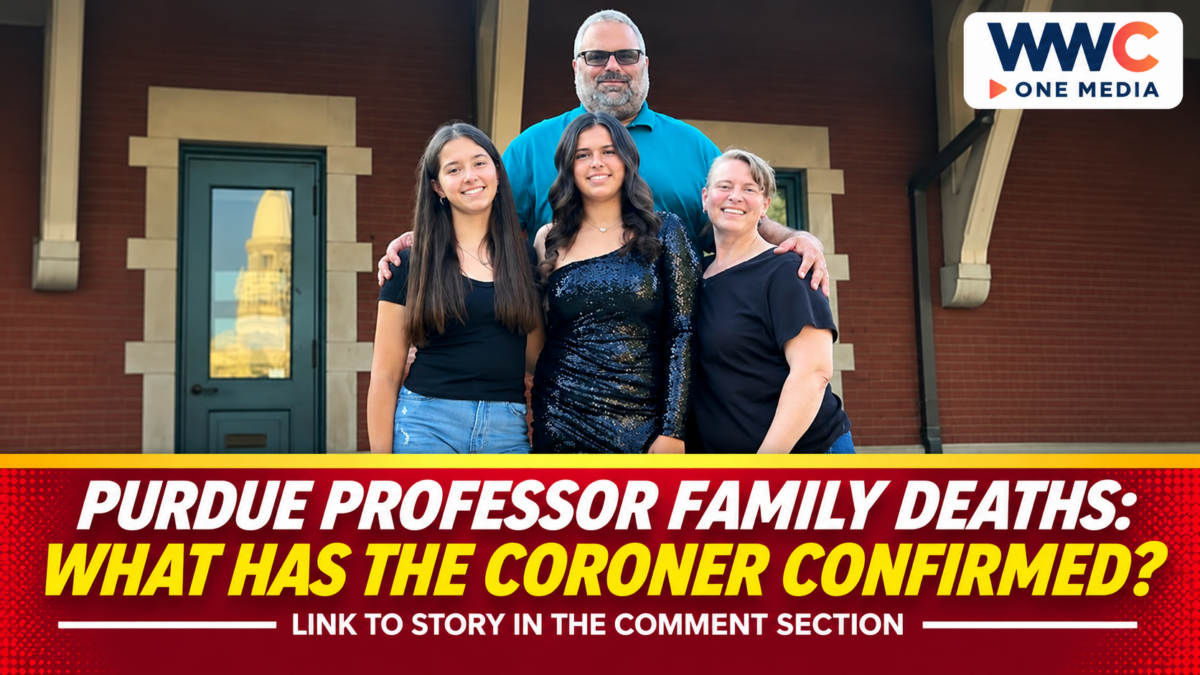
WEST LAFAYETTE, Indiana — Nov. 22, 2026. The Tippecanoe County Coroner’s Office has released preliminary findings in the deaths of four members of a West Lafayette family, including a Purdue University faculty member and two teenagers. Its Nov. 20 report classifies three deaths as homicides and the fourth as a suicide, while the wider investigation remains ongoing.
The Purdue professor family deaths have drawn attention to what can be established from official forensic records—and to the important questions those records cannot yet answer. The coroner’s findings identify the people who died and the preliminary manner of each death; they do not establish a motive or provide a complete account of the family’s final hours.
Purdue Professor Family Deaths: What the Coroner Confirmed
The coroner identified the deceased as Julie Tkach, 53; Thomas Tkach, 51; Katharyn Tkach, 17; and Lauren Tkach, 16. All four were residents of West Lafayette, Indiana.
Forensic autopsies were performed on Nov. 20. The coroner classified Julie’s, Katharyn’s and Lauren’s deaths as homicides in the preliminary findings. Thomas’s death was classified as suicide.
These are medical-legal classifications in an official county document. They should not be confused with a completed criminal investigation or a comprehensive explanation of what happened inside the residence.
The release does not disclose a motive, discuss any previous family dispute or provide a verified sequence of events. Those gaps matter, particularly when public attention is focused on a tragedy involving two minors.
What the Official Timeline Establishes
The county coroner’s record states that its office was notified of multiple deaths at approximately 1:50 a.m. on Thursday, Nov. 19, at a residence in West Lafayette.
That time identifies when the coroner’s office received notification. It is not necessarily the time the deaths occurred, when someone first sought emergency assistance or when police officers arrived.
This distinction is important because different stages of an emergency can involve different timestamps. Without an original dispatch record or police incident report establishing those moments, publishing a precise sequence would go beyond what the coroner’s release proves.
The document also states that the investigation involves the Tippecanoe County Sheriff’s Office, Indiana State Police and the county coroner. It does not provide a final investigative report.
Julie Tkach’s Role at Purdue University
Purdue University’s College of Health and Human Sciences faculty directory lists Julie Tkach in its White Lodging–J.W. Marriott, Jr. School of Hospitality and Tourism Management, with the title of clinical professor.
This institutional record independently establishes her academic affiliation. It does not, by itself, confirm every employment date, earlier appointment or personal detail that may circulate following her death.
The loss of a faculty member has significance beyond the police investigation. Universities are places where teachers, students and colleagues build professional relationships, and the death of a member of that community can affect many people.
That observation should not be mistaken for a claim about how any particular student or colleague is coping. Individual experiences are private, and institutional responses should be described only when verified in direct official communications.
Why Preliminary Findings Must Be Read Carefully
The coroner’s release distinguishes between preliminary cause of death and preliminary manner of death. A cause addresses the medical circumstances; a manner classifies a death within categories such as homicide or suicide.
A homicide classification does not, on its own, resolve the criminal-law questions of who was responsible or whether particular conduct could have resulted in a prosecution. Those matters require evidence beyond the classification itself.
The county also states that toxicology testing remains pending and that results may take approximately six to eight weeks. This is an estimated laboratory period, not a confirmed publication date for a final report.
WWC has previously covered the importance of distinguishing unresolved family-death investigations from established findings. That editorial distinction applies here as well: unanswered questions should not be filled with assumptions.
The Wider Questions About Family Safety and Accountability
The Indiana case raises legitimate public-interest questions about emergency response, violence prevention and the treatment of families affected by serious crimes. It does not justify assuming that any particular warning was ignored or that an intervention would necessarily have changed the outcome.
Public accountability requires a documentary foundation. A question about an agency’s actions is not evidence of institutional misconduct, just as an unverified personal history cannot be used to establish motive.
In another jurisdiction, WWC examined how allegations involving police personnel require careful investigative oversight. That coverage concerns a separate matter; it is relevant here only to the general principle that official employment and allegations must be evaluated through independent evidence.
WWC also examined the distinction between criminal allegations and proven findings in a separate United States domestic-violence case. Nothing in that case should be treated as evidence about the Tkach family.
For people facing threats or abuse in the United States, the National Domestic Violence Hotline offers confidential support by telephone, text and online chat. Emergency assistance should be sought through 911 when there is immediate danger.
What Happens Next?
The most important next steps are the completion of outstanding forensic work and any further official investigative announcements. The Nov. 20 coroner’s release does not say when investigators will issue a final account.
As of Nov. 22, the verified public record supports the identities and preliminary death classifications, but not a specific motive or a minute-by-minute reconstruction of the incident.
Responsible reporting therefore requires maintaining that boundary: acknowledging what the authorities have formally established, preserving the privacy of people affected and correcting the public account if later official evidence changes it.
Frequently Asked Questions
Who were the four people identified by the coroner?
The Tippecanoe County Coroner’s Office identified Julie Tkach, 53; Thomas Tkach, 51; Katharyn Tkach, 17; and Lauren Tkach, 16.
What did the coroner determine about the deaths?
Preliminary autopsy findings classified Julie’s, Katharyn’s and Lauren’s deaths as homicides and Thomas’s death as suicide. The report did not establish a motive.
Was Julie Tkach a Purdue University professor?
Yes. Purdue’s College of Health and Human Sciences directory identifies Julie Tkach as a clinical professor in its hospitality and tourism management school.
Is the investigation complete?
No final investigation report was identified in the primary records reviewed. The coroner’s release describes an ongoing investigation and pending toxicology testing.
Where can people in the United States seek help with domestic abuse?
The National Domestic Violence Hotline can be reached at 800-799-7233 or by texting START to 88788. Anyone facing immediate danger should call 911.










