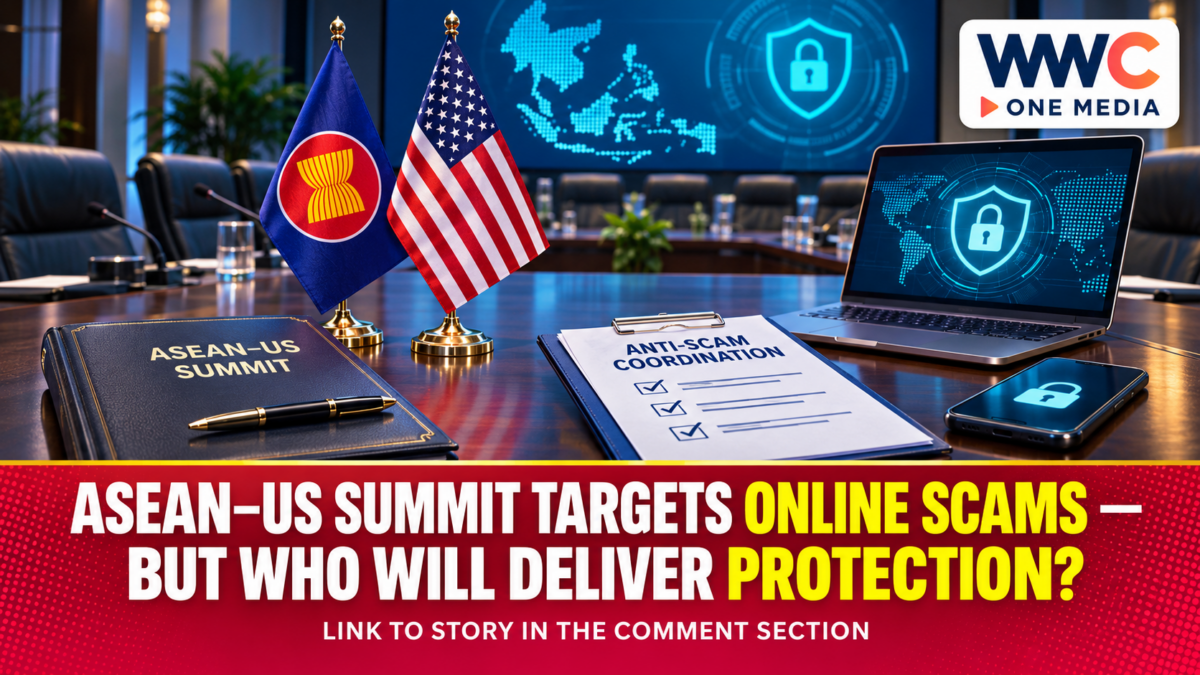
MANILA, Philippines — Nov. 22, 2026. ASEAN and the United States adopted 10 public-private partnership principles against online scams during their special summit in Manila on Nov. 17. They also released a cooperation work plan running from 2026 to 2030, setting out priorities in security, technology, trade and other areas.
The ASEAN US summit has therefore produced more than a ceremonial statement. But its most immediate test is practical: whether governments, banks, digital platforms and other participants can translate shared priorities into faster warnings, better investigations and meaningful assistance for people targeted by fraud.
ASEAN US Summit Puts Online Fraud on the Regional Agenda
The anti-scam statement treats online fraud as an issue affecting public security, economic activity and social trust. It encourages authorities and businesses to make the problem a high-level policy priority instead of handling it entirely through separate consumer complaints or isolated investigations.
The statement is not presented as the creation of a new regional police agency. Its implementation section expressly says the principles do not themselves establish new institutions, staffing obligations or financial commitments.
That distinction is essential for readers. Agreement about the seriousness of a problem does not prove that a new reporting service, regional investigation team or victim-compensation programme has begun operating.
WWC’s earlier account of the Wong–Trump ASEAN encounter examines the broader diplomatic partnership. The consumer-protection issue deserves a separate test: what changes for an individual who reports a scam?
Ten Principles Cover Cooperation, Finance and Accountability
The adopted document identifies ten areas for collaboration. They range from elevating online scams as a regional priority to strengthening international coordination, protecting victims, sharing threat information, improving policies and promoting accountability.
Financial institutions receive particular attention. The statement invites banks and fintech companies to consider improved sharing of information about suspicious transactions and to review customer-verification and due-diligence measures, subject to national law and confidentiality protections.
It also discusses information on fraudulent web addresses, phishing domains and accounts used to move stolen money. Such exchanges could help separate organisations recognise connected patterns that might be missed when each looks only at its own customers.
However, the wording matters. These are principles for cooperation, not a blanket order requiring every financial institution in Southeast Asia to share all customer data. The document repeatedly preserves applicable legal requirements, privacy safeguards and national procedures.
For readers, this is the dividing line between a promising policy direction and an enforceable protection already available in their country.
Why Victims and Trafficked Workers Both Matter
The summit document also links scam operations with trafficking in persons and forced criminal activity. It calls for approaches that protect users while recognising that some people involved in scam compounds may themselves have been coerced.
This makes the policy challenge more complex than blocking suspicious messages. Cross-border cases can involve victims in one country, digital infrastructure in another, and money passing through multiple financial systems.
The principles encourage investigation, legal assistance, asset recovery and coordination where appropriate under domestic laws. They also refer to safeguards and due process when authorities pursue confiscation or recovery of assets.
A victim-centred approach should not be confused with a guaranteed refund. The statement does not promise automatic repayment, establish a new compensation fund or set a universal deadline for recovering money.
The wider challenge of regional technology oversight has also appeared in WWC’s coverage of the AIPA AI governance debate. Parliamentary discussions and intergovernmental principles can guide policy, but national legal and administrative action is needed to make protections workable.
The 2026–2030 Work Plan Extends Beyond Scams
The separate ASEAN–US work plan places fraud prevention within a much larger programme. Under its security priorities, it provides for cooperation on transnational crime, cybercrime, maritime security and capacity-building.
On economic matters, the document addresses trade and investment, financial-sector development, small businesses, digital commerce, transport, energy and critical minerals. It also identifies cooperation on digital infrastructure, data governance and emerging technologies.
These are areas where companies could eventually benefit from better coordination. But the work plan does not, by itself, demonstrate that any particular investment has been funded, a tariff has been reduced or a new infrastructure project has been completed.
ASEAN’s broader implementation challenge is explored in WWC’s report on Vietnam’s proposals for regional unity. Proposals, agreements and delivered projects are different stages of cooperation; they should not be reported as interchangeable outcomes.
For the Philippines, digital trust is an economic issue as well as a public-safety issue. Consumers are less likely to embrace online transactions if they cannot determine how suspicious activity is reported or what happens after a report reaches the responsible institution.
What Could Make the Agreement Measurable?
Analysis: A useful follow-through programme would identify the agencies and industries responsible for specific actions, explain how information can be exchanged lawfully, and publish indicators showing whether collaboration is improving prevention and response.
Possible measures include publicly documented training, operational reporting channels, faster identification of scam infrastructure and clearer explanations of victim-assistance procedures. These are proposed tests for progress, not outcomes the summit has already achieved.
The work plan offers one accountability route: it provides for review through existing ASEAN–US dialogue arrangements and calls for progress reports to the annual ASEAN Post Ministerial Conference Plus One with the United States.
The public should be able to distinguish between activities launched, activities proposed and results independently demonstrated. A growing list of meetings is not necessarily evidence that fewer people are being defrauded.
What Happens Next
Implementation now depends on participating governments and relevant industries acting within their own laws, resources and responsibilities. The anti-scam principles leave decisions on additional arrangements and funding to the countries concerned.
The next meaningful documents will be national implementation measures, identifiable cooperation projects and progress reports under the 2026–2030 work plan. Until those appear, claims of a new mandatory regional anti-fraud regime would go beyond what the adopted texts establish.
The Manila summit set out a shared direction. Its credibility will depend on what governments and private organisations can later show they have done, especially for people who need protection before financial losses become irreversible.
Frequently Asked Questions
What did the ASEAN US summit agree on in November 2026?
The Nov. 17 special summit produced an ASEAN–US statement on ten public-private anti-scam principles and a comprehensive cooperation work plan for 2026–2030.
Did ASEAN and the United States create a new anti-scam police force?
No. The principles explicitly state that they do not themselves create new institutional arrangements or staffing requirements.
Do the principles require banks to share all customer information?
No. They encourage appropriate cooperation and review of financial safeguards, subject to applicable national laws, privacy, confidentiality and data-protection requirements.
Will people who lose money to scams receive automatic compensation?
The statement encourages victim assistance and asset recovery under applicable legal procedures. It does not establish automatic reimbursement or a new compensation guarantee.
How will progress on the ASEAN–US work plan be reviewed?
The plan identifies existing ASEAN–US dialogue mechanisms for review and calls for implementation progress reports to the annual ASEAN Post Ministerial Conference Plus One with the United States.