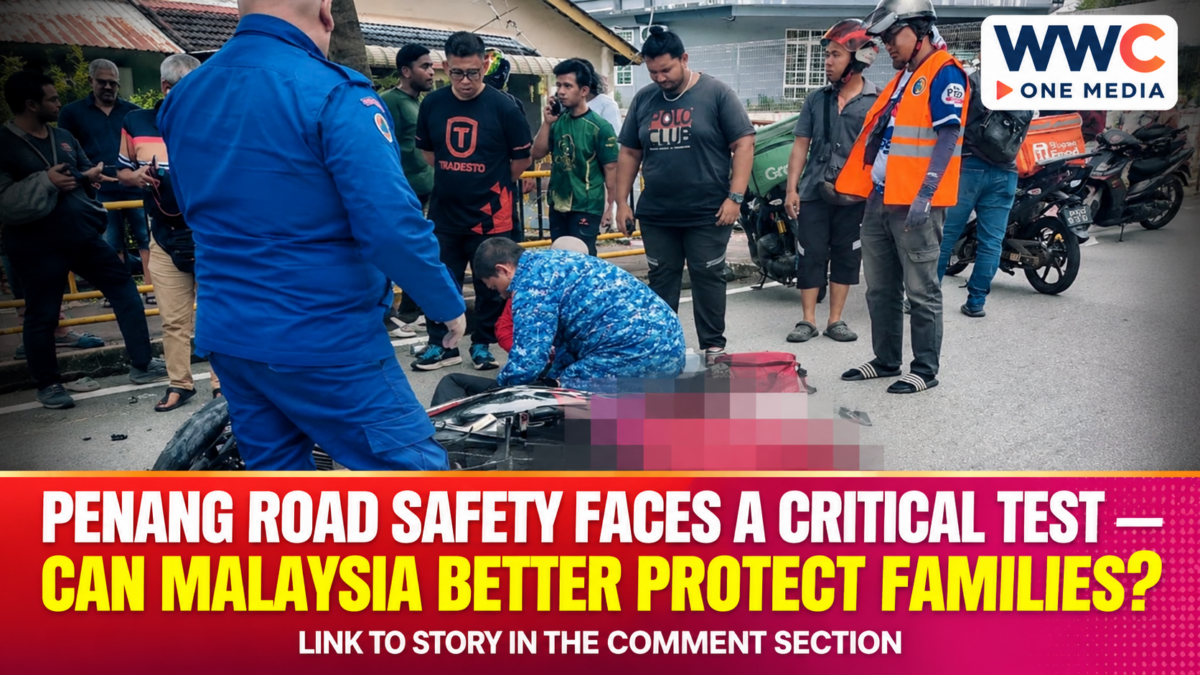
PENANG, Malaysia — Nov. 22, 2026. Malaysia’s road-safety policies are facing renewed scrutiny following reports of a serious collision in Penang on Nov. 17 involving a woman and a young child. While the incident’s full circumstances still require verification against an original police record, the country’s existing transport policies provide a clear framework for examining the safety of families travelling on Malaysian roads.
The broader issue extends beyond any single collision. Malaysia has committed to reducing road fatalities by 50% by 2030, making protection for motorcyclists, children and other vulnerable road users a central test of whether national safety promises are being translated into practical improvements.
Penang Road Safety: What the Official Framework Establishes
Malaysia’s Road Safety Plan 2022–2030 sets out a national strategy for reducing deaths and serious injuries through prevention, safer infrastructure, improved vehicle standards and more effective responses after crashes.
The programme targets a 50% reduction in road fatalities by 2030 compared with the 2019 baseline.
Rather than concentrating solely on individual driver behaviour, the plan recognises that road safety depends on several interconnected responsibilities, including road design, traffic management, vehicle standards and emergency response.
That distinction matters whenever a serious collision becomes the focus of public attention.
An immediate account may identify the vehicles involved or describe the circumstances under investigation. It does not necessarily establish the underlying cause, whether infrastructure contributed to the outcome or whether preventive measures could have reduced the consequences.
Malaysia’s transport framework therefore provides a broader basis for assessing road safety than simply identifying who may have made a mistake.
Why Motorcycle Safety Remains a National Priority
Motorcycle riders face significant exposure because they do not have the same protective structure available to occupants of passenger cars.
Malaysia’s Ministry of Transport identifies motorcyclists as the largest category of road-user fatalities in its historical fatality data, accounting for approximately 59% of deaths in the period covered by the published figures.
The national road-safety plan accordingly includes safer motorcycle riding among its ten priority areas.
Measures that could support this objective include better management of vehicle speeds, improvements to road surfaces, clearer road markings and road layouts that reduce dangerous interactions between different vehicle types.
Such measures require careful evaluation rather than assumptions about individual incidents.
WWC ONE MEDIA has previously examined comparable questions about vehicle exposure in its coverage of a Malaysian motorcyclist injured in a collision near Woodlands Checkpoint.
That separate incident illustrates why investigations must distinguish the sequence of a collision from the factors that ultimately caused it.
For Malaysian policymakers, the challenge is ensuring that motorcycle safety programmes produce measurable reductions in serious injuries and deaths.
Child Passenger Protection Requires the Right Safeguards
Children require particular protection because their physical vulnerability and dependence on adult decision-making can increase the consequences of road incidents.
Malaysia introduced child restraint system requirements for private vehicles on Jan. 1, 2020.
The Ministry of Transport states that approved child restraints must comply with United Nations Regulations R44 or R129. The official rules address children based on age, height and weight criteria.
These requirements apply to child restraint systems in private vehicles. They should not be confused with rules governing passengers on motorcycles.
That legal distinction is important when discussing collisions involving different types of transport.
A road-safety analysis must also recognise that protective equipment, road design, safe speeds and responsible vehicle operation can serve different functions.
No single intervention can eliminate every danger.
For families, the practical objective is to reduce the likelihood of a collision and minimise the severity of injuries when one occurs.
Malaysia’s Safety Targets Demand More Than Enforcement
Malaysia’s national plan identifies ten priority areas, including speed management, safer journeys for high-risk groups, safer infrastructure, safer vehicles and post-crash management.
These areas indicate that road safety requires coordinated decisions across government agencies and the wider transport system.
Enforcement remains necessary, but its effectiveness also depends on road conditions, public education and the availability of safer transport options.
A similar concern appears in WWC ONE MEDIA’s reporting on the Tapah police van crash and questions surrounding vehicle safety.
That incident is unrelated to the reported Penang collision. Its relevance lies in a shared policy principle: identifying risks before they result in serious harm is preferable to relying exclusively on investigations after a crash.
The Malaysian government’s safety strategy already recognises this principle through its emphasis on prevention and shared responsibility.
The remaining public-policy challenge is demonstrating that interventions are properly implemented, evaluated and improved.
Why Evidence Matters After a Serious Road Collision
Malaysia’s Ministry of Transport distinguishes between police investigations conducted for legal purposes and research-based crash investigations undertaken by the Malaysian Institute of Road Safety Research.
Police enquiries establish information relevant to legal accountability.
Technical safety investigations can examine the interaction of human, vehicle, engineering and environmental factors.
Those functions complement one another but should not be treated as interchangeable.
A preliminary police assessment is not automatically a final determination of liability. Likewise, identifying a possible road-design concern does not establish that a road authority was negligent.
WWC ONE MEDIA previously explored the importance of preventive assessments in its report on the Selayang roadside tree death and road-safety responsibilities.
Although that case involved a different hazard, it similarly raises the question of how public authorities identify and address risks before people are injured.
For the reported Penang incident, any detailed conclusion about cause, responsibility or potential safety failures must await an accessible official investigation record.
What Happens Next?
Malaysia’s national target remains a 50% reduction in road fatalities by 2030.
Meeting that objective will require sustained action involving safer roads, motorcycle protection, child-passenger safety, reliable data collection and effective emergency services.
For the reported Nov. 17 collision, the immediate editorial priority is obtaining an authenticated police statement and any officially releasable updates before publishing further personal or medical details.
Beyond that specific incident, the policy question is measurable: are road-safety investments and enforcement actions reducing preventable deaths and serious injuries?
Malaysia has already established its national objectives. The harder task is proving that those commitments are delivering safer journeys for the families who depend on its roads.
Frequently Asked Questions
1. What is Malaysia’s road-safety target for 2030?
Malaysia aims to reduce road fatalities by 50% compared with its 2019 baseline under the Road Safety Plan 2022–2030.
2. Why are motorcyclists a major road-safety concern in Malaysia?
Historical Ministry of Transport data identify motorcyclists as the largest category of road-user fatalities. Their exposure makes protective measures and safer road design particularly important.
3. Are child safety seats required in Malaysia?
Malaysia implemented child restraint requirements for private vehicles in January 2020, with equipment standards and child eligibility criteria established under its transport regulations.
4. Who investigates serious road collisions in Malaysia?
The Royal Malaysia Police conduct investigations for legal purposes, while the Malaysian Institute of Road Safety Research also conducts research-based examinations of crash and injury factors.
5. What has been independently confirmed about the reported Penang collision?
The underlying police incident statement and a current hospital update have not been independently retrieved for this draft. Specific casualty, medical and investigative details therefore remain outside the verified article.