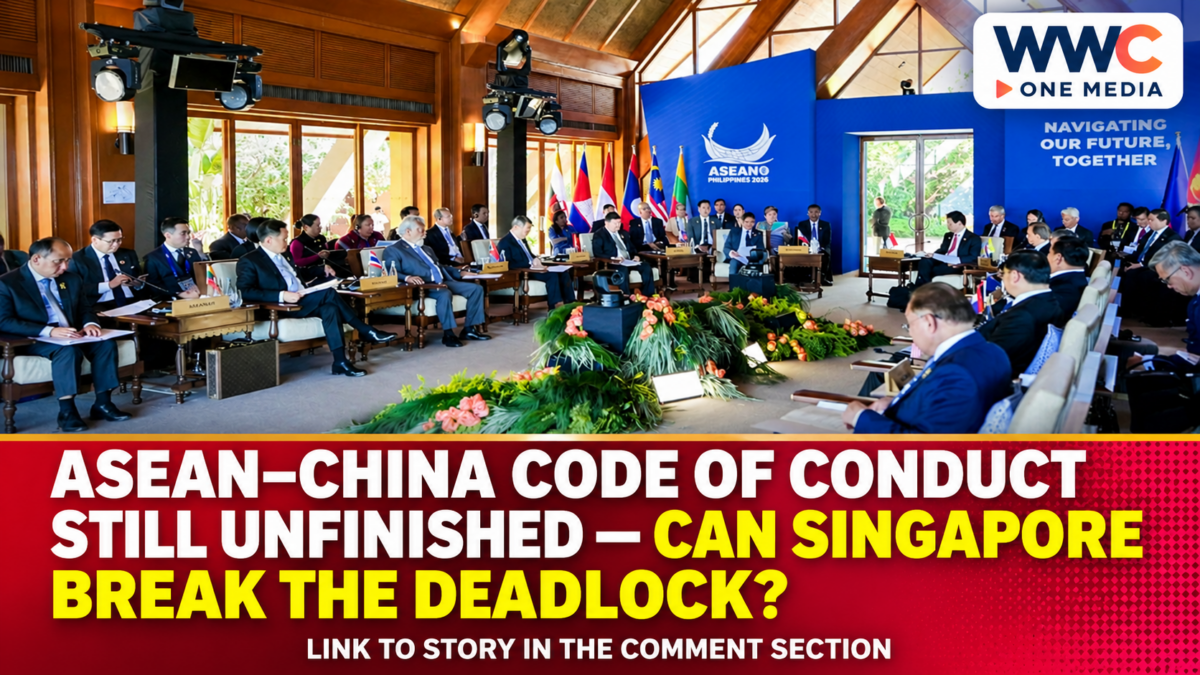
MANILA, Philippines — ASEAN and China left the November 2026 Manila summit without announcing a completed Code of Conduct for the South China Sea. Their Nov. 16 joint statement instead welcomed progress in negotiations and called for continued intensive work toward an effective and substantive agreement.
Singapore accepted the regional bloc’s next chairmanship on Nov. 17, putting it in a position to guide the diplomatic process during 2027. The challenge now is whether negotiators can convert years of discussions into rules that participating governments can agree to and apply.
The distinction matters because a diplomatic statement endorsing further negotiations is not the same as an adopted maritime agreement. For the Philippines and its regional neighbours, the central question is no longer simply how often officials meet, but what practical commitments a completed code will contain.
ASEAN–China Code of Conduct: What Manila Delivered
The Nov. 16 ASEAN–China joint statement, issued during the 29th ASEAN–China Summit in Manila, recognised significant progress in negotiations but stopped short of declaring the Code of Conduct finished.
The governments called for sustained efforts to conclude an agreement consistent with international law, including the 1982 United Nations Convention on the Law of the Sea, or UNCLOS.
This language establishes a continuing diplomatic commitment. It does not establish that the draft has been formally adopted, that its provisions have entered into force or that a mechanism for enforcing compliance already exists.
The summit also produced wider regional cooperation commitments. As examined in WWC’s coverage of Manila’s 49th ASEAN Summit, evaluating diplomatic achievements requires separating adopted decisions from proposals that still need further implementation.
The same distinction applies to the maritime negotiations. Progress is meaningful, but the final agreement remains the decisive test.
Why the 2026 Target Proved Difficult
The ambition to complete negotiations during 2026 was publicly stated well before the November summit.
In March, Chinese Foreign Minister Wang Yi expressed confidence that the parties could overcome differences and reach an agreement during the year. Philippine government communications in July likewise identified year-end completion as an objective.
Negotiating activity continued. In January, senior ASEAN and Chinese officials met in Cebu and adopted a roadmap for subsequent consultations. In May, another senior officials’ meeting in Kuala Lumpur reaffirmed the commitment to accelerate the process.
The Chinese foreign ministry also recorded a joint working group meeting in Manila from Aug. 19 to 21, demonstrating that technical discussions continued beyond the ministerial level.
What this could mean: Frequent consultations can narrow differences without resolving every question needed for final approval. The November statement’s emphasis on further negotiations suggests that the diplomatic work remained incomplete despite an intensified schedule.
It would be inaccurate, however, to attribute the outcome to a particular government or negotiating demand without a sufficiently detailed official record establishing that conclusion.
What a South China Sea Agreement Must Address
The proposed code is intended to help participating governments manage conduct in a maritime area where competing interests create persistent diplomatic challenges.
The existing Declaration on the Conduct of Parties in the South China Sea, adopted in 2002, provides the earlier cooperation framework. The current negotiations seek to develop a further Code of Conduct rather than simply reproduce the declaration.
ASEAN’s 2026 Maritime Outlook emphasises the need for an effective and substantive agreement grounded in international law, including UNCLOS. It also describes efforts to increase the frequency of consultations.
From a practical policy perspective, the value of any future code will depend on how clearly it defines expected behaviour, supports communication and provides processes for managing disagreements.
A document with broad commitments but unclear procedures could leave governments facing many of the same problems they encounter today.
Conversely, provisions that parties understand consistently and are prepared to implement could improve predictability at sea. These are assessments of potential effectiveness, not claims that specific draft provisions have already been agreed.
Why the Philippines Has a Direct Interest
For Manila, the negotiations form part of a wider effort to support peaceful maritime relations while maintaining the importance of international law.
The Philippines chaired ASEAN during 2026 and hosted the November summit. President Ferdinand R. Marcos Jr. used the summit plenary to emphasise regional cooperation and the need to respond collectively to security and economic challenges.
ASEAN’s joint statement with China reaffirmed peaceful approaches to territorial and jurisdictional differences. It also placed the ongoing code negotiations within the broader relationship between the regional bloc and Beijing.
This matters because a code intended to manage conduct is not necessarily an instrument for deciding sovereignty or maritime entitlements.
Governments can pursue procedures for preventing dangerous encounters without settling every underlying dispute. The effectiveness of those procedures will depend on their eventual wording and implementation.
The diplomatic importance of the Manila meetings also extended beyond maritime issues. WWC previously examined the operational preparations for the ASEAN summit in Metro Manila, illustrating the scale of the Philippines’ hosting responsibilities.
Singapore Inherits the Next Diplomatic Test
At the Nov. 17 closing ceremony, Singapore Prime Minister Lawrence Wong accepted ASEAN’s chairmanship from the Philippines.
Singapore selected the theme “Deeper Integration, Wider Partnerships” for 2027, combining regional cooperation with continued engagement with external partners.
Wong also identified growing competition between major powers and pressures on ASEAN unity as challenges for the region.
The incoming chairmanship therefore provides an opportunity to maintain momentum in the negotiations, but it does not give Singapore unilateral authority to decide the final agreement.
Progress will depend on the positions of ASEAN member states and China, including their willingness to approve a common text.
WWC’s earlier examination of Singapore–Indonesia cooperation and the coming ASEAN chairmanship highlights a related challenge: regional ambitions need to be matched by specific agreements and subsequent national action.
In the South China Sea negotiations, that means Singapore’s diplomatic success should be evaluated through concrete negotiating outcomes, not simply the number of meetings convened.
What Happens Next
The next stage is to determine whether negotiators can complete the remaining work and present an agreed Code of Conduct for the necessary political and legal steps.
The immediate indicators will be any officially announced negotiating timetable, confirmation of an agreed text, clarification of its legal status and publication of implementation arrangements.
ASEAN and China have not abandoned the process. Their November joint statement explicitly supports further work toward a substantive agreement.
But continued engagement alone cannot answer whether the eventual code will materially improve maritime conduct.
The central test for 2027 is whether diplomatic momentum becomes a completed agreement with clear, usable commitments.
Frequently Asked Questions
1. Did ASEAN and China finalise the South China Sea Code of Conduct in 2026?
No completed code was announced in the Nov. 16 joint statement. The document instead acknowledged progress and called for further negotiations.
2. What is the South China Sea Code of Conduct?
It is a proposed regional framework intended to guide conduct and help manage differences in the South China Sea. Negotiations build on the earlier 2002 declaration.
3. Which country will lead ASEAN in 2027?
Singapore will chair ASEAN in 2027. Prime Minister Lawrence Wong accepted the chairmanship at the Nov. 17 closing ceremony in Manila.
4. Will the code settle territorial disputes?
A conduct-management framework should not be treated as a settlement of sovereignty disputes. Its eventual scope and legal effects must be assessed against the final adopted text.
5. When will the agreement be completed?
The official November joint statement did not establish a new definite completion date. The timing remains dependent on further negotiations and agreement among the participating governments.