
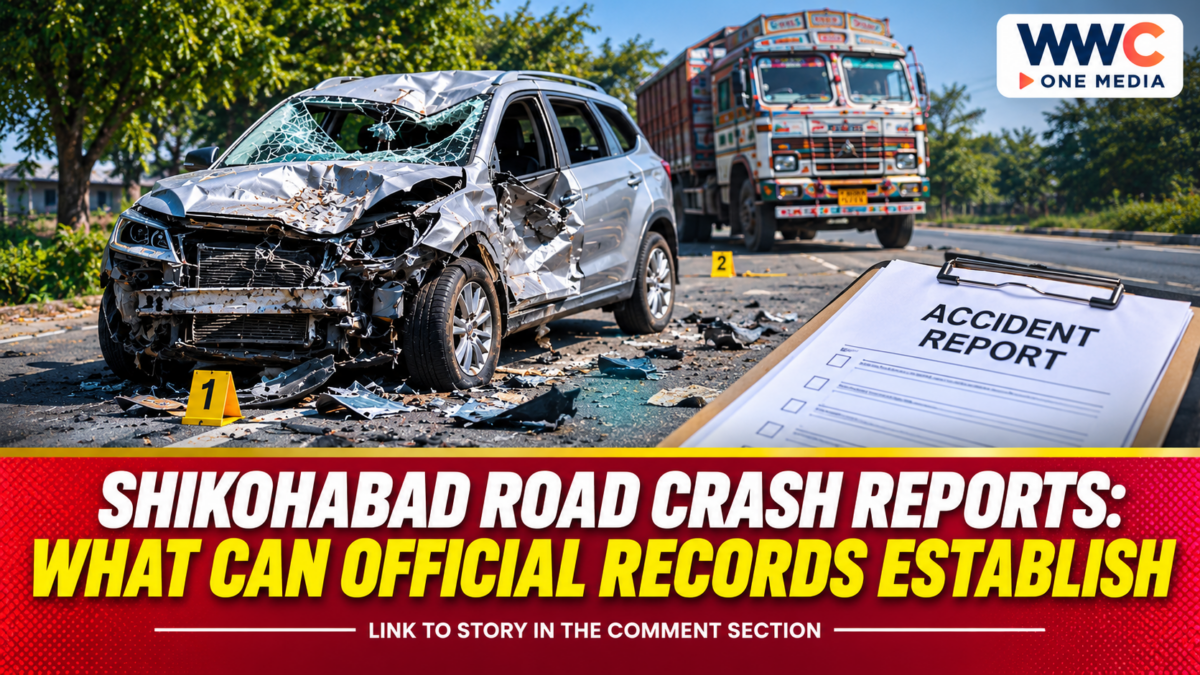
UTTAR PRADESH, India — Nov. 22, 2026. Reports circulating after Nov. 17 describe multiple deaths in motorcycle-related collisions near Shikohabad in Firozabad district. An original, incident-specific police release or authenticated case document confirming the reported casualty figures has not been obtained for this review.
That evidentiary gap matters. India’s official road-safety records demonstrate the scale of risk facing road users, but nationwide statistics cannot authenticate an individual crash, identify those involved or determine responsibility. A responsible account must separate the reported incident from what the public record actually proves.
Shikohabad Road Crash Reports: What Is Still Unconfirmed?
The reported event concerns a road section near Shikohabad, but the available official material reviewed here does not establish a verified sequence of collisions. The incident’s exact location, timing, vehicle movements and casualty identities therefore remain outside this article’s confirmed findings.
A police complaint, first information report, station announcement or authenticated medical record would provide a firmer basis for reporting. Each document serves a different purpose. An initial complaint may describe allegations, a hospital record can establish clinical outcomes, and a completed investigation may assess evidence about cause.
Until those documents are available, descriptions such as a truck travelling too fast, a motorcycle colliding with a stationary vehicle, or congestion triggering another impact must not be presented as established facts. Such details require incident-specific verification rather than repetition across publications.
What Government Road-Safety Data Actually Show
India’s Ministry of Road Transport and Highways reported 461,312 road accidents, 168,491 deaths and 443,366 injured people for calendar year 2022. These are historical national figures, not an estimate of accidents occurring in November 2026.
For Uttar Pradesh, the same government release recorded 41,746 accidents, 22,595 deaths and 28,541 injured people in 2022. The figures illustrate the long-standing public-safety burden in the state, while offering no evidence of what happened in the individual Shikohabad case.
The ministry also recorded 151,997 crashes and 61,038 fatalities on national highways, including expressways, across India in 2022. The corresponding shares of the country’s total were 32.94% of accidents and 36.22% of fatalities.
These numbers show why highway protection deserves attention. They cannot establish whether a particular road junction was defective or whether any driver breached the law. WWC previously examined the same distinction between historical highway statistics and unverified collision allegations in Haryana.
Why Investigators Need a Clear Collision Timeline
Analysis: If several vehicles were involved within a short period, a useful investigation would distinguish the first impact from later movements rather than treat every injury as the product of one event. That is an investigative question, not a finding about Shikohabad.
A timeline might include verified emergency-call times, vehicle positions, physical impact evidence and witness accounts documented by authorities. Investigators could compare those materials with available camera footage and any vehicle examination. None of those items should be presumed to exist in this specific case.
The difference between what witnesses initially believe and what a formal reconstruction can support is important. Visibility, traffic queues, braking distances, road signs and junction design are potentially relevant categories of evidence, but none is confirmed as a contributing factor here.
The same careful separation of early reporting and later investigative findings applies to WWC’s coverage of a separate Kanpur bus crash. The incidents should not be treated as connected merely because both involve roads in Uttar Pradesh.
Road Design, Enforcement and Emergency Care
India’s transport ministry describes its national road-safety approach as covering education, engineering of roads and vehicles, enforcement, and emergency care. This broad framework recognises that risk reduction involves more than the behaviour of a single road user.
A location-specific safety review could examine road geometry, signage, lighting, safe stopping areas and the way vehicles enter or leave the main carriageway. Whether any of those features needs improvement at the reported location remains unestablished until the responsible road authority’s records and a field assessment are available.
Enforcement questions are separate. Authorities would need actual evidence before concluding that speeding, impaired driving, distraction or another violation contributed to a collision. No finding of guilt should be drawn from the existence of a complaint or a media description.
Emergency care also matters. A documented response timeline can show whether those injured received assistance and where they were taken. It cannot, on its own, reveal why an accident happened. In another context, WWC’s reporting on a Malaysian police-vehicle crash likewise distinguishes vehicle-safety questions from unproven conclusions about responsibility.
What This Could Mean for Public Accountability
Analysis: The strongest public follow-up would be a dated police account that reconciles the number of people involved with hospital and post-mortem records, while protecting personal information that need not be public. That would reduce the risk of conflicting casualty figures becoming permanent claims online.
If officials identify a hazardous road configuration, any recommended engineering response should be documented separately from criminal proceedings. A driver investigation and a road-safety assessment can address different questions without predetermining each other’s conclusions.
For editors, careful language is equally important. A death toll should come from a confirmable official record; the identity of an injured person should not be repeated unless necessary and verified; and assertions about the driver’s conduct should reflect the current procedural stage.
The public interest is not served by an unnecessarily detailed account that outruns the evidence. It is served by clarity about what has been established and what remains unresolved.
What Happens Next
The essential next step is to obtain an original, dated statement from the responsible Firozabad police office, an authenticated incident registration and any official casualty update. A road-authority statement could then address whether a safety inspection is planned, without implying that defective infrastructure has already been found.
As of Nov. 22, 2026, this review cannot independently confirm the incident-specific names, ages, exact death toll, injuries, arrests, vehicle movements or any criminal allegation. Those details are deliberately withheld rather than repeated from secondary reporting.
Frequently Asked Questions
How many people died in the reported Shikohabad accidents?
An original police or medical record confirming the casualty count was not obtained in this review. A number reported elsewhere is not treated as verified here.
Where did the reported collisions take place?
The lead identifies the Shikohabad area of Firozabad district, but an authenticated police incident document establishing the precise location has not been reviewed.
What do official figures say about road accidents in Uttar Pradesh?
The central government’s 2022 data recorded 41,746 road accidents and 22,595 fatalities in Uttar Pradesh. These figures do not verify a particular 2026 incident.
Has the cause of the reported crash been established?
Not in the primary material available for this review. Any conclusion about speed, road design, stopping distance or responsibility would require incident-specific evidence.










