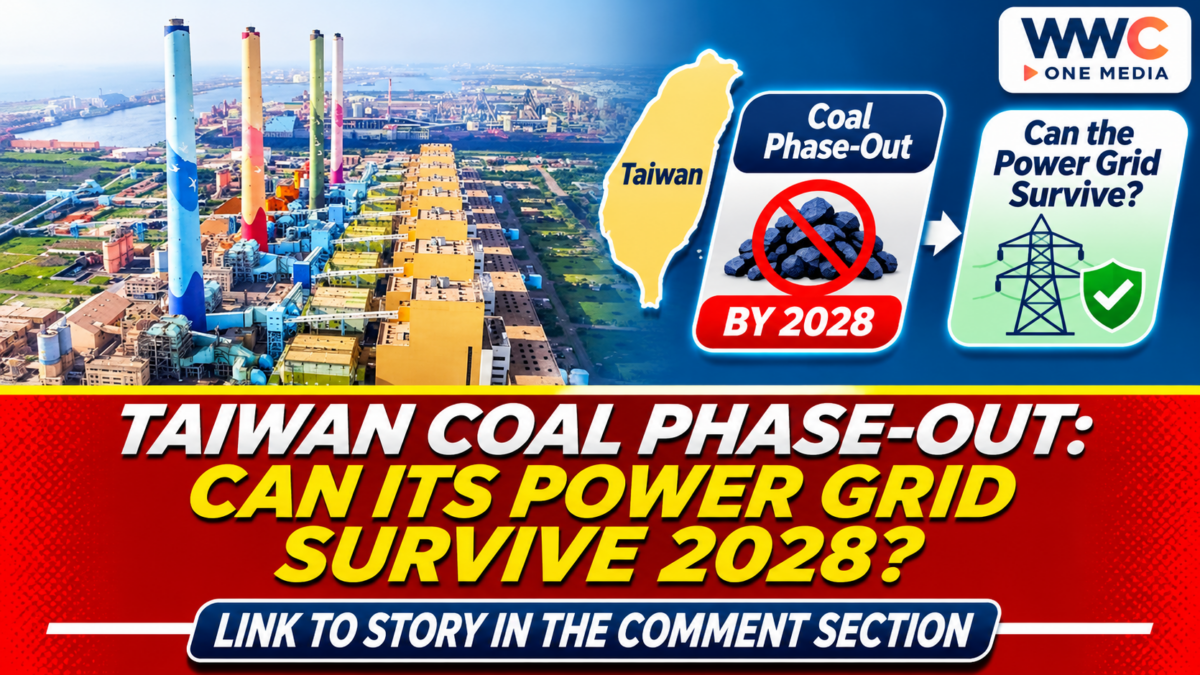
TAIPEI, Taiwan — Taiwan’s Ministry of Economic Affairs warned on Nov. 12, 2026, that proposals to force earlier retirements of coal-fired generating units could put electricity reserves under pressure in 2028 and 2029. The warning followed proposed changes to the Air Pollution Control Act and sharpened a policy choice between faster reductions in coal use and the timing of replacement power capacity.
The Taiwan coal phase-out debate is not simply a contest between cleaner air and electricity. Official planning records show that both objectives are already part of the transition; the unresolved question is whether the replacement plants, grid infrastructure and safeguards can be ready before an accelerated retirement deadline.
Taiwan Coal Phase-Out: Why 2028 Is Contested
The ministry’s Nov. 12 statement identifies proposals introduced on Nov. 10 to amend Articles 28 and 30 of the Air Pollution Control Act. It says mandatory early retirement and limits on emergency-backup operation could materially change the existing generation timetable. The changes have not been established as law.
In its risk assessment, the ministry grouped coal-fired capacity at Taichung, Heping, Linkou and Dalin. The capacity it identified totalled 9.72 gigawatts, and it warned that reserve margins could become negative during 2028 and 2029 if the proposed schedule were imposed. This is a forecast, not an actual outage.
Legislators have separately pursued an earlier coal-free deadline for Taichung. The Legislative Yuan’s public record documents a 2025 resolution seeking coal elimination at that power plant by 2028. Neither resolution nor proposal establishes a completed retirement.
What the Government’s Electricity Forecast Actually Says
Taiwan’s 2025 National Electricity Supply and Demand Report, released in June 2026, forecasts average annual electricity-demand growth of about 2.5% from 2026 through 2035. The projection takes account of semiconductor expansion, artificial intelligence, data centres, economic activity, temperature and energy-saving measures.
The ministry reported that electricity consumption fell by about 0.3% in 2025 compared with 2024. It also said the operating reserve exceeded 10% on 342 days that year. Historical annual results cannot guarantee future supply.
Electricity security has become an investment question as well as a utility question. The demand outlook helps explain why WWC previously examined Eaton’s expansion in Taiwan’s AI power-equipment market. This illustrates the sector’s dependence on reliable power.
Taichung’s Gas Replacement Is Not Yet the Whole Answer
Taipower’s published transition plan has targeted eliminating coal use at Taichung by the end of 2034, with deeper reductions expected after further gas-fired capacity becomes available. That schedule is later than the 2028 date sought by advocates of faster retirement.
An official Taipower project page describes two new combined-cycle gas units at Taichung, each designed for 1.3 million kilowatts of output. Its April 2026 progress report showed the construction programme underway and recorded scheduled commercial-operation milestones. Scheduled dates do not prove operational completion.
There is also an environmental-review complication. In an Oct. 8 statement, Taipower acknowledged a Taipei High Administrative Court ruling that annulled the environmental impact assessment conclusion for the second-phase gas project. Taipower said it would study the decision and assist the subsequent process. The decision creates an unresolved legal obstacle.
Additional transmission and grid equipment can matter as replacement generation is connected. WWC has covered LS Electric’s Taiwan power-infrastructure venture, a separate commercial development illustrating the wider market for electrical infrastructure rather than confirming completion of Taichung’s transition.
Pollution Controls Are Part of the Record Too
The case for earlier coal retirement includes the environmental burden of continuing to burn coal. It is therefore important not to assess the policy solely against reserve-margin forecasts. Air quality and emissions reduction are public-policy objectives in their own right.
Taipower said in October that, compared with 2014, coal use at Taichung had fallen by 7.39 million tonnes and air-pollution emissions by about 80%. Those are utility-reported historical comparisons; they should not be presented as independently measured improvements in every nearby resident’s health.
Taipower also documents upgrades to air-quality control systems for units 5 through 10, including equipment to reduce nitrogen oxides, sulphur oxides and particulate emissions. Pollution-control retrofits do not make a coal unit emissions-free, but their existence matters when evaluating the costs and benefits of different retirement schedules.
Efficiency on the demand side belongs in the same discussion. WWC’s report on Taichung’s LED streetlight programme provides a separate example of efforts to reduce electricity use. Local conservation cannot substitute automatically for generating capacity.
What the 2028 Deadline Would Need to Prove
WWC analysis: The fundamental test is sequencing. Removing capacity is relatively easy to announce; providing equally reliable electricity at the hours, places and conditions where it is needed requires operational proof. Forecasts should identify reserve margins under plausible delays, heat-related demand peaks and generating-unit outages.
A credible timetable would also disclose the expected commissioning of replacement generation, fuel availability, grid capacity, emissions results and any permitted emergency reserve. Public comparisons should use the same assumptions. Otherwise, a headline capacity number from one side can appear to contradict an energy-demand forecast that measures something different.
The debate should not be reduced to choosing either unlimited coal burning or immediate retirement at any cost. Faster pollution reduction and reliable electricity are both legitimate goals; transparency about the path between them is what allows the public to judge competing proposals.
What Happens Next
As of Nov. 22, 2026, the reviewed records establish the legislative push, the government’s objections and Taipower’s existing transition work. They do not establish that the proposed accelerated retirement requirements have become law or that the projected negative reserve margins have materialised.
The next decisive documents would be the final statutory text, a revised official capacity plan, updated construction and environmental-review milestones, and transparent operating-reserve assumptions. Until those appear, 2028 is a contested policy deadline—not a confirmed electricity crisis.
Frequently Asked Questions
Is Taiwan shutting down Taichung’s coal units in 2028?
A 2028 coal-free deadline has been pursued through legislative action, but the reviewed official material does not establish that all the required early retirements have occurred or that the latest proposed amendment is enacted.
Why does the government oppose an earlier deadline?
The Ministry of Economic Affairs forecasts that forcing several coal units out before replacement resources are available could produce negative reserve margins in 2028 and 2029. That is a conditional forecast, not a guaranteed blackout.
When does Taipower plan to end coal use at Taichung?
Taipower’s published transition plan has targeted a coal-free Taichung plant by the end of 2034, subject to delivering the necessary replacement facilities and transition works.
Does Taiwan’s AI industry affect electricity planning?
Yes. Taiwan’s official electricity outlook explicitly considers semiconductor manufacturing, data centres and AI-related demand when estimating growth during 2026–2035.
Have pollution-control improvements already been made?
Taipower documents equipment upgrades and reports substantial historical emissions reductions at Taichung. Those improvements do not establish that all environmental concerns have been resolved.