
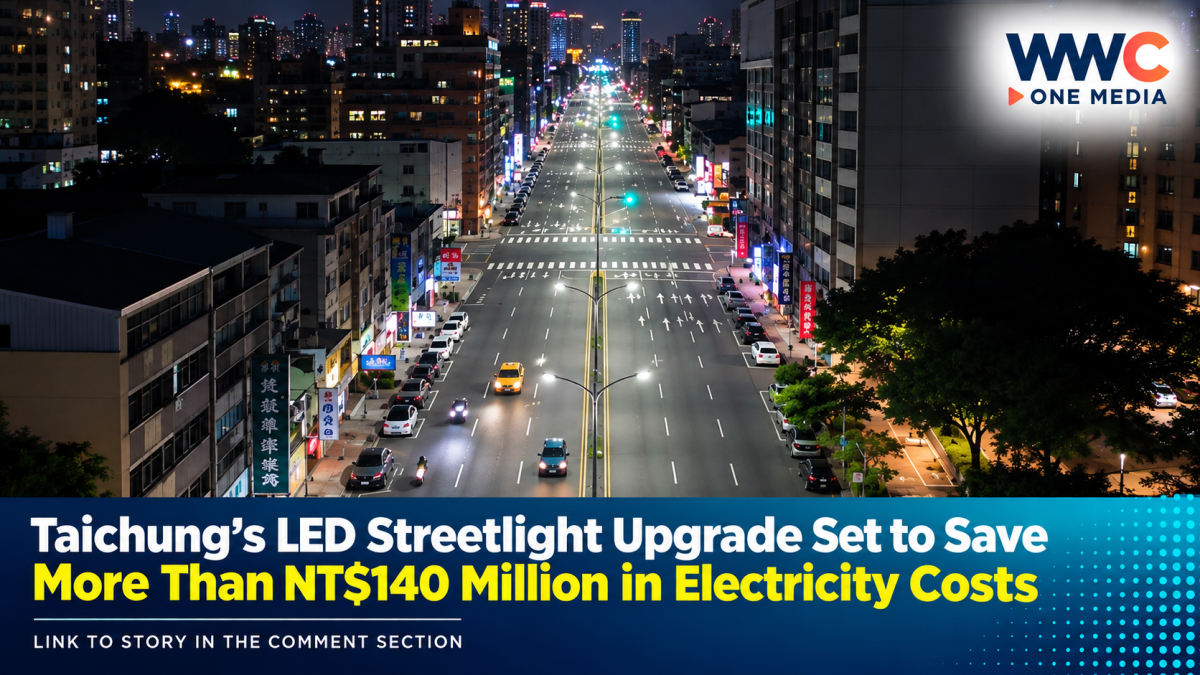
TAICHUNG, Taiwan — Taichung’s large-scale streetlight modernization is delivering both financial and environmental gains, with the city government expecting to save more than NT$140 million (about US$4.4 million) in electricity costs in 2026 as older lighting systems are replaced with high-efficiency LED fixtures.
The city had already saved approximately NT$93.45 million by the end of August, putting the program ahead of its original annual savings target of NT$130 million, according to the Taichung City Government.
The upgrade is not simply about cutting electricity bills. Officials say the newer LED streetlights are also significantly improving nighttime visibility. Road illumination has increased from roughly 12 lux to more than 40 lux in upgraded areas, providing brighter and more consistent lighting for motorists, pedestrians and other road users.
From higher power consumption to smarter lighting
Taichung began accelerating its streetlight replacement program as part of a broader effort to improve energy efficiency and public safety.
The city reported that the program generated about NT$16.31 million in electricity savings during the second half of 2025, after the latest phase began in July. Savings then reached another NT$64.9 million during the first half of 2026.
Earlier reporting on the city’s LED transition indicated that the full modernization could reduce electricity consumption by around 80 million kWh annually, while cutting electricity expenditures by roughly NT$130 million a year.
The result is a rare combination of infrastructure investment and recurring public-sector savings: the city can use less electricity while providing brighter streets.
The environmental payoff could extend beyond electricity savings
Taichung’s streetlight project has also been registered with Taiwan’s Ministry of Environment as a voluntary emissions-reduction initiative.
According to city officials, the project could generate carbon credits equivalent to approximately 20,000 metric tons of carbon dioxide. Based on current market prices, those credits could potentially generate an estimated NT$60 million to NT$80 million over 10 years.
That means the financial impact of the project could extend beyond lower electricity bills if the anticipated carbon-credit value is realized.
Smart monitoring aims to make repairs faster
Taichung is also pairing the lighting upgrade with smarter maintenance.
Residents can report malfunctioning streetlights through a 24-hour QR-code reporting system, while the city says major repairs can now be completed within about nine hours. The approach is intended to reduce the time that faulty lights remain out of service and improve maintenance efficiency.
The city says the program is therefore designed around three goals: lower energy consumption, safer nighttime streets and more efficient maintenance.
Taichung Port is taking the LED transformation further
A separate but related project is underway at the Port of Taichung, where more than 3,000 traditional high-pressure sodium streetlights are being replaced with smart LED fixtures.
The port’s new lights reduce power demand from 400 watts to 140 watts per fixture, with expected annual savings of approximately 2.84 million kWh of electricity and nearly NT$10 million in electricity costs. The project is also expected to cut annual carbon emissions by about 1,327 metric tons.
Unlike a conventional streetlight replacement, the port system incorporates networked monitoring that can automatically identify lighting failures and alert maintenance personnel. The new fixtures also provide more uniform illumination and are designed to withstand the port’s exposure to moisture and salt-laden sea air.
A brighter road to lower public costs
Taichung’s experience highlights how a seemingly ordinary infrastructure project can have a much wider impact.
By replacing older, less-efficient lighting with LEDs and adding smart monitoring, the city is reducing electricity consumption while improving road visibility and potentially creating additional environmental value through emissions reductions.
With savings already approaching NT$100 million before the end of August, Taichung’s streetlight transformation is on track to turn energy efficiency into one of the city’s most visible sources of public savings in 2026.




Leave a Reply