
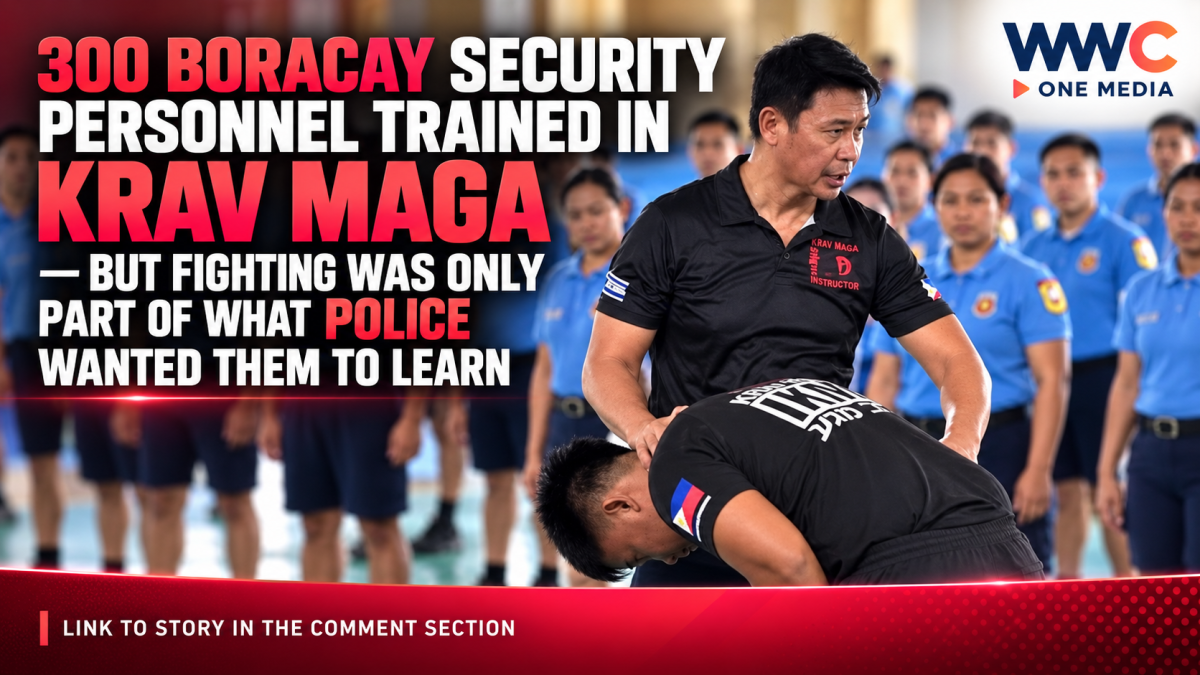
BORACAY, Aklan — Behind the white-sand beaches, sunset cruises and resort crowds that define Boracay for millions of visitors, local authorities have been preparing for a very different scenario: what happens when a police officer or community peacekeeper has to confront a physical threat at close range.
Around 300 police personnel, auxiliary officers and barangay peacekeepers have completed three days of Basic Army Combatives training incorporating Krav Maga, part of a broader push to strengthen security and operational readiness on one of the Philippines’ most internationally visible tourism destinations.
The September 11-13 program brought together personnel from the Malay Municipal Police Station, Malay Auxiliary Police, and barangay peacekeeping personnel serving Boracay Island. Malay police chief Lt. Col. Orlando Carag Jr. said the capability-enhancement activity involved approximately 300 participants.
But this was not simply about teaching officers how to fight.
The course was built around knowing when to engage, how to assess a threat, how to disengage and how to control a dangerous encounter—skills that can matter in crowded places where officers may be surrounded by tourists and civilians.
What Boracay’s security personnel actually learned
According to information released by the Malay police and reproduced in Manila Standard’s coverage, the Basic Army Combatives program emphasized practical, instinct-based defensive techniques.
Training included:
- proper defensive posture;
- threat assessment;
- disengagement techniques;
- control techniques; and
- other fundamental close-contact defensive skills.
The emphasis on assessment and disengagement is important.
Krav Maga is often popularly associated with aggressive close combat, but a law-enforcement setting presents a different problem from military combat. Police officers may need to restrain or control a person rather than simply defeat an opponent, while operating around civilians and within rules governing police conduct.
The Boracay training was therefore described as a capability-enhancement exercise, not an expansion of police powers.
The Philippine Army brought the training to Boracay
The course was facilitated by the Philippine Army, with Manila Standard identifying Lt. Col. Lawrence San Juan in connection with the instruction.
San Juan has a significant background in the discipline.
The International Krav Maga Federation’s Philippine branch currently lists him at Graduate Level 4 and identifies him as head of its military division.
His involvement also connects the Boracay program with a longer Philippine Army effort to institutionalize Krav Maga.
The Army formally adopted the system into its combatives training in 2019, when 57 soldiers from different Army units went through a multiweek International Krav Maga Federation trainers’ course at Fort Bonifacio.
Those graduates were expected to return to their units and serve as trainers.
At the time, the Army said its objective was to standardize aspects of its combatives program and strengthen personnel’s ability to respond to armed and unarmed threats.
San Juan was later described as one of the proponents of Krav Maga’s incorporation into Philippine Army training.
That makes the Boracay course less of a one-off martial-arts seminar and more an extension of an existing military training system into local public-safety preparedness.
Why train barangay personnel alongside the police?
The composition of the class may be as significant as its size.
The roughly 300 participants did not consist solely of regular PNP officers.
They included members of the Malay Auxiliary Police and barangay peacekeeping personnel serving Boracay’s communities.
That reflects the way security actually works on a heavily visited island.
Police are not necessarily the first uniformed people to encounter an argument, disturbance, intoxicated visitor, suspicious person or developing emergency.
Auxiliary officers and barangay personnel may already be nearby.
Teaching multiple groups a common set of basic responses can potentially improve coordination when an incident escalates—a theme that Boracay authorities have repeatedly emphasized in previous security exercises.
Boracay has been rehearsing much bigger emergencies for years
Close-contact defense represents only one piece of the island’s security preparations.
In September 2023, Police Regional Office 6 staged a major simulation exercise across Boracay to test the Malay police force against several simultaneous emergency scenarios.
The drill included an armed maritime intrusion, a water rescue, a checkpoint operation involving suspected attackers, a hostage-taking scenario, and a bomb threat requiring EOD and K-9 personnel.
Officers practiced vessel interdiction, first aid, arrest and handcuffing procedures, hostage negotiation and tactical response.
Afterward, then-PRO6 director Brig. Gen. Sidney Villaflor called for similar exercises to be conducted regularly and with broader participation from local government, law-enforcement agencies, stakeholders and force multipliers.
The reasoning was straightforward.
An incident on Boracay does not remain a purely local story for long.
As Daily Guardian noted at the time, serious security problems on the island can quickly attract international attention because of Boracay’s importance to Philippine tourism.
Police have also tried to cut emergency-response time
Malay police previously set another ambitious operational goal: getting officers to some incidents in as little as three minutes.
Panay News reported in 2023 that the station was examining road layouts and running simulation exercises as it worked toward faster responses to emergencies and non-emergency incidents across the island.
The police force at the time numbered about 290 personnel.
Boracay presents unusual challenges for emergency response.
Its dense development, narrow roads, large pedestrian crowds, shoreline activity, nightlife establishments and constant movement of visitors mean an ordinary mainland policing model does not always translate neatly to the island.
An officer arriving quickly is one part of the equation.
Knowing what to do during the first seconds after arriving is another.
That is where authorities appear to see practical combatives training fitting in.
Tourist policing requires a very different skill set too
There is another reason the Krav Maga course should not be mistaken for the entirety of Boracay’s police strategy.
In 2024, the Department of Tourism and the PNP conducted a separate three-day Tourist-Oriented Police for Community Order and Protection, or TOPCOP, program for officers on the island.
That course dealt with subjects far removed from hand-to-hand combat, including:
tourist behavior, local visitor markets, gender and development, child-safe tourism, human rights and the Incident Command System.
DOT-Western Visayas said the objective was to strengthen proactive security measures while supporting a safe and sustainable tourism industry.
Taken together, the programs reveal the balancing act facing Boracay police.
An officer may have to handle an aggressive individual one moment and help a confused foreign visitor the next.
Tourist policing demands both physical readiness and restraint, communication, service and awareness of different cultures and expectations.
More than 2.1 million tourists visited Boracay last year
The scale explains why relatively small security failures can have outsized consequences.
Boracay registered 2,155,217 tourist arrivals in 2025, according to Malay Tourism Office figures reported by Manila Standard.
Of those, more than 1.76 million were domestic visitors, with South Korea, the United States, Australia, Taiwan, Russia, China, Britain, Japan, Germany and India among its leading foreign markets.
Malay authorities entered 2026 targeting around 2.3 million arrivals.
That means local security personnel are protecting not merely three island barangays.
They are operating inside one of the Philippines’ most recognizable tourism brands.
A confrontation captured on a visitor’s phone can travel globally within minutes.
So can footage of a poorly handled arrest.
That places a premium not only on the ability to respond quickly, but on judgment and control.
Why Krav Maga?
Krav Maga is a close-contact self-defense system emphasizing relatively direct responses, natural movements and rapid reaction to threats.
The Philippine Army’s own adoption of the system came after it sought to standardize aspects of close-combat preparation. Its 2019 training combined techniques influenced by several combat disciplines while preparing soldiers for encounters involving both armed and unarmed threats.
Krav Maga organizations in the Philippines also maintain separate programs for military and police users, reflecting the different objectives faced by uniformed personnel compared with ordinary civilian practitioners.
For police on Boracay, however, the most relevant skills may not be the spectacular techniques usually associated with martial-arts demonstrations.
They are the simpler ones:
Spot the threat.
Keep balance.
Create distance when possible.
Control an encounter when necessary.
And avoid allowing a manageable situation to become a larger emergency.
The real test won’t happen on the training mat
Completing a three-day course does not by itself make an officer an expert in Krav Maga, nor does it guarantee that every confrontation will be handled perfectly.
Skills involving physical control generally depend on repetition, supervision and continued training.
The importance of the Boracay program therefore lies less in awarding completion certificates than in whether what participants learned becomes part of continuing operational preparation.
Boracay’s police have already spent years practicing for scenarios ranging from water rescues to bomb threats and hostage incidents.
Tourist officers have undergone human-rights and visitor-management instruction.
Authorities have pursued faster emergency responses.
Now police, auxiliaries and barangay peacekeepers have been put through a common close-combat program.
All of those efforts point toward the same objective:
preventing the kind of incident that tourists should never have to notice.
Because for an island whose economy depends heavily on people feeling safe enough to arrive, stay out late, walk the beach and come back again, the most successful security operation is often the one visitors never realize happened.



Leave a Reply