
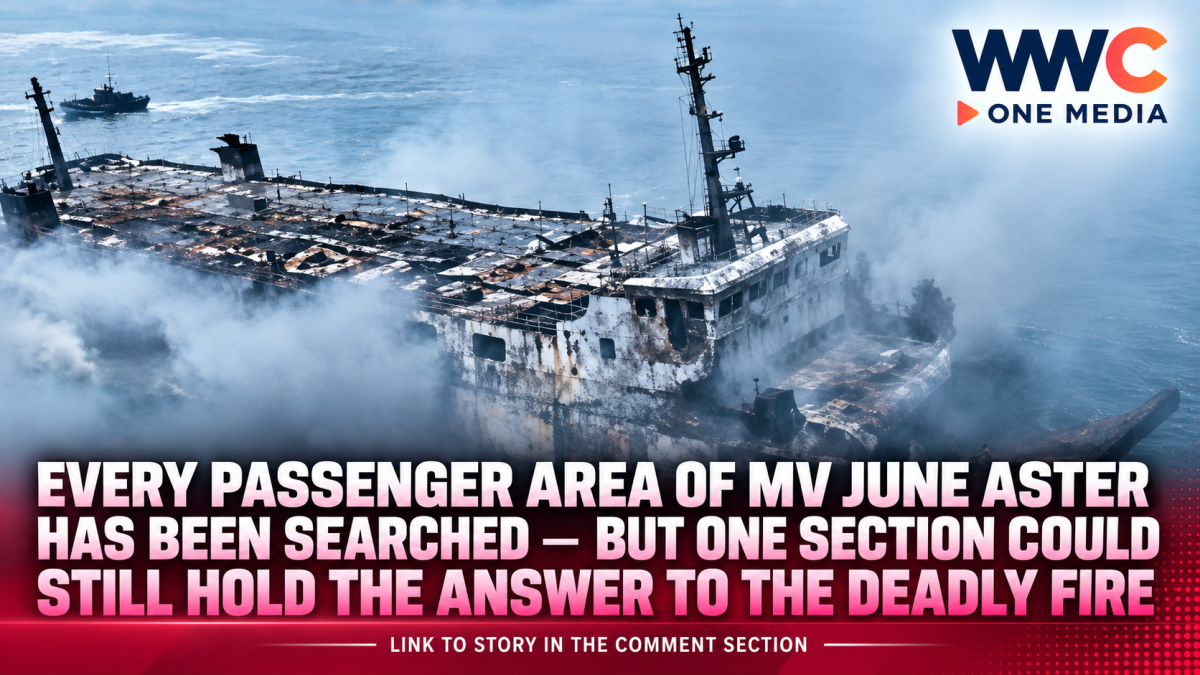
CORON, Palawan — Days after fire ripped through the passenger ferry MV June Aster, killing at least 76 people, Philippine Coast Guard teams are going back through the burned vessel for a second painstaking sweep — this time not only looking for anyone still unaccounted for, but also for evidence that could explain how one of the country’s deadliest recent maritime fires unfolded.
The Philippine Coast Guard said response teams had already completely entered and searched the vessel’s bridge, crew quarters, economy passenger section and air-conditioned passenger accommodations.
Those areas have been “100-percent penetrated,” according to PCG spokesperson Commodore Noemie Cayabyab. But investigators are not finished.
A secondary sweep will be carried out to recover possible evidence and other materials relevant to the investigation, while teams continue working through parts of the ship that have not yet been fully reached.
Cargo hold remains a major focus
One area is receiving particularly close attention: the cargo hold.
The Coast Guard said roughly 65 percent of the cargo area had been penetrated as of the latest detailed update. Survivors previously told authorities they heard an explosion around the cargo section before flames spread rapidly through the vessel.
That does not mean investigators have determined what caused the fire.
Authorities have repeatedly stressed that the official cause remains under investigation, despite accounts pointing to the cargo hold as the area where the blaze may have begun.
The distinction is important. Survivor testimony can help establish a timeline, but investigators will still need physical evidence, vessel records and technical analysis before determining whether the fire resulted from mechanical failure, cargo, electrical problems, human error or another cause.
76 confirmed dead
The scale of the disaster became clearer after firefighters were finally able to enter sections of the vessel.
The Coast Guard initially recovered five fatalities following the September 9 fire. Thirty more bodies were later found after the blaze was declared extinguished, followed by the recovery of 41 additional charred remains, pushing the confirmed death toll to 76.
A total of 43 people were reported rescued.
The ship’s ticket manifest initially listed 134 passengers and crew, but authorities later confirmed that two people whose names appeared on the manifest said they had not boarded the ferry. That effectively reduced the known number actually aboard to 132.
The Coast Guard subsequently listed 13 people as unaccounted for, although later local reporting on September 15 put the number at 12 as authorities continued verifying identities and reconciling passenger records. The PCG has cautioned that the figures could still change.
Why investigators are returning to the wreck
The second sweep could become critical because fire can destroy or badly damage many of the clues investigators normally rely upon.
Teams are looking for anything that could help reconstruct what happened before and during the blaze — including material evidence from the vessel and its cargo spaces.
Authorities have also been removing water and oily residue from the ship.
Since September 12, joint teams have been siphoning water from the engine room, with oily-water mixtures transferred into at least 13 drums for proper handling.
The PCG has ordered the vessel’s shipping company to secure a competent salvage contractor to continue siphoning operations and evaluate the ship’s structural condition.
That assessment will be important before further salvage work can proceed on the badly damaged vessel.
Ferry was not overcrowded, PCG says
The tragedy has also raised questions over whether the ferry was fit to sail.
According to the Coast Guard, MV June Aster was not overcrowded. Its listed complement was far below its maximum passenger capacity of 333.
PCG officials also said the vessel had passed mandated safety inspections before the tragedy, including a Vessel Safety Enforcement Inspection. Authorities said it had also undergone an emergency-readiness evaluation that included firefighting procedures.
That has shifted part of the investigation toward a different question: what happened once the emergency began?
Investigators are examining how quickly the crew responded, whether passengers were properly warned and directed, how evacuation procedures were carried out and whether lifesaving equipment could be accessed as flames spread.
Survivors described the blaze as spreading extremely quickly, with some reportedly jumping into the sea before they could retrieve life jackets. Strong winds may also have accelerated the spread of the flames.
Captain remains central to investigation
The Coast Guard has also been seeking the vessel’s captain, Roel Sarmiento, for questioning.
The shipping company reportedly informed authorities that Sarmiento survived and had been seen with surviving crew members following the fire. But as of the latest widely reported updates, investigators had not yet obtained a full statement from him.
Cayabyab said the captain has significant responsibility for the vessel, its passengers and cargo, although the precise extent of any legal liability will ultimately depend on the investigation.
The shipping operator, Atienza Interisland Ferries Inc., has said it would cooperate with authorities and assist affected families.
Families still waiting for answers
Beyond determining what started the fire, authorities face another grim task: identifying the victims.
Many of the recovered remains were badly burned, forcing forensic teams to rely on DNA, dental material and personal belongings to establish identities.
President Ferdinand Marcos Jr. has ordered government agencies to mobilize additional specialists and resources to accelerate the identification process and return victims to their families.
For investigators, the next stage aboard the June Aster may therefore be crucial.
Most of the vessel’s passenger spaces have already been searched. The cargo hold remains only partially penetrated. Physical evidence is still being collected, the exact sequence of events remains unresolved, and authorities have yet to announce a definitive cause.
The fire is out. But inside the blackened hull of the MV June Aster, investigators are still looking for the evidence that could explain why so many people never made it off the ship.



Leave a Reply