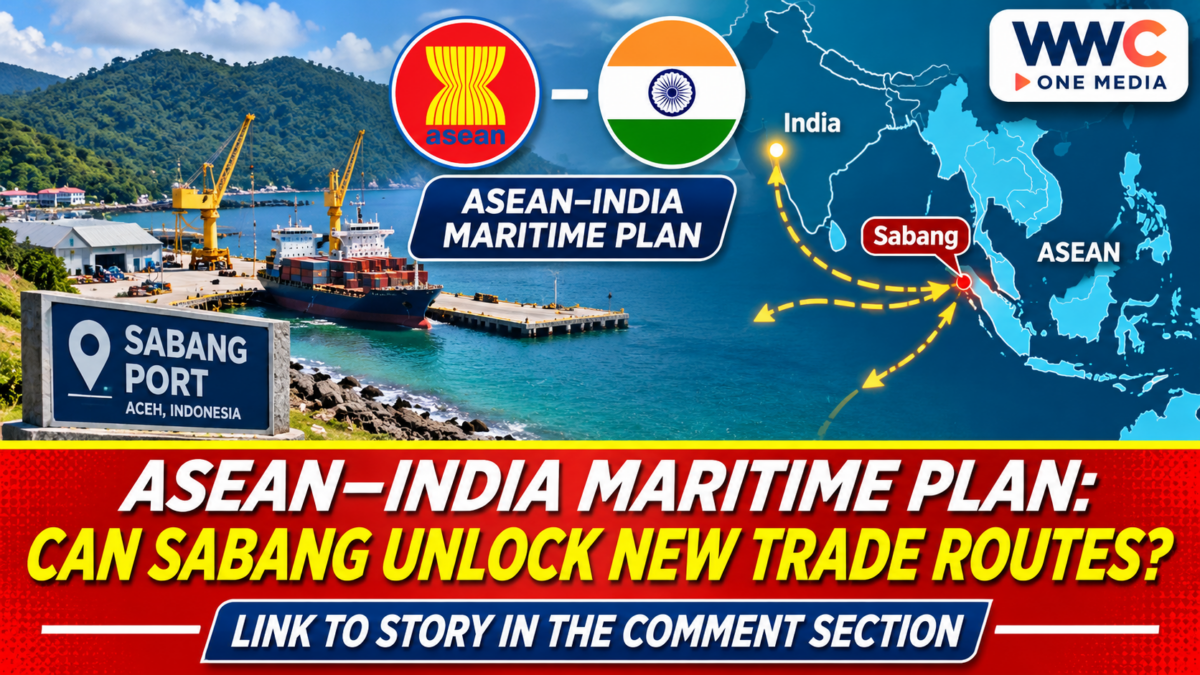
INDONESIA — Indonesian President Prabowo Subianto proposed closer maritime cooperation between ASEAN and India during the 23rd ASEAN–India Summit in Manila on Nov. 17, 2026, placing port links and secure shipping routes at the centre of his economic message. His official speech identified plans to develop Sabang in Indonesia and the Andaman and Nicobar Islands in India, but did not announce a signed construction contract, project cost or completion date.
That distinction matters for businesses and coastal communities. A proposal to connect ports could eventually support trade and jobs, but its value depends on financing, port capacity, shipping demand and transparent decisions by the governments involved.
ASEAN India Maritime Cooperation: What Was Proposed?
Prabowo’s published remarks described the Indian Ocean as an established connection between Southeast Asia and India. He argued that protecting sea lanes and improving connections between ports were important for economies dependent on trade.
He also linked ASEAN’s Outlook on the Indo-Pacific with India’s Indo-Pacific Oceans Initiative, describing their principles as compatible foundations for practical cooperation. Compatibility is not the same as a new legal agreement; it identifies areas where governments may choose to coordinate.
The concrete geographic proposal concerned Sabang and the Andaman and Nicobar Islands. Prabowo presented their development as a way to expand access to markets and support economic activity in coastal communities. His transcript did not identify specific ports or terminals, contractors, financiers or project stages.
The announcement should therefore be read as a policy direction rather than evidence that construction has begun. That framing preserves the distinction between a leader’s intention and a completed public investment decision.
Why Sabang and the Andaman Islands Matter
Sabang in Indonesia and India’s Andaman and Nicobar Islands feature in the official proposal for stronger Indian Ocean connectivity. These locations place maritime connectivity, rather than an overland transport corridor, at the centre of the proposal.
A connection between maritime gateways could have commercial implications if shipping operators see sufficient demand, port facilities can handle relevant vessels and customs procedures support efficient movement. These are conditions for evaluating the idea, not outcomes established by the summit.
For Indonesia, the stated ambition is to make coastal development part of an ASEAN–India economic relationship. For India, stronger links with Southeast Asia could complement its existing maritime partnerships. For the Philippines, improved regional shipping resilience may matter indirectly to companies that rely on predictable Asian trade routes.
This approach sits alongside—but is separate from—WWC’s coverage of the proposed ASEAN Maritime Centre in the Philippines. The centre concerns regional knowledge-sharing and coordination, whereas Prabowo’s proposal concerns potential physical connectivity and commercial opportunities.
An Earlier Maritime Agreement Provides Context
The ASEAN–India Joint Statement on Maritime Cooperation, issued in 2023, established a wider agenda that includes maritime safety, emergency response, search and rescue, information exchange and connectivity. This means the 2026 discussion did not create maritime cooperation from nothing.
Indonesia’s foreign minister, Sugiono, returned to those themes at the ASEAN–India Post Ministerial Conference in July 2026. His published remarks called for practical work in coast guard training, resilient ports, search and rescue, humanitarian assistance and blue-economy activity. They also identified Sabang’s potential as a gateway connecting ASEAN and India.
These records show continuity from an agreed framework to a ministerial proposal and then a presidential statement. They do not establish that a Sabang–Andaman construction package was approved at the November summit.
That is a useful distinction when comparing regional announcements. WWC previously examined how the ASEAN Plus Three summit adopted maritime-trade and logistics commitments. That separate forum involves ASEAN, China, Japan and South Korea—not India—and its adopted documents should not be confused with the ASEAN–India proposal.
What the Summit Actually Adopted
ASEAN’s Nov. 17 summary of the 23rd ASEAN–India Summit records adoption of the ASEAN–India Joint Statement on Cooperation in Disaster Management. It also describes leaders reviewing their Comprehensive Strategic Partnership and discussing its future direction.
Disaster cooperation is particularly relevant to maritime trade. Ports and coastal communities can face disruptions that require early warning, coordinated response and reliable infrastructure. But a disaster-management statement is not an approval notice for a commercial port project.
Prabowo also raised health cooperation in his address, discussing pharmaceutical supply, medical equipment and domestic industry. WWC’s separate report on ASEAN–India health cooperation examines that strand of the same summit. The maritime proposal requires its own assessment of shipping and infrastructure decisions.
The difference between what the summit adopted and what individual leaders advocated is central to assessing results. The public should not be told that a proposed development initiative has become an ASEAN-wide binding commitment without a document establishing that change.
What Would Turn the Proposal Into Trade Benefits?
WWC analysis: The first milestone would be a clearly defined project. Governments or port authorities would need to say which facilities they intend to improve, the expected type and volume of shipping, and who would pay for the work. Those details would allow businesses to test whether a new connection is commercially sensible.
A second milestone would be implementation arrangements. Procurement rules, environmental review, port management, customs processes and maritime safety standards could all affect the project’s practical value. None should be assumed to have been completed merely because cooperation was announced.
The final test is measurable use. Higher trade activity, more reliable shipping services or demonstrable opportunities for coastal workers would be more meaningful evidence than another summit statement. Results would also need to be weighed against costs and local environmental responsibilities.
What Happens Next
As of Nov. 22, 2026, the official records reviewed here establish a presidential proposal, existing maritime cooperation principles and a newly adopted ASEAN–India disaster-management statement. They do not establish a signed Sabang–Andaman development agreement, a budget, construction start date or guaranteed jobs.
The next useful disclosures would be a bilateral project document, named implementing agencies, financing terms and a published timetable. Until then, the opportunity is real as a diplomatic proposal, but its economic payoff remains unproven.
Frequently Asked Questions
What did Indonesia propose at the ASEAN–India Summit?
President Prabowo called for stronger maritime security and port connectivity, including plans involving Sabang and India’s Andaman and Nicobar Islands.
Was a Sabang–Andaman construction deal signed?
The official presidential speech and summit summary reviewed here do not establish a signed project contract, approved budget or construction schedule.
What did ASEAN and India formally adopt on Nov. 17, 2026?
The summit adopted a joint statement on cooperation in disaster management, while leaders also discussed the wider strategic partnership.
Why does maritime connectivity matter to trade?
Better-functioning ports and predictable shipping routes can support the movement of goods, provided demand, infrastructure, regulations and financing make the services viable.
Does this proposal involve the Philippines?
The proposed Sabang–Andaman development concerns Indonesia and India. The Philippines participated as the 2026 ASEAN summit host and has its own separate maritime-cooperation initiatives.