
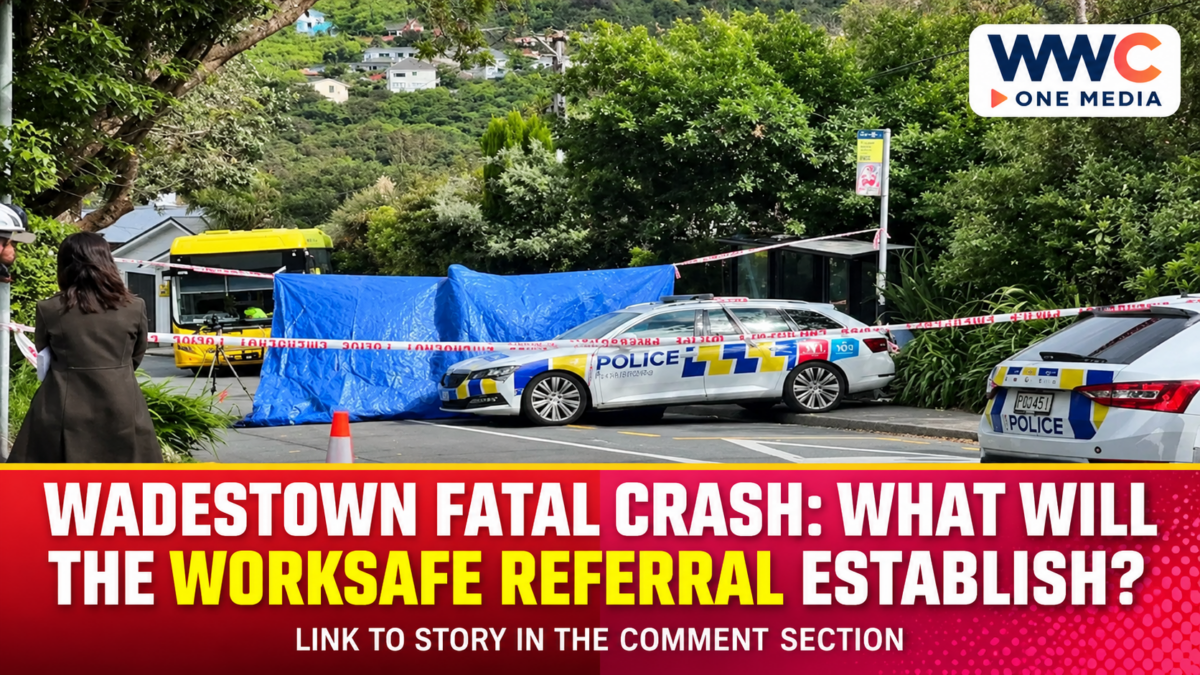
WELLINGTON, New Zealand — A person died after a single-vehicle crash on Norwich Street in Wadestown on Friday, Nov. 20, 2026, New Zealand Police confirmed. Officers were called at about 8:15 a.m.; after a Serious Crash Unit scene examination, the road reopened and the matter was referred to WorkSafe.
The key public-interest question is what investigators can establish about the vehicle, the circumstances of the collision and any possible connection to work activity. Police have not identified the vehicle type or released a cause in the official notices reviewed for this report.
Wadestown fatal crash: What has been confirmed?
The first police public update, issued at 8:31 a.m. on Nov. 20, reported a single-vehicle crash on Norwich Street. Emergency services were attending, early information indicated serious injuries, and motorists were advised to avoid the area while the road was closed.
A second update at 1:46 p.m. confirmed that one person had died at the scene. It also said that the Serious Crash Unit had examined the location and that Norwich Street had reopened. The police statement did not identify the person who died or explain whether anybody else was injured.
These two updates show how an emergency account can change as authorities confirm an outcome. The initial reference to serious injuries should not be treated as a separate casualty count or as evidence of additional victims.
Nor should the phrase “single-vehicle crash” be stretched into an explanation of cause. It describes the recorded nature of the incident, not a conclusion about driving decisions, vehicle condition or the road itself.
Why the WorkSafe referral matters
Police confirmed that the matter was referred to WorkSafe, New Zealand’s workplace health and safety regulator. That is an important procedural development, but it is not a published finding that a workplace safety rule was breached.
WorkSafe’s public notification guidance explains that serious work-related events can require regulatory notification. Its guidance also distinguishes the receipt or assessment of a notification from the decision to carry out a full investigation. The agency has several possible responses depending on the evidence and circumstances.
The existence of a referral therefore raises a question for an eventual official update: whether any work activity, business duty or workplace safety responsibility is relevant to the incident. It does not establish the answer. No business, employer or operator should be accused of failing a legal duty on the basis of the referral alone.
A sound investigation needs to separate the immediate sequence of events from any broader organisational responsibilities. That distinction also appears in WWC ONE MEDIA’s coverage of an Antipolo truck crash and the evidence needed to test vehicle-safety claims. The Philippine case is unrelated and offers no evidence about what happened in Wadestown.
Why the vehicle and cause cannot yet be stated
The official police releases examined for this article do not specify the make, model, class or operator of the vehicle. They also do not identify the person who died as a driver, passenger, pedestrian or worker. Publishing any of those descriptions as an established fact would go beyond the verified public record.
Likewise, there is no official finding in those releases about speed, brakes, road surface, weather, medical circumstances or driver conduct. Such possibilities should not be presented as competing explanations without evidence. An investigation may rule possibilities in or out, but a news report cannot do that on its own.
This is also why a photograph or an informal description should never substitute for a properly identified official case record. WWC previously addressed similar verification limits in its Christchurch pedestrian crash report. That separate story illustrates a reporting principle, not a factual connection to Norwich Street.
Public accuracy requires restraint until the investigators establish the relevant facts.
What a Serious Crash Unit examination can clarify
Police reported that the Serious Crash Unit carried out a scene examination before the road reopened. A scene examination can preserve and assess physical evidence, but the police release did not announce its findings or say that an investigation had reached a conclusion.
The questions worth asking are concrete. What did the evidence establish about the vehicle’s movements? Were there confirmed road or vehicle conditions relevant to the crash? Was any work-related activity involved? Which authority will publish the next formal findings?
Reporting them clearly avoids turning a preliminary inquiry into an accusation.
The same separation between a crash outcome and a proven cause is important in WWC’s earlier report on a passenger bus overturning in Ilocos Norte. That incident occurred in the Philippines and cannot establish anything about the Wadestown collision.
Why this crash also matters for road safety
New Zealand’s published Road Safety Objectives, introduced in October 2024, outline government priorities involving safer roads, drivers, vehicles and enforcement. Those priorities provide useful policy context, but they are not findings about this individual collision.
The broader lesson is that an effective road safety response has two distinct stages. Investigators first establish what happened in a particular case; agencies can then consider whether an identified risk points to a preventable problem that needs action beyond that case.
A fatal crash alone cannot prove that a road design, workplace practice or vehicle inspection system failed. Equally, a road reopening does not establish that every question about the event has been answered. Temporary traffic management and investigative conclusions are different matters.
What happens next
The next meaningful developments would be an updated police release identifying the vehicle and confirming any findings, or a WorkSafe statement explaining whether it has opened an investigation and what matters fall within its remit. Any further official finding should be assessed on its precise wording.
As of Nov. 22, 2026, the verified public position is limited but clear: one death, a single-vehicle crash on Norwich Street, an examination by the Serious Crash Unit, a reopened road and a referral to WorkSafe. The cause and any question of responsibility have not been established in the police notices reviewed here.
Frequently asked questions
When did the Wadestown fatal crash happen?
Police were called to the single-vehicle crash on Norwich Street at about 8:15 a.m. on Friday, Nov. 20, 2026.
How many people died in the crash?
New Zealand Police confirmed that one person died at the scene. Their public releases reviewed for this story did not establish a count of additional injured people.
Was a bus involved in the Wadestown crash?
The police releases reviewed here do not identify the vehicle type. A bus should not be described as officially confirmed on that evidence alone.
Why was the crash referred to WorkSafe?
Police confirmed the referral but did not publicly explain its reason. A referral is not, by itself, a finding of a workplace safety breach.
Has Norwich Street reopened?
Yes. Police stated in their 1:46 p.m. update on Nov. 20 that the road had reopened after the Serious Crash Unit’s scene examination.










