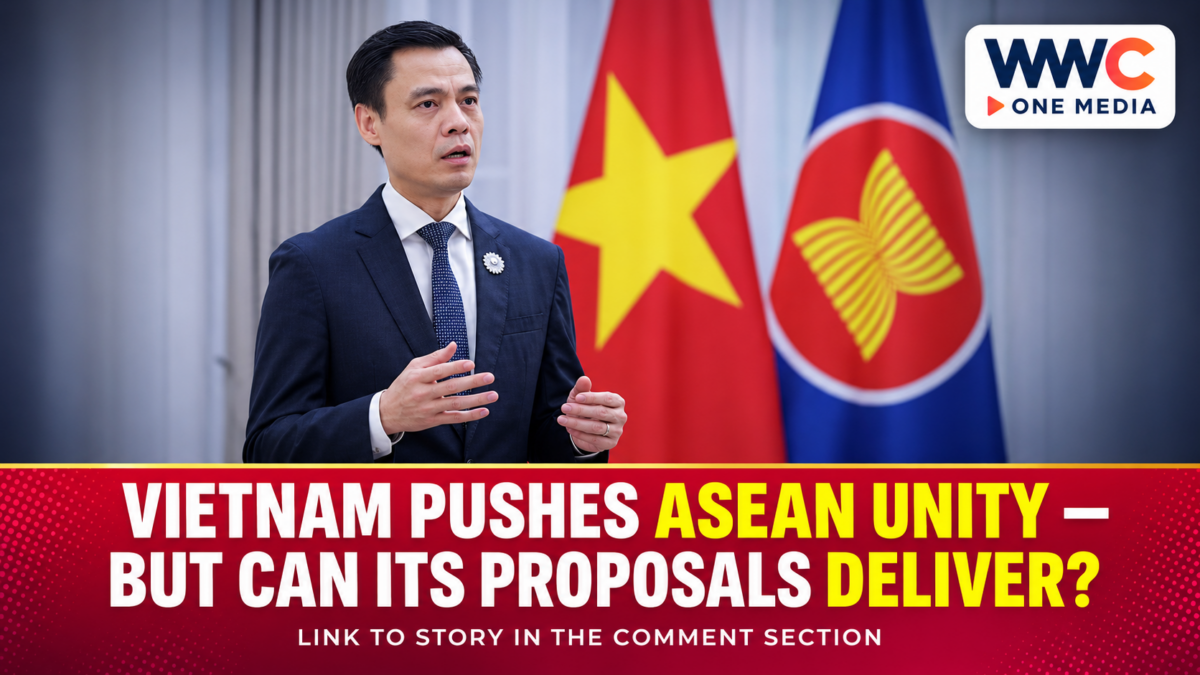
MANILA, Philippines — Vietnam set out proposals for deeper regional cooperation during the 49th ASEAN Summit and related meetings held in Manila in November 2026. In an official account published on Nov. 18, Deputy Foreign Minister Dang Hoang Giang described Prime Minister Le Minh Hung’s agenda as an effort to strengthen stability, development and cooperation with ASEAN’s partners.
The important question now is how ASEAN unity becomes practical cooperation. A proposal announced at a summit is not automatically a funded programme, a binding agreement or a completed project. That distinction matters to businesses and governments assessing the region’s ability to act together.
Vietnam’s ASEAN unity agenda has three priorities
The Vietnamese foreign ministry’s published account identifies three broad priorities advanced by the prime minister: a peaceful and stable regional environment, innovative and resilient shared development, and stronger identification with a cohesive ASEAN community.
These priorities connect economic policy with security and social cooperation. More predictable regional conditions can support cross-border investment, while coordinated development policies can help countries address problems that do not stop at national boundaries.
But unity does not require identical national policies. ASEAN members have different economic structures and priorities. The practical challenge is finding shared programmes that countries can implement while maintaining their own decision-making responsibilities.
That is a useful distinction from the broader outcomes already explored in WWC ONE MEDIA’s coverage of the Manila summit’s digital agreement and continuing unity challenges. Vietnam’s agenda deserves assessment on its own terms: what was proposed, what was adopted, and what remains to be developed.
Two initiatives put future cooperation on the table
The foreign ministry’s account identifies two proposals: an ASEAN space partnership for development and resilience, and a regional role in advancing the International Decade of Culture for Sustainable Development.
The space proposal raises practical possibilities for cooperation in areas such as environmental observation, disaster planning and technical capacity. These are potential applications rather than projects demonstrated as operational by the announcement.
For the initiative to become more than a diplomatic idea, governments would need to define participating agencies, technical responsibilities, financing and the intended benefits for member states. A public work plan or a subsequent ASEAN decision would provide stronger evidence of progress.
The culture-related proposal has a different emphasis. It would connect regional identity with sustainable development goals. Its success would likewise depend on concrete programmes, participation and measurable outcomes rather than on the proposal alone.
Neither initiative should be described as a completed regional programme solely because it was raised at a leaders’ meeting. That distinction protects readers from confusing diplomatic support with implementation.
A signed digital agreement offers a different benchmark
ASEAN’s official record confirms that the Digital Economy Framework Agreement, known as DEFA, was signed in Manila on Nov. 14, 2026, in connection with the ASEAN Economic Community Council meeting.
The difference is significant. A signed regional agreement has progressed beyond the idea stage, although signing does not itself prove that businesses have received every intended benefit. Subsequent legal, regulatory and administrative steps remain crucial.
Digital cooperation can matter to smaller businesses attempting to serve customers across borders. Differences in national rules, payment systems and business processes can make regional expansion more complicated than selling within one domestic market.
Whether the agreement makes those processes easier will need to be judged against its eventual implementation. ASEAN’s earlier work on digital integration provides context, but announcements alone cannot establish the financial gains that individual firms might realise.
The same results-based approach applies to the region’s investment environment. WWC has separately examined how changing ASEAN supply chains affect investment opportunities for Philippine businesses. Investment announcements and regional frameworks become economically meaningful when they translate into functioning projects, trade and productive capacity.
Partnerships need priorities, not just more meetings
Vietnam’s official assessment also called for a strategic approach to cooperation with ASEAN’s external partners. The underlying policy issue is how regional priorities can guide partnerships, rather than allowing individual initiatives to develop without a common framework.
A structured approach could make it easier to compare proposed activities with the needs of ASEAN members. Energy security, digital readiness, environmental resilience and institutional capacity all demand sustained coordination, although the precise commitments must be established through specific records.
This is an analytical test, not a claim that every proposal has been approved. A ministerial statement can establish a government’s preferred direction; an ASEAN decision, implementation plan and budget establish different levels of commitment.
ASEAN’s relationship with international institutions already illustrates the value of longer-term frameworks. WWC’s review of the ASEAN–UN partnership and its 2026–2030 action plan explores how multi-year cooperation can continue beyond a single chairmanship.
Singapore inherits the implementation question
The ASEAN Secretariat confirmed that the Philippines handed the chairmanship to Singapore at the summit’s closing ceremony on Nov. 17, 2026. Singapore is due to assume the chairmanship on Jan. 1, 2027.
That transition matters because many ASEAN projects need longer than a single annual chairmanship to move from an announcement to delivery. Singapore’s leadership will provide a new period in which members can consider proposed work and advance existing commitments.
Vietnam’s diplomatic priorities therefore enter a regional process involving other governments and ASEAN institutions. No single member can turn an entire regional agenda into operational policy by declaration alone.
What happens next
The most useful developments to monitor are any formal ASEAN decisions on the proposed space and cultural initiatives, implementation steps for DEFA, and published plans setting responsibilities and resources for regional cooperation.
WWC analysis: Vietnam’s proposals offer a direction for further cooperation, but their lasting importance will depend on whether ASEAN governments turn them into programmes that can be evaluated publicly. Unity becomes more meaningful when the region can show what has changed, for whom, and by when.
Frequently asked questions
What did Vietnam propose at the 49th ASEAN Summit?
Vietnam’s official account describes priorities covering regional peace and stability, resilient development and community cohesion, along with proposals on space cooperation and culture linked to sustainable development.
Was Vietnam’s ASEAN space partnership already implemented?
The available official account confirms the proposal. It does not, by itself, demonstrate an operational partnership with approved funding and completed projects.
What was signed at the ASEAN summit in November 2026?
ASEAN confirmed the signing of its Digital Economy Framework Agreement in Manila on Nov. 14, 2026. The agreement’s benefits still depend on subsequent implementation.
When does Singapore become ASEAN chair?
Singapore assumes ASEAN’s chairmanship on Jan. 1, 2027, following the handover ceremony held in Manila on Nov. 17, 2026.