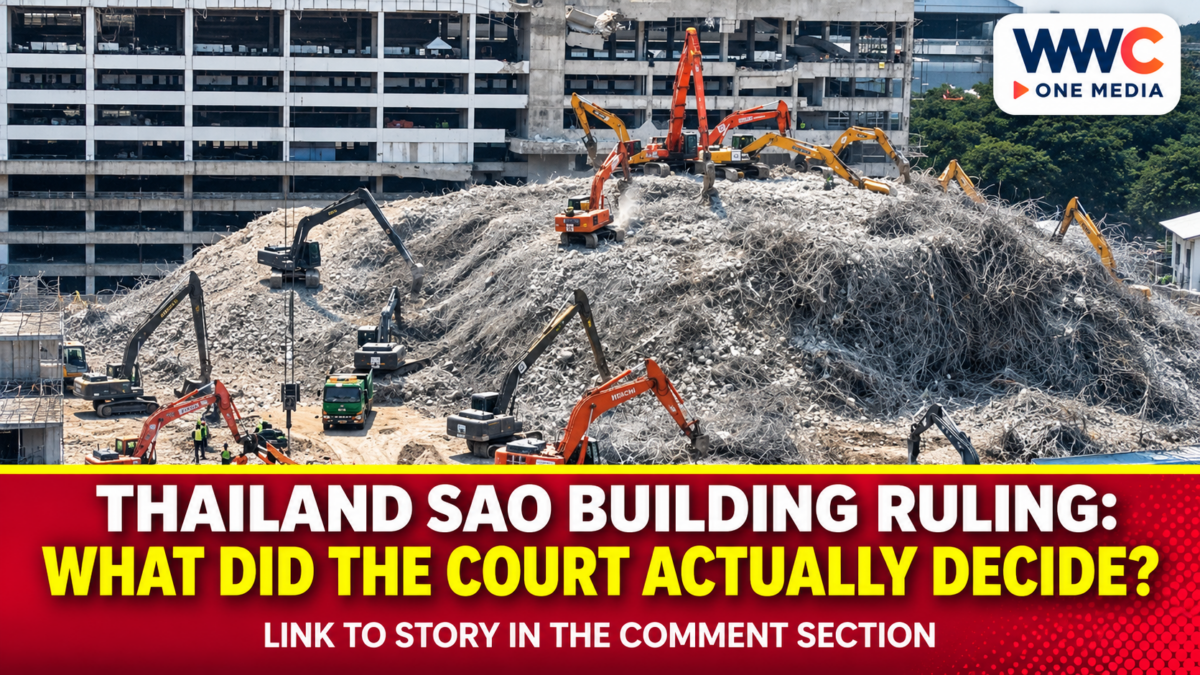
BANGKOK, Thailand — Nov. 21, 2026. A Thai criminal court on Nov. 18 convicted China Railway Number 10 (Thailand) and four individuals of offences under Thailand’s Foreign Business Act in a case connected with the State Audit Office (SAO) building project. The judgment, confirmed in an official announcement by Thailand’s Department of Special Investigation (DSI), concerns unlawful foreign-business operations and nominee shareholding—not a judicial finding about what caused the unfinished building to collapse.
That legal distinction is the central issue in the Thailand SAO ruling. The collapse of the government project on March 28, 2025, made the contractor’s ownership arrangements a matter of public interest, but the November judgment answers a narrower question: whether the business was lawfully structured and operated.
Thailand SAO Ruling: Who Was Convicted?
The DSI identified five defendants in Criminal Court case อ.1558/2568: China Railway Number 10 (Thailand), its Chinese authorised director, and three Thai individuals. The court imposed a 1 million baht fine on the company and ordered it to stop conducting business under conditions specified in the judgment.
The Chinese director received three years’ imprisonment and a 1 million baht fine. Two Thai defendants each received four years, nine months and 18 days in prison and fines of 1.6 million baht. The third Thai defendant received two years, four months and 24 days in prison and an 800,000 baht fine.
The DSI linked reduced Thai sentences to guilty pleas.
Crucially, a prison sentence imposed at trial is not itself confirmation that an appeal has been exhausted or that a defendant remains in custody. This report does not assume either position.
Why Nominee Shares Were at the Centre of the Case
A nominee arrangement occurs when a shareholder appears in company records as an owner but holds that interest for someone else. In this case, investigators examined whether the Thai individuals provided genuine capital and exercised genuine ownership, or whether the arrangements concealed foreign control.
DSI said it had scrutinised shareholder structure, funding sources, financial capacity and actual management authority. Those questions matter because Thailand regulates foreign participation in certain business activities, including construction, under its Foreign Business Act.
This case therefore concerned more than an administrative discrepancy. The question was whether a company operating in a regulated sector relied on Thai individuals to bypass the restrictions that applied to foreign businesses.
The broader issue has appeared elsewhere in Thailand. WWC previously reported on companies under investigation for suspected nominee ownership of Thai land. Those investigations are separate from the SAO court case, and being investigated is not the same as being convicted.
What the Judgment Does Not Prove About the Collapse
The most important boundary is explicit in the DSI’s announcement: the Nov. 18 decision was not the main criminal judgment concerning the cause of the SAO building collapse.
A finding that a contractor used an unlawful corporate ownership structure does not, by itself, establish defective engineering, negligent supervision or responsibility for deaths and injuries. Those questions require evidence and legal findings specific to construction, professional duties and the physical mechanism of failure.
The distinction protects both the integrity of the investigation and the rights of everyone involved. Readers should be able to understand that a serious conviction has been handed down without being led to believe a different case has already been decided.
Italian-Thai Development, which was involved in the project, previously stated in a published corporate communication that allegations and investigative steps did not constitute a definitive finding of responsibility for the collapse. That statement was made earlier in the proceedings and must not be treated as the current status of every separate case.
What the Investigation Reveals About Project Oversight
The DSI’s official description of its investigation identifies several lines of inquiry: who owned the contractor, where the money came from, whether the Thai shareholders could finance their stakes, and who actually managed the company.
Concealed control can obstruct oversight of decision-making and contractual responsibility.
Analysis: The lesson for public procurement is not that foreign investment is inherently improper. It is that legal ownership, beneficial control and compliance checks must be credible before major contracts are awarded and monitored throughout their execution.
WWC has also covered suspected nominee arrangements arising during an investigation into a Bangkok business. That matter involved different operators and allegations; it is relevant only as an example of the wider enforcement challenge.
Why the Decision Matters Beyond One Construction Company
Thailand’s foreign-business rules are designed to govern which entities may undertake restricted commercial activities and under what conditions. The SAO judgment illustrates that the formal names on a shareholder register may be tested against the underlying evidence of finance and control.
For investors, ownership paperwork must reflect real control.
For public agencies, the questions are equally direct: who was allowed to bid, how the contractor’s legal status was checked and what warning signs should trigger further scrutiny?
Thailand’s wider enforcement environment has already been the subject of WWC’s reporting on the government’s response to unlawful foreign-business activity. The SAO case is distinct because a court judgment, rather than merely an investigation, has now been publicly announced.
What Happens Next
The next relevant developments are any documented appeal outcomes, changes to the company’s legal operating status, and official steps in the separate proceedings dealing with the collapse itself.
The DSI said the company was ordered to cease business under the court’s conditions. That does not automatically answer when every commercial or registration obligation will end, or how any appeal may affect enforcement.
For families affected by the disaster, and for the wider public, accountability needs careful separation: unlawful business ownership has been adjudicated at trial, while responsibility for the structural failure must be determined through its own evidence and proceedings.
The November ruling answers one major question. It must not be presented as the final answer to all the others.
Frequently Asked Questions
1. What did the Thai court decide in the SAO building case?
On Nov. 18, 2026, the Criminal Court convicted a construction company and four individuals of Foreign Business Act offences involving nominee ownership and unlawful business operations.
2. Was the company convicted of causing the building collapse?
No. The DSI expressly distinguished this ruling from the main criminal case examining the cause of the building’s collapse.
3. What sentence did the Chinese director receive?
The court imposed three years in prison and a fine of 1 million Thai baht, the DSI announced.
4. What is a nominee shareholder?
It is a person who formally holds shares on behalf of another beneficial owner. Such an arrangement may violate applicable laws when used to disguise control and circumvent restrictions.
5. What remains unresolved?
Any subsequent appeal outcome, the full execution of the business-cessation order and the separate judicial determination of responsibility for the collapse require their own official records.