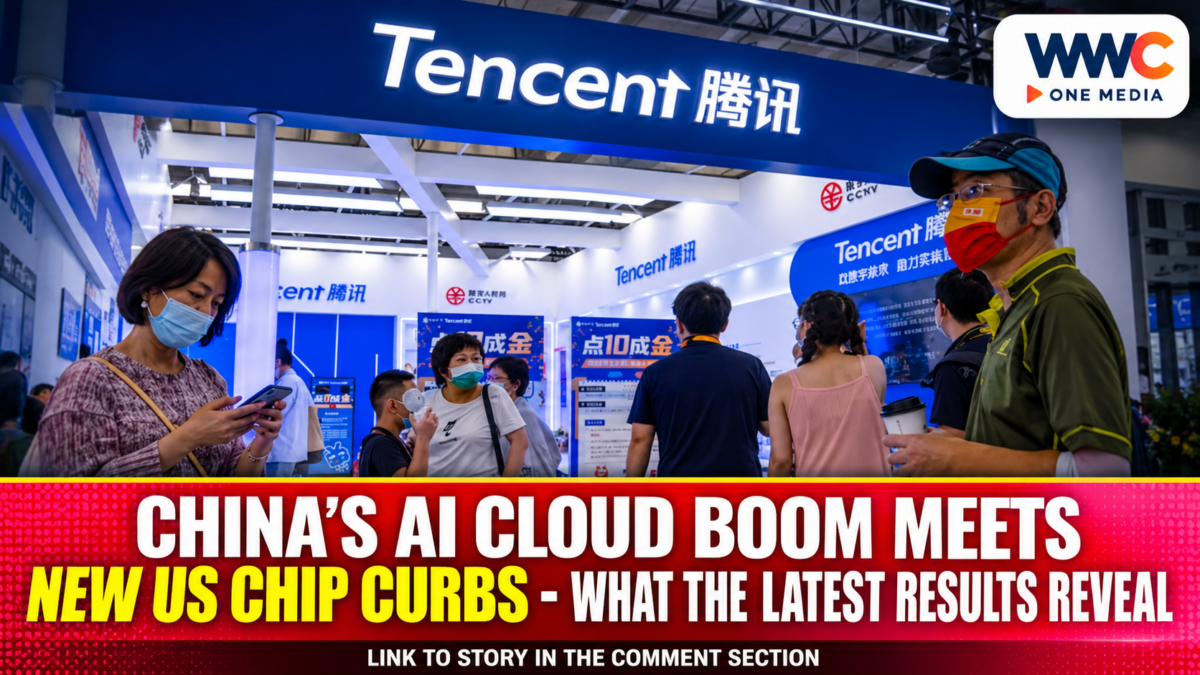
Alibaba Group and Tencent are expanding their artificial intelligence businesses as new US export rules tighten access to advanced computing power for certain Chinese companies, including through overseas data centres. The regulations took effect on Nov. 19, 2026, extending US scrutiny beyond the physical movement of semiconductors to certain remote-computing arrangements.
The timing is significant because both companies are investing heavily in AI infrastructure. Their latest financial disclosures show growing demand for AI-related services and substantial spending on computing capacity, although neither company’s published results quantify any financial damage caused by the newly effective US restrictions.
Alibaba’s AI cloud business continues to expand
Alibaba reported RMB60.973 billion in revenue from AI Cloud and Compute Services for the quarter ended Sept. 30, 2026, a 53% increase from the same period a year earlier. Revenue from external customers increased 64%, while the segment’s adjusted EBITA rose 121% to RMB8.838 billion.
AI-related product revenue reached RMB17.918 billion, recording triple-digit year-on-year growth for the thirteenth consecutive quarter. The company attributed the expansion to demand across sectors including internet services, automotive, financial services and biotechnology.
Alibaba is also developing its own semiconductor capabilities through its T-Head chip-design business. Its Zhenwu V900 processor, designed for AI training and inference, is scheduled for commercial release in the first quarter of 2027.
The figures show why access to computing resources matters to Alibaba’s strategy. Its cloud business is growing, but maintaining that growth requires processors, data-centre infrastructure and reliable access to the technology needed to operate AI services.
Tencent’s spending highlights the scale of the computing race
Tencent’s third-quarter results, announced on Nov. 18, provide another indication of how much infrastructure the AI expansion requires.
The company reported RMB207.3 billion in total revenue, up 8% year-on-year. Its capital expenditure payments reached RMB65.1 billion, an increase of 225% from the previous year.
Tencent also disclosed significant prepayments for computing procurement to support its Hy model family, WorkBuddy inference requirements and AI development across its products and services. The company said these payments also supported external demand for its cloud services.
These disclosures establish the scale of Tencent’s computing investment. They do not, however, establish that the new US rule has already delayed a particular model, cancelled a cloud contract or caused a measurable financial loss.
The new US rule reaches beyond physical chip shipments
The US Commerce Department’s interim final rule, titled Addressing Remote Access to Advanced Semiconductors, became effective upon publication in the Federal Register on Nov. 19.
One major provision requires licensing for certain advanced computing items intended for data centres that provide significant computing capacity, directly or indirectly, to companies headquartered in China, Macau or other destinations covered by Country Group D:5.
The regulation sets a threshold of more than 12 million aggregate total processing performance for the relevant arrangements. It also allows linked data centres to be assessed together when their infrastructure enables them to share computing resources.
Existing facilities already providing covered services before publication must obtain the required licence within 90 days of the rule’s effective date if they intend to continue those services. Applications are subject to case-by-case review.
The regulation also introduces additional licensing requirements for specified advanced semiconductor exports, re-exports and transfers involving Indonesia, Malaysia, Singapore, Thailand and Brazil. A qualified exception applies to certain transactions involving recipients or ultimate parent companies headquartered in the United States, provided reporting requirements are met.
The measure is not a universal prohibition on every Chinese cloud service, every overseas data centre or every AI processor. Its application depends on the technology, destination, end user, computing arrangement and intended use.
Beijing objects as regional compliance becomes more important
China has publicly criticised the expanded US controls. On Nov. 17, Foreign Ministry spokesperson Guo Jiakun described the measure as an abuse of export controls and said it could disrupt normal technology cooperation and global supply chains.
That response highlights the diplomatic dimension of the dispute. Washington frames the restrictions around national security and preventing access to advanced computing resources by designated entities, while Beijing argues that the measures interfere with legitimate commercial activity.
For Southeast Asian operators, the practical challenge is determining whether a transaction falls within the new licensing requirements. A data centre’s physical location alone may not settle the issue if its computing capacity is supplied remotely to a restricted customer.
WWC’s earlier examination of US AI chip curbs targeting overseas computing explains the broader regulatory framework. Its report on US AI chip rules affecting Philippine data centres also examines why the Philippines’ absence from the five-country list does not automatically exempt every overseas computing arrangement.
What happens next
The next important developments will come from licensing decisions, implementation guidance and company disclosures showing whether the new requirements affect actual computing contracts or infrastructure plans.
Alibaba’s planned Zhenwu V900 commercial release in early 2027 will also be worth watching as the company seeks to strengthen its domestic hardware capabilities. Its latest results show that AI cloud demand is expanding, but they do not prove that its own processors can replace every advanced foreign accelerator.
For Tencent, future financial disclosures may clarify how its substantial computing investments translate into AI services, cloud revenue and operating performance.
The central question is no longer limited to which country receives an advanced chip shipment. It increasingly concerns who ultimately uses the computing power, where that capacity is hosted and whether the arrangement requires regulatory approval.
Frequently Asked Questions
What do the new US AI chip rules cover?
They establish licensing requirements for certain advanced semiconductor transactions and overseas data-centre arrangements that provide substantial computing capacity to companies in designated restricted jurisdictions.
Did Alibaba report a decline in AI cloud revenue?
No. Alibaba reported RMB60.973 billion in AI Cloud and Compute Services revenue for the quarter ended Sept. 30, 2026, up 53% year-on-year.
How much did Tencent spend on capital expenditure in the third quarter?
Tencent reported capital expenditure payments of RMB65.1 billion for the third quarter of 2026, up 225% year-on-year.
Are all Chinese AI companies prohibited from using overseas data centres?
No. The rule applies to specified technologies, customers, computing thresholds and end-use arrangements. It is not a blanket prohibition on all overseas cloud services.
Does the rule automatically prohibit Philippine data centres from serving Chinese customers?
No blanket prohibition can be inferred. However, facilities outside the five specifically named countries may still fall under the remote-access provisions if the relevant conditions are met.