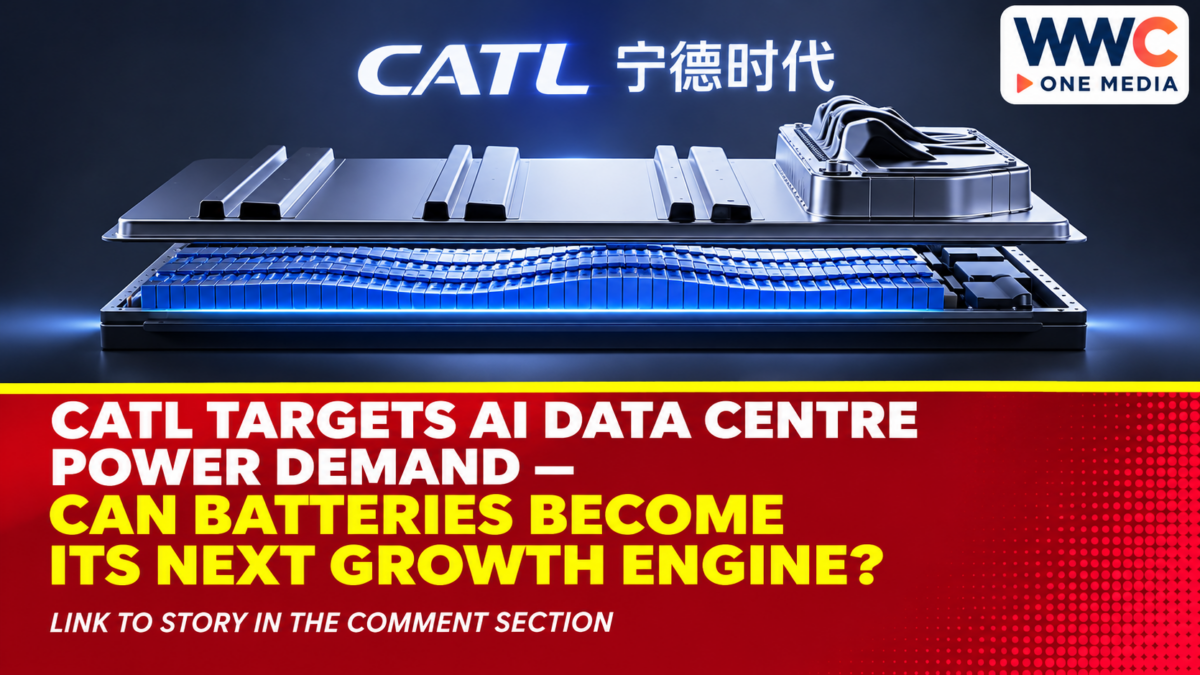
NINGDE, China — Battery manufacturer CATL is positioning energy storage as part of the electricity infrastructure needed for artificial intelligence data centres, extending its business beyond electric vehicles. In public remarks released on Oct. 15, 2026, chairman and chief executive Robin Zeng described technologies designed to respond to rapidly changing computing loads, while the company’s October delivery of long-duration storage equipment demonstrated another part of its wider energy strategy.
For customers, the question is whether batteries can provide reliable, economically competitive support for increasingly power-intensive facilities. For CATL, it is whether system integration and long-term performance can translate technical capability into repeatable commercial demand.
CATL AI Data Centres Strategy Builds on Existing Products
CATL’s 2026 interim report identifies data-centre energy storage among the applications for its energy storage system batteries. Its portfolio extends from battery cells and cabinets to containers and integrated systems, serving both grid-side and customer-site projects.
That matters because a data centre does not simply need more battery cells. Operators must manage sharp shifts in power demand, maintain dependable electricity and coordinate storage with their other electrical equipment.
At an October energy-storage conference, Zeng said CATL’s high-rate cells and intelligent controls were designed for millisecond-level responses to the changing power requirements of AI data centres. The company framed these capabilities as part of a larger move from selling components to delivering dependable power infrastructure.
The remarks establish a technical direction, not a disclosed new data-centre revenue target or an announced contract with a particular hyperscale operator.
Batteries Can Serve Different Jobs in a Data Centre
Energy storage can perform several roles, but they should not be confused. A fast-response system may help stabilise power during changing server loads, while a longer-duration battery can move electricity generated earlier to a later period.
Emergency backup has a different obligation: it must maintain critical loads when the normal power supply fails, under the facility’s specified design and safety requirements. No single battery specification automatically demonstrates suitability for every role.
Zeng’s publicly released February remarks described the use of artificial intelligence to improve energy-system management at SenseTime’s AI data centre in Shanghai. CATL said the approach helps manage fluctuations in electricity demand from computing work.
This is a disclosed example of an energy-management application. It does not establish the number of additional facilities that have adopted the technology or the revenue associated with that installation.
The distinctions are familiar to competitors too. WWC ONE MEDIA previously examined Samsung SDI’s battery solutions for AI data centres, including backup and integrated storage applications.
Eight-Hour Storage Expands the Commercial Opportunity
On Oct. 28, CATL announced the first delivery of EnerQB, a long-duration system developed with energy-infrastructure investor Quinbrook for Australian projects. The company described the product as designed for eight-hour energy-storage applications.
CATL said its framework agreement with Quinbrook covers a pipeline exceeding 3 gigawatts of power capacity and 24 gigawatt-hours of energy storage. That pipeline is a prospective project portfolio, not proof that every unit has been installed, commissioned or paid for.
A system designed to discharge over eight hours could help make renewable power available beyond the hours when sunshine or wind output is strongest. That may be useful to data-centre operators seeking dependable energy arrangements, although it does not replace the need for appropriate grid connections or other sources of power.
The company describes a 25-year design life for EnerQB. Design life is an engineering specification, not an independent guarantee of actual performance in every operating environment.
WWC has also reported on an Australian data-centre renewable-power and battery proposal, highlighting why energy generation and storage increasingly feature in digital-infrastructure planning.
Reliability Could Determine Whether Growth Is Sustainable
Battery projects must work at the level of the entire facility, not merely in laboratory cell testing. Grid interaction, thermal management, controls and maintenance all influence whether promised services can actually be delivered.
CATL opened its Xiamen Energy Storage Validation Research Institute in May 2026. The company described roughly RMB 3 billion in investment to create a testing platform covering grid integration, environmental conditions and safety assessment.
In October, Zeng said the institute had conducted systematic validation for 32 storage projects representing more than 16 gigawatt-hours of combined installed capacity. Those are CATL’s reported validation figures; they are not an independently audited failure-rate comparison with other suppliers.
Analysis: The closer energy storage comes to essential computing infrastructure, the more important operational reliability becomes. A lower initial equipment price may not compensate a customer for costly downtime, poor availability or performance that deteriorates over time.
What the Expansion Could Mean for the Philippines
CATL’s November Asia-Pacific announcement identified the MGEN Carmen battery energy storage project in the Philippines among regional projects recognised through an energy-storage initiative. The recognition shows the company’s involvement in the regional power-storage ecosystem, without proving a separate CATL contract for a Philippine AI data centre.
Locally, electricity availability and cost are important considerations for digital-infrastructure development. WWC previously covered MGEN and VITRO’s proposed renewable-powered data-centre collaboration, which remained at the assessment stage when announced.
For Philippine operators, pairing electricity supply with storage could improve flexibility, depending on project economics and grid conditions. It would not automatically make data centres carbon-free, eliminate electricity interruptions or guarantee lower customer bills.
What this could mean: Battery manufacturers may find additional customers as computing companies seek integrated power systems. However, the commercial outcome will depend on completed orders, measured reliability, installation costs and long-term service performance.
What Happens Next
The next evidence to watch is not another broad estimate of AI electricity demand, but CATL’s specific project deliveries, commissioned systems and future disclosures of energy-storage revenue. Progress across Quinbrook’s Australian project pipeline and independently verifiable data-centre deployments would clarify how far the strategy is advancing.
CATL’s official statements support the case that AI infrastructure is a target application for its battery and energy-management technology. They do not yet establish how much additional profit the market will generate or whether data centres will become its dominant growth business.
Frequently Asked Questions
Is CATL supplying batteries for AI data centres?
CATL’s interim report includes data-centre storage among its applications, and its chairman has publicly described technology for rapidly changing AI computing loads. The verified records do not establish a comprehensive customer list or associated sales total.
What is EnerQB?
EnerQB is CATL’s long-duration energy-storage system designed for eight-hour applications. Its initial units were delivered for planned Australian projects with Quinbrook in October 2026.
Can batteries power a data centre without the grid?
Batteries store electricity rather than generate it. The feasibility of operating without a grid connection depends on the entire generation, storage and backup design, not batteries alone.
Why does AI increase demand for energy storage?
AI facilities require reliable electricity and can experience changing power loads. Storage may help with fast response, backup functions and shifting electricity to periods when it is needed.
Does CATL have a confirmed new AI data-centre revenue forecast?
No separate revenue forecast for AI data-centre storage was verified in the primary documents reviewed for this article.