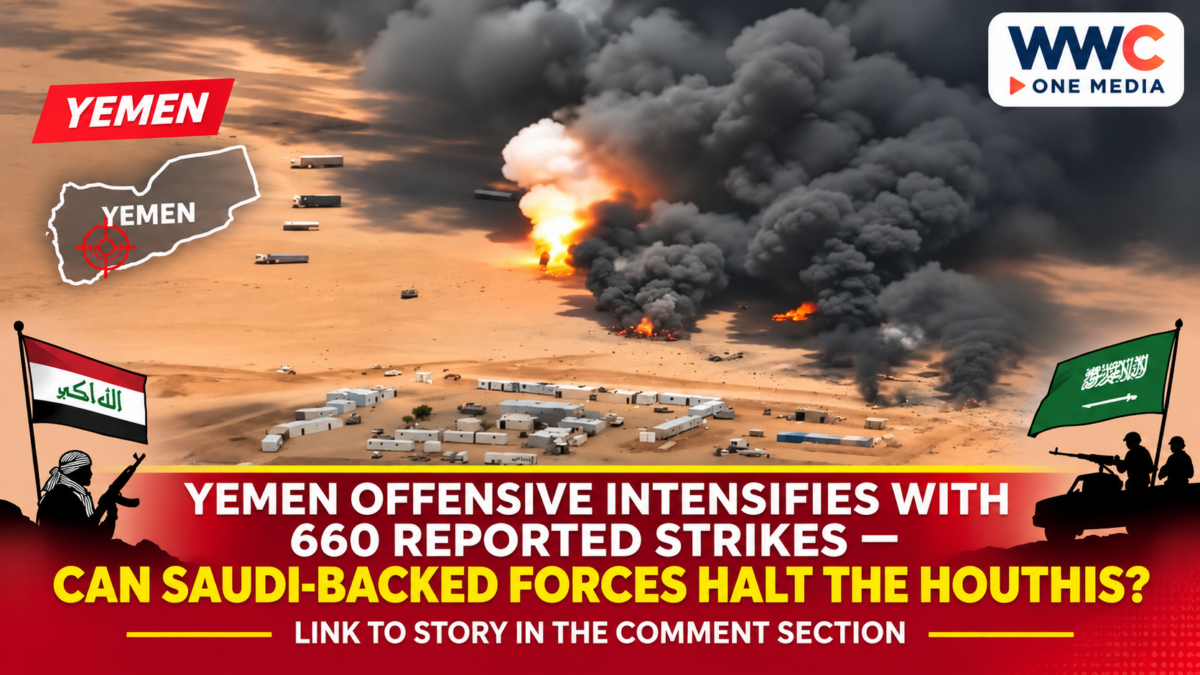
ADEN, Yemen — Nov. 18, 2026. Yemen’s government-aligned armed forces said on Nov. 17 they carried out 660 air and ground attacks on Houthi positions, while the Saudi-led coalition announced a separate operation against 60 targets on Nov. 18. The military announcements mark another escalation in a conflict that is putting civilians, regional security and critical shipping routes under pressure.
The figures are claims issued by the forces conducting the operations, not independently verified strike or casualty counts. Their importance lies in the declared scale of the campaign and its stated objectives, especially as the government seeks to strengthen its position against the Houthis.
Yemen Offensive: What the 660 Operations Claim Actually Means
A Nov. 17 statement by the Yemeni armed forces broke down its reported 660 operations into 24 warplane strikes, 46 drone attacks, 39 rocket-launcher strikes and 551 field-artillery operations. Those categories add up to 660, but they do not mean 660 separate airstrikes: most reported actions involved artillery.
The military spokesman, Colonel Majed al-Nazili, also claimed that approximately 178 Houthi commanders and fighters were ‘neutralised’ and 74 vehicles or pieces of military equipment were destroyed or damaged. These casualty and damage assessments have not been independently established. The term ‘neutralised’ also should not be interpreted automatically as a confirmed death toll.
The military identified operations in Taiz, Marib and al-Jawf. The total does not describe one attack near a single city.
Saudi-Led Coalition Reports a Separate 60-Target Operation
On Nov. 18, coalition spokesman Major General Turki al-Maliki announced that the coalition had carried out a military operation targeting Houthi capabilities in Sanaa, Hodeidah, Amran and Saada. He claimed 60 military targets had been destroyed, including infrastructure associated with ballistic missiles, drones and storage facilities.
That claim is separate from the Yemeni military’s Nov. 17 total. Adding the two numbers into a single verified tally would be misleading because they describe different reporting periods, target definitions and military statements.
The coalition also announced on Nov. 18 that it had intercepted and destroyed a cruise missile launched towards the Riyadh region. The coalition attributed the missile to the Houthis; the operational account and attribution remain those of the coalition.
Previous WWC coverage of attacks on Saudi airports and fighting near the Red Sea illustrated how threats to civilian infrastructure and military operations within Yemen can become connected. The new official announcements show why regional security remains central to the government’s campaign.
What Is the Government Trying to Achieve?
Yemen’s Presidential Leadership Council has publicly described its Fajr al-Yemen, or Dawn of Yemen, operation as an effort to reassert government authority across the country. At its Nov. 2 meeting, the council discussed reported progress in al-Jawf, Marib and the western coast and reaffirmed its intention to continue the operation.
In a Nov. 5 statement, the council claimed more than 40,000 military strikes since Oct. 5 and credited Saudi Arabia with supporting the government. Those are the council’s figures, not an independently audited record of completed strikes or territorial control.
What this could mean: The government is signalling that its campaign is intended to go beyond defending individual positions. Yet bombardment totals alone cannot demonstrate that roads are secure, administrative authority has returned or people can safely go home.
It is important to distinguish what the government says it intends to accomplish from what has already been achieved. Without corroborated changes in control and security, a large strike count is evidence of claimed operational intensity, not proof that the war is approaching an end.
Why the Red Sea and Saudi Arabia Matter
Yemen’s western coast faces the Red Sea and the Bab el-Mandeb passage, making conflict around coastal areas significant for maritime security. Safe vessel passage also matters for commercial operators.
The conflict has also brought threats against Saudi territory. Earlier WWC reporting on Philippine authorities’ monitoring of overseas Filipino workers in Saudi Arabia highlighted why such security developments deserve attention in the Philippines. The existence of a fresh military claim does not, however, establish that Filipinos were affected by the Nov. 18 events.
Why it matters: An expansion of missile, drone or maritime threats could impose costs on carriers, businesses and travellers. That is a plausible risk, not a documented change in shipping charges or oil prices arising from the latest announcements.
Civilians Face a Much Bigger Emergency Than Strike Counts Show
The humanitarian consequences are measurable beyond military communiqués. In an Oct. 30 briefing, the United Nations said more than 290,000 people had been displaced in Yemen since the start of August. It also highlighted risks to pregnant women, refugees and communities whose access to services has deteriorated.
A United Nations cooperation framework published Nov. 14 reported that more than 19.5 million people needed assistance in 2025, around 18 million faced food insecurity and 4.8 million remained internally displaced. These figures describe different periods and populations, so they should not be combined into a single current casualty or displacement total.
Yemen’s government separately reported alleged human-rights violations by the Houthis on Nov. 17. Such allegations require careful independent assessment and must not be treated as judicial findings. Civilian harm can result from actions by any party to the conflict, and all parties remain responsible for protecting civilians.
Earlier WWC coverage of contested civilian-casualty accounts after Yemen airstrikes demonstrates why damage reports should be handled cautiously when parties dispute responsibility. Whether attacks are described as precise or defensive does not remove the need for verifiable civilian-protection measures.
What Happens Next
The most meaningful indicators will be independently corroborated changes in frontline control, access for humanitarian organisations, the safety of transport corridors and any credible resumption of negotiations. Further announcements of strikes will show continued military activity, but will not by themselves establish a decisive shift.
Further military statements should be checked against evidence of humanitarian access and civilian safety.
For now, the official record supports a clear conclusion: government-aligned forces and their Saudi-led partner have announced intensified action against the Houthis. It does not establish that the campaign has defeated the group or resolved the humanitarian emergency.
Frequently Asked Questions
Did Yemeni government forces launch 660 airstrikes?
No. The Yemeni military reported 660 combined operations, including aircraft, drones, rocket launchers and field artillery. Only 24 were described as strikes by warplanes.
Did the Saudi-led coalition attack 60 targets?
The coalition said on Nov. 18 that it destroyed 60 military targets in Sanaa, Hodeidah, Amran and Saada. The claim has not been independently verified here.
Have Saudi-backed forces defeated the Houthis?
No verified official record reviewed establishes that outcome. The Yemeni leadership says the operation is continuing towards its goals.
Why should the Philippines monitor the Yemen conflict?
Escalation can have implications for regional transport and for the security of Filipinos in neighbouring countries. No direct impact on Filipinos from these specific Nov. 17–18 operations was independently confirmed.