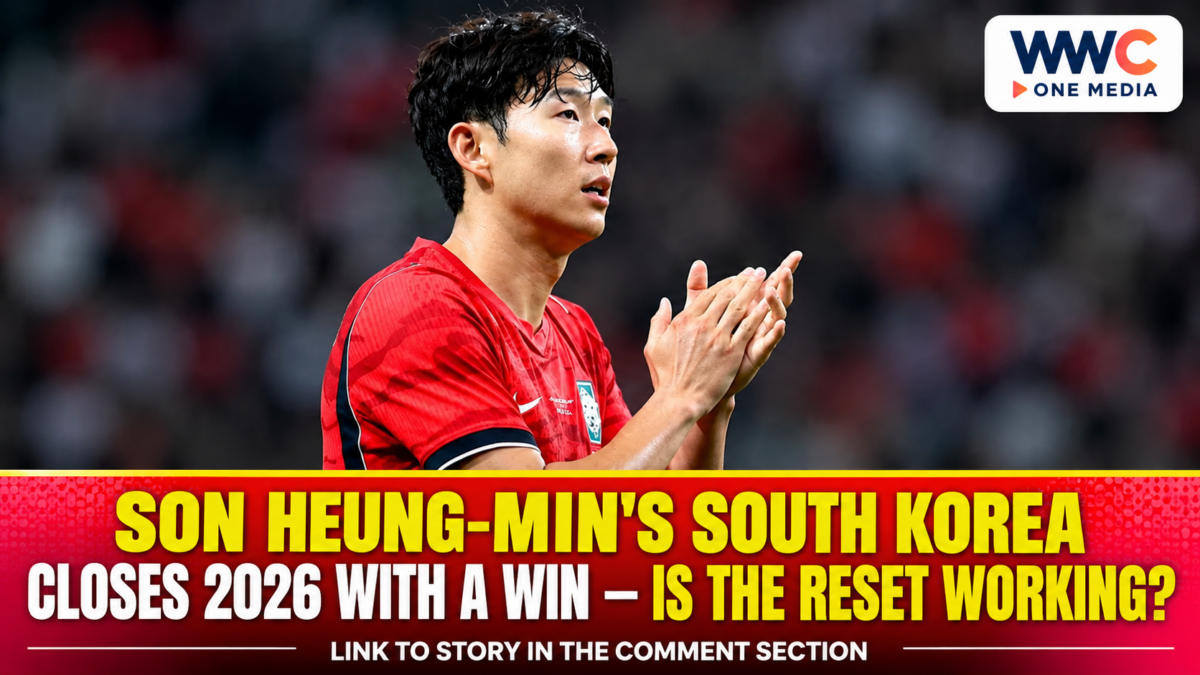
South Korea closed its men’s international football schedule for 2026 with a 1–0 friendly victory over Qatar on Nov. 17, giving captain Son Heung-min and his teammates a positive result after a year marked by a disappointing World Cup campaign and questions about the national team’s leadership.
Forward Oh Se-hun scored the only goal at Abdullah bin Khalifa Stadium, while the Korea Football Association’s records show that the team finished its November trip with one win and one defeat. 대한축구협회+1
The result does not erase South Korea’s earlier setbacks. But it gives the team a practical starting point for its next phase: rebuilding confidence, maintaining unity among senior players and preparing for the next international window.
Son Heung-min and teammates publicly commit to moving forward
The national team’s internal tensions became a public issue before the November friendlies. On Nov. 12, the KFA published a joint statement signed by Son, Lee Jae-sung, Kim Min-jae, Hwang In-beom and Hwang Hee-chan.
The players said they had met during the national-team camp to discuss their views about the team and its direction. They said the conversations helped them understand one another’s positions and reaffirmed their shared goal of improving South Korean football. 대한축구협회
The statement also addressed speculation surrounding the players’ disagreements. The five said the discussions were not driven by personal conflict with a particular teammate or by an attempt to secure demands through the threat of international retirement.
They said they wanted to move beyond the controversy, respect one another’s responsibilities and concentrate on the national team.
That public commitment matters because a national side depends on more than individual ability. Senior players must coordinate on the pitch, communicate with younger teammates and maintain trust when results are poor.
However, a joint statement is only a starting point. Its real value will be measured through team performances and whether the players can sustain the cooperation they publicly promised.
Qatar win gives South Korea a better finish
South Korea’s final match of the year produced a narrow but useful result. The KFA recorded a 1–0 victory over Qatar on Nov. 17, with Oh Se-hun scoring the decisive goal. 대한축구협회+1
The result followed a 3–2 defeat to Saudi Arabia on Nov. 13. South Korea therefore ended the two-match trip with three goals scored and three conceded across the two fixtures, based on the association’s published results. 대한축구협회
The contrast between the matches illustrates why the Qatar result is relevant but should not be overstated. One victory can improve the mood around a squad, but it does not establish that all tactical or leadership problems have been resolved.
The KFA’s October 29 squad announcement had named 26 players for the two friendlies, including Son, Kim Min-jae, Lee Kang-in, Hwang In-beom and Hwang Hee-chan. The selection brought several established internationals together despite the public discussion surrounding the group. 대한축구협회
For interim head coach Robert Moreno, the November matches also provided an opportunity to assess players before the next stage of the national team’s planning.
The World Cup exit remains the year’s biggest setback
South Korea entered the 2026 FIFA World Cup with expectations of progressing beyond the group stage. Instead, the team finished its Group A campaign with one victory and two defeats.
FIFA’s tournament records show a 2–1 opening win over Czechia, followed by 1–0 defeats against Mexico and South Africa. The results left Korea Republic outside the teams advancing to the knockout rounds. fifa.com+1
The early exit was followed by the departure of head coach Hong Myung-bo. FIFA reported that Hong announced he would step down after the team’s failure to progress from the group stage. fifa.com
That sequence created a difficult backdrop for the national team. A major tournament disappointment can prompt questions about tactics, preparation, player selection and leadership. But addressing those issues requires a structured review rather than relying on a single result or public statement.
South Korea’s November camp was therefore significant as a chance to bring senior players together and begin moving beyond the fallout from the summer.
Moreno’s November squad mixed established players and new faces
The KFA’s 26-man selection for the November fixtures included experienced players based overseas and in South Korea’s domestic league.
Son was listed as an LA FC player, while Kim Min-jae was named from Bayern Munich, Lee Kang-in from Atlético Madrid, Hwang In-beom from FC Porto and Hwang Hee-chan from Schalke 04. 대한축구협회
The squad also included first-time selections Shin Min-ha of Gangwon FC and Son Jeong-beom of FC Seoul, according to the association’s announcement. Defender Kim Ji-soo was also included after previously appearing in youth national-team setups. 대한축구협회
This combination points to two priorities for the national team: preserving the experience of established internationals while creating opportunities for additional players.
That balance will be important as South Korea prepares for its next competitive cycle. Relying too heavily on a small group can limit squad development, while making too many changes at once can disrupt continuity.
For more context on the country’s football ambitions, WWC previously examined South Korea’s pressure to defend its Asian Games men’s football title. The youth competition is a different programme from the senior national team, but it reflects the wider expectations placed on Korean football.
A win is a beginning, not proof that the problems are over
South Korea’s November results offer a mixed assessment. The defeat to Saudi Arabia showed that the team still had work to do, while the Qatar victory provided a stronger final result.
The more important question is whether the players’ public commitment to one another becomes visible in future performances. Communication, role clarity and trust are difficult to measure through a single friendly, but they can influence how a team responds when it faces pressure.
The issue also has implications for the next generation. Established players such as Son and Kim Min-jae are among the senior figures expected to help younger teammates adapt to international football. Their example will matter both on and off the pitch.
WWC has also covered South Korea’s wider sporting ambitions at the Aichi-Nagoya Asian Games, where the country sent a broad delegation targeting strong results across multiple sports.
For Philippine readers, the importance of team cohesion is familiar across national sports programmes. WWC’s report on Gilas Pilipinas’ tune-up defeat against South Korea also showed how preparation matches can expose areas that require attention before a major tournament.
The lesson is straightforward: a result can provide encouragement, but sustained improvement depends on what a team does between matches.
What happens next?
South Korea’s men’s team has completed its 2026 international schedule. The KFA’s November 17 match record identifies the Qatar fixture as the final friendly of the year, while the players’ joint statement points to the next Asian Cup as a major preparation target. 대한축구협회+1
The next phase will require decisions about the coaching structure, squad continuity and how the team converts its stated commitment into consistent performances.
For Son, the immediate challenge is to continue leading a group that has experienced both a major tournament setback and public questions about its internal relationships.
The Qatar victory gives South Korea a more positive closing result. Whether it marks the beginning of a genuine recovery will become clearer when the team returns to international competition.
Frequently asked questions
1. Did South Korea beat Qatar in its final match of 2026?
Yes. South Korea defeated Qatar 1–0 in Doha on Nov. 17, 2026. The KFA recorded the result in its men’s national-team match results. 대한축구협회
2. Who scored South Korea’s goal against Qatar?
Forward Oh Se-hun scored the only goal in the 1–0 victory. 대한축구협회
3. What did Son Heung-min and his teammates say in their joint statement?
Son, Lee Jae-sung, Kim Min-jae, Hwang In-beom and Hwang Hee-chan said they had discussed their views about the national team, better understood one another and wanted to move forward together. They also rejected the claim that they had used international retirement threats to force specific demands. 대한축구협회
4. How did South Korea perform at the 2026 World Cup?
Korea Republic beat Czechia 2–1 but lost 1–0 to Mexico and 1–0 to South Africa. The team did not advance from the group stage. fifa.com+1
5. Who was included in South Korea’s November 2026 squad?
The KFA announced a 26-player squad that included Son Heung-min, Kim Min-jae, Lee Kang-in, Hwang In-beom and Hwang Hee-chan, alongside first-time selections Shin Min-ha and Son Jeong-beom.