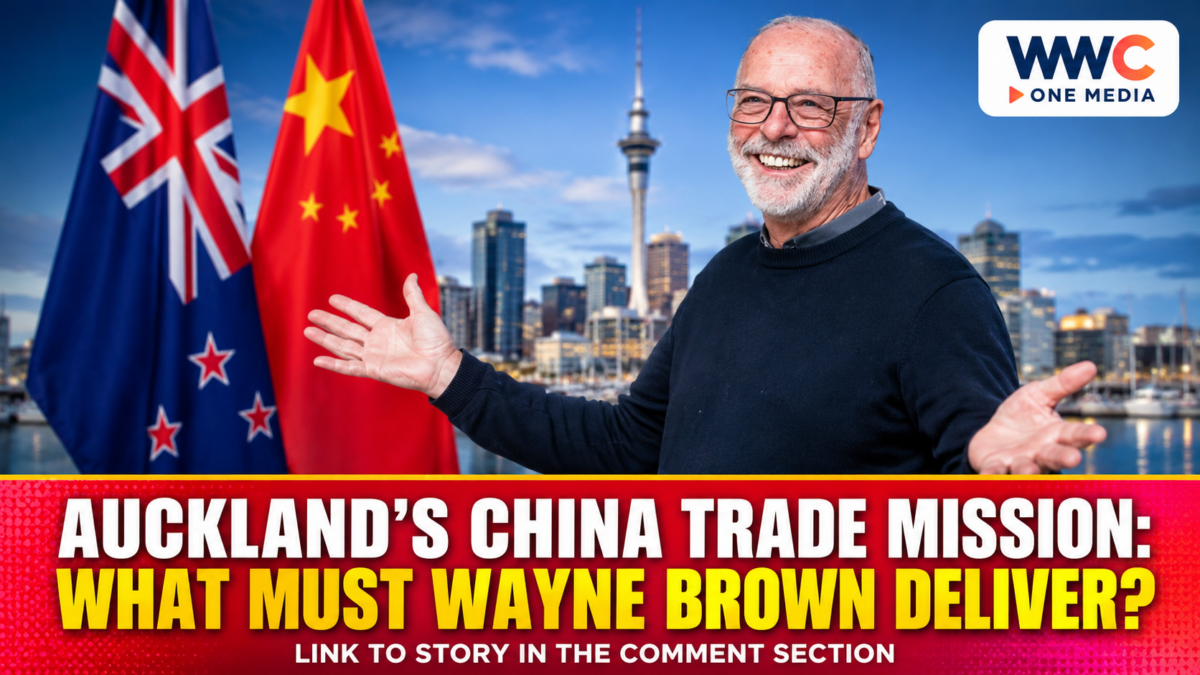
Auckland Mayor Wayne Brown confirmed in an Auckland Council announcement on Oct. 28, 2026, that he would travel with an Auckland delegation to China to strengthen trade links and attract investment. The trip formed part of the city’s wider effort to secure international business opportunities as Auckland prepares for its next phase of growth. OurAuckland
The economic objective is clear. The harder question is whether overseas engagement can produce measurable benefits for Auckland businesses, workers and residents.
International visits can open doors, create contacts and introduce companies to potential partners. But those activities are not the same as completed investments, signed commercial agreements or increased exports.
For a city seeking a larger role in international trade, the value of a delegation should ultimately be judged by what follows after its representatives return home.
Auckland China mission is tied to a wider growth strategy
The council’s Oct. 28 announcement placed the China delegation alongside Brown’s broader manifesto for building Auckland into a city of two million people.
The manifesto identified five priorities: transport improvements, better-managed urban growth, stronger global economic connections, reduced regulatory barriers, and greater resilience and environmental protection.
Its international economic agenda specifically calls for attracting global capital, increasing trade and tourism, and making it easier for businesses to recruit and retain skilled workers.
This matters because the China visit was not presented simply as a diplomatic courtesy. The council connected it to the city’s economic ambitions and its attempt to strengthen Auckland’s position in international markets.
The same announcement said Brown had launched a manifesto calling for a stronger partnership between Auckland and central government through the Auckland Deal, a framework intended to support infrastructure investment and shared responsibilities.
The relationship between those priorities is important. International investment can support economic expansion, but the city also needs infrastructure, transport capacity and a regulatory environment capable of supporting new commercial activity.
China has long featured in Auckland’s trade strategy
The latest delegation follows a longer history of Auckland’s engagement with Chinese businesses and institutions.
In October 2024, Auckland Council announced another official China visit involving business leaders from the city. The programme included meetings with the Hainan Government, support for Auckland companies exhibiting at the China International Import Expo in Shanghai, discussions with the China Chamber of Commerce in Ningbo and engagement with local officials.
The 2024 programme also included a visit to Auckland companies operating in Guangzhou and participation in an international friendship-cities conference in Chengdu. OurAuckland
The council described the mission as an opportunity to promote Auckland businesses and identify investment and export opportunities.
The earlier announcement also disclosed that the expected travel cost was around NZ$75,000, with business delegates paying their own travel expenses. That figure belongs to the 2024 visit, not the 2026 delegation, and should not be treated as the cost of the latest trip.
The historical record nevertheless illustrates that Auckland’s China engagement has been part of a continuing economic strategy rather than a newly introduced initiative.
For a wider regional perspective, WWC has examined how ASEAN–China economic cooperation is being tested by regional priorities.
Trade connections need commercial results
One of Auckland’s earlier projects provides a concrete example of how international engagement can move beyond meetings.
In December 2025, the council announced the inaugural Southern Link flight route connecting Shanghai and Buenos Aires through Auckland. The service was operated by China Eastern Airlines, using Auckland as a stop between the two major markets.
The council said the route followed advocacy involving the mayor, Auckland Airport and other participants over the removal of transit visa requirements for travellers from China.
The announcement described the route as an opportunity to improve connections between Asia, New Zealand and South America, including for tourism and trade. OurAuckland
That development illustrates a practical form of economic diplomacy: improving connectivity can create opportunities for passenger travel, logistics and business relationships.
However, the existence of a route does not automatically establish how much additional trade or investment it generates. Those outcomes require separate evidence, including passenger numbers, freight volumes, commercial contracts and export performance.
The same standard should apply to the latest China delegation.
Auckland must compete for investment
Attracting international capital is not simply a matter of securing meetings with business leaders or government representatives.
Companies evaluating a new market consider infrastructure, workforce availability, operating costs, regulation, access to customers and the ability to move goods efficiently.
Auckland’s own manifesto recognises several of these challenges. It calls for better transport systems, more coordinated infrastructure decisions, reduced red tape and stronger support for businesses.
Those priorities are relevant because investment decisions depend on conditions at home as much as relationships overseas.
A foreign company may express interest in a city, but the investment becomes economically meaningful only when it moves towards a concrete project, creates commercial activity or supports local employment.
New Zealand’s relationship with China also has a broader strategic dimension. Economic engagement takes place alongside security and diplomatic concerns, requiring public institutions to distinguish commercial cooperation from other aspects of bilateral relations.
WWC previously examined New Zealand’s official concerns about state-backed cyber activity. That security context does not determine the outcome of a trade mission, but it demonstrates why economic and national-security considerations must be assessed separately.
Public accountability should follow overseas visits
The public record provides a clear starting point for assessing the latest delegation: Auckland Council announced the purpose of the visit, but the announcement alone does not establish what commercial outcomes were achieved.
A useful post-visit account would identify the businesses involved, the organisations met, the sectors discussed and any agreements or investment commitments reached.
It should also distinguish between preliminary expressions of interest and binding commercial commitments.
This is particularly important when public officials undertake international travel in the name of economic development. Residents and businesses have a legitimate interest in knowing whether the activity produced results that justify the expenditure of public resources.
Analysis: The strongest measure of a successful trade mission is not the number of meetings held or the prominence of the people attending. It is whether those meetings lead to opportunities that businesses can use and whether the resulting benefits can be demonstrated.
Auckland’s global ambitions will depend on its ability to convert international relationships into practical economic activity.
What happens next
The next important step is a public account of the 2026 delegation’s outcomes.
Auckland businesses and residents would benefit from details of any commercial agreements, investment discussions that advanced beyond initial contact, export opportunities and follow-up programmes.
The council could also clarify the delegation’s final itinerary and the cost of the mayoral travel, separating public expenditure from costs paid directly by participating businesses.
Until those details are published, the mission’s stated objectives are clear, but its economic results remain to be established.
Auckland’s relationship with China will continue to be relevant to the city’s international outlook. Whether the latest visit becomes a meaningful economic achievement will depend on what can be documented after the diplomatic engagements end.
Frequently asked questions
Why did Auckland Mayor Wayne Brown travel to China?
Auckland Council’s Oct. 28, 2026 announcement said the mayor would depart with an Auckland delegation to strengthen trade links and attract investment.
What were Auckland’s economic objectives?
The council’s manifesto identified attracting global capital, increasing trade and tourism, and improving conditions for businesses to recruit and retain skilled workers.
Has Auckland previously sent business delegations to China?
Yes. Auckland Council documented an official China visit in October 2024 involving Auckland business leaders, government meetings and participation in the China International Import Expo.
Did the latest China mission produce confirmed investment agreements?
The council announcement reviewed here establishes the purpose of the trip but does not confirm specific investment agreements or completed commercial commitments.
How can the public assess whether the trip was successful?
The most useful evidence would include published agreements, confirmed investment commitments, export opportunities, business participation and a transparent account of public travel expenditure.