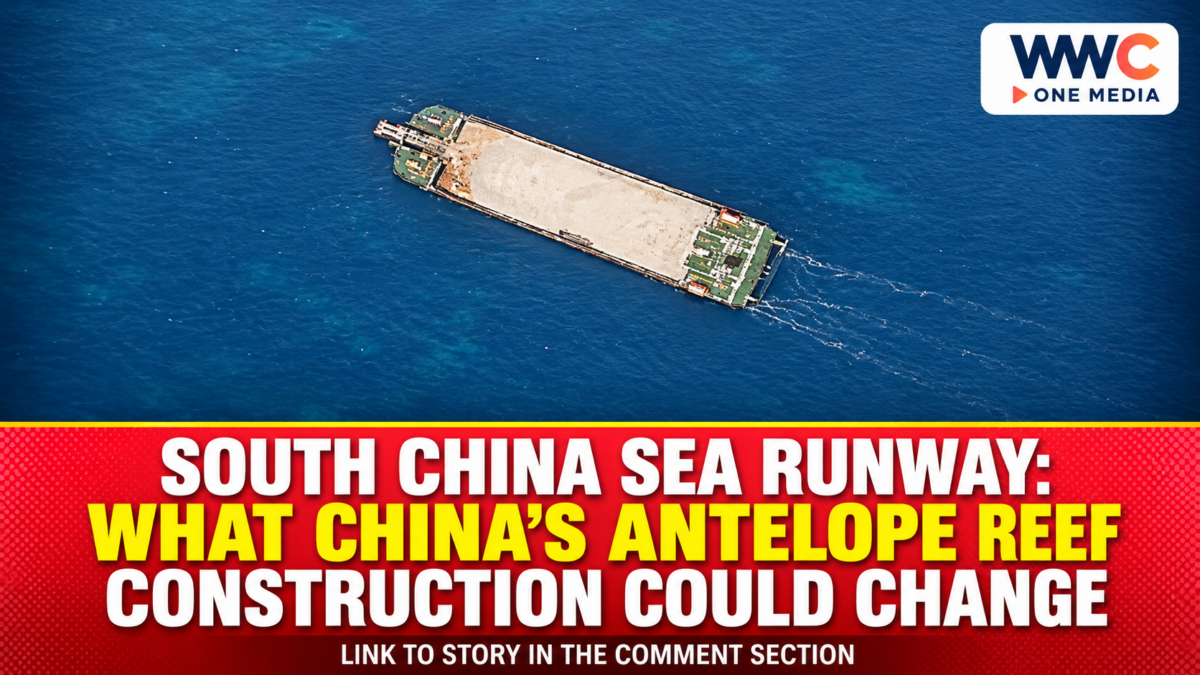
Construction at Antelope Reef in the disputed Paracel Islands is showing signs of a major aviation infrastructure project, with satellite-image analysis identifying land preparation consistent with a runway.
The development adds another strategic infrastructure site to a region where competing maritime claims, military activity and diplomatic negotiations continue to shape Southeast Asian security. However, the available imagery does not establish that the runway is complete, operational or being used for military aircraft.
The distinction matters. A runway can provide logistical and surveillance advantages, but its actual strategic value depends on the facilities built around it, the aircraft it can accommodate and how the site is eventually operated.
Antelope Reef’s transformation is visible in satellite imagery
Antelope Reef, also known as Lingyang Jiao in Chinese, is part of the Crescent island group in the Paracel Islands. China controls the Paracels, which are also claimed by Vietnam and Taiwan.
The scale of construction has changed substantially since the project began. AMTI’s March 19 assessment, based on commercial satellite imagery from Vantor, estimated that reclaimed land at Antelope Reef had reached approximately 1,490 acres. The assessment compared the expanded feature with other major Chinese outposts in the South China Sea. Asia Maritime Transparency Initiative
The same analysis identified a long, straight section on the northwestern side of the reclaimed land that could accommodate a runway. It also documented preliminary construction, including structures, a helipad and foundations for larger buildings.
By August, further satellite imagery showed excavation along the northwestern edge. AMTI reported that the area being shaped extended approximately 4,300 feet, with work appearing consistent with preparation for a longer airstrip. It also identified foundations for a structure resembling the dimensions of hangars at other Chinese outposts. Asia Maritime Transparency Initiative
These observations point to an extensive infrastructure project. They do not, by themselves, establish the final design or operational status of the proposed runway.
What the South China Sea runway could mean for China
A runway on an expanded reef could provide more options for aircraft operations in the northern South China Sea.
Depending on its final length, surface, supporting facilities and operational arrangements, an airstrip could support transport, surveillance and other aviation activities. If developed to accommodate larger aircraft, it could also improve the ability to sustain operations farther from China’s mainland.
AMTI’s March assessment said Antelope Reef’s reclaimed area could accommodate a runway comparable in length to those at Woody Island, Mischief Reef, Subi Reef and Fiery Cross Reef. It also assessed that a developed facility could add capacity and redundancy to China’s existing network of outposts. Asia Maritime Transparency Initiative
That is a strategic assessment, not confirmation that all those capabilities have been installed.
The difference between construction potential and demonstrated military capability is important. A runway alone does not establish the presence of combat aircraft, weapons systems, fuel storage or permanent military units.
Nevertheless, infrastructure can have long-term value even when it is described as civilian. Ports, airfields, communications systems and logistics facilities can serve different purposes depending on how authorities operate them.
Beijing describes the construction as civilian development
China has publicly defended its construction activities in the Paracel Islands.
During a March 23, 2026, Foreign Ministry briefing, spokesperson Lin Jian responded to a question about Vietnam’s opposition to land reclamation in the area. He said: “Necessary construction on our own territory is aimed at improving living and working conditions on the islands and growing the local economy.” Ministry of Foreign Affairs China
That statement sets out Beijing’s official position. It does not provide a detailed description of the Antelope Reef project’s final facilities or confirm whether the runway will have a military role.
The distinction between stated purpose and potential use remains central to regional assessments of infrastructure development.
For neighbouring countries, the concern is not limited to whether a particular facility is labelled civilian or military. It also involves the capabilities that could become available once construction is complete and how those capabilities might affect activity in surrounding waters and airspace.
The legal dispute cannot be reduced to the runway itself
The Paracel Islands form part of a wider dispute involving territorial sovereignty and maritime rights.
The 2016 South China Sea arbitration between the Philippines and China remains an important part of the region’s legal background. However, its scope needs to be understood accurately: the tribunal expressly stated that it did not rule on sovereignty over land territory or delimit maritime boundaries between the parties. PCA CPA Docs
The tribunal addressed maritime entitlements and specific conduct under the United Nations Convention on the Law of the Sea. It also examined the environmental consequences of construction at seven features in the Spratly Islands.
That award should not be misrepresented as a direct ruling on the sovereignty of Antelope Reef or the legality of this particular construction project.
For the Philippines, the distinction is significant. Legal arguments about maritime entitlements, territorial sovereignty and the conduct of states are related, but they are not interchangeable.
The development also highlights why international law and diplomatic engagement remain important even when physical construction changes the situation on the ground.
ASEAN faces a wider maritime-security challenge
The construction is unfolding while Southeast Asian governments continue to discuss rules for managing disputes in the South China Sea.
In its Jan. 29, 2026, statement, ASEAN foreign ministers expressed concern over land reclamation and other activities that could increase tensions or damage the marine environment. They reaffirmed the importance of restraint, peaceful dispute resolution and compliance with international law, particularly UNCLOS. ASEAN 2026 Photos
The Philippines has also made maritime cooperation and the proposed Code of Conduct central parts of its 2026 ASEAN chairship.
But diplomatic progress and physical developments do not necessarily move at the same pace. Negotiations can establish principles and expectations, while construction projects can alter the practical capabilities available to individual states.
WWC has examined the diplomatic challenge in its report on the South China Sea Code of Conduct negotiations moving into 2027.
The region’s maritime-security agenda also extends beyond negotiations. The Philippines’ planned ASEAN Maritime Centre is one example of a regional initiative intended to support maritime cooperation and information-sharing.
Meanwhile, China’s military activity around other disputed features remains part of the regional picture. WWC previously reported on Chinese naval and air exercises around Scarborough Shoal, a separate location with its own dispute history.
These developments should not be treated as evidence that a confrontation is inevitable. They do, however, show why maritime monitoring, communication and agreed rules remain important.
What happens next
The next significant indicators at Antelope Reef will be the completion and configuration of the runway and the supporting infrastructure around it.
Further satellite imagery may establish whether the prepared strip is paved, how long it becomes and whether aircraft-support facilities are added. Official statements from China could also clarify the intended function of the site.
For other South China Sea claimants, the practical questions will include whether the development changes patterns of aircraft activity, coast guard operations or maritime presence in the surrounding area.
The Philippines and other ASEAN members will also have to continue balancing diplomatic engagement with the need to protect their maritime interests.
For now, the public evidence supports a measured conclusion: Antelope Reef has undergone extensive reclamation, and satellite analysis identifies construction consistent with a substantial runway project. Its eventual operational role remains to be established.
The strategic significance will depend not simply on the runway’s completion, but on what China builds around it and how the facility is used.
Frequently asked questions
Where is Antelope Reef?
Antelope Reef is in the Paracel Islands, also known as Xisha in Chinese and Hoang Sa in Vietnamese, in the South China Sea.
Is China building a runway at Antelope Reef?
Satellite-image analysis published by AMTI identifies excavation and land preparation consistent with runway construction. The available evidence does not establish that the runway is complete or operational.
How large is the reclaimed area at Antelope Reef?
AMTI estimated the reclaimed land at approximately 1,490 acres in its March 19, 2026, assessment, based on commercial satellite imagery. Asia Maritime Transparency Initiative
Has China confirmed that the runway is a military facility?
The Chinese Foreign Ministry has described construction in the Paracel Islands as necessary work intended to improve living and working conditions and support the local economy. The March statement did not confirm a military role for a runway at Antelope Reef. Ministry of Foreign Affairs China
Did the 2016 South China Sea arbitration decide who owns the Paracel Islands?
No. The tribunal expressly stated that it did not decide sovereignty over land territory or delimit maritime boundaries between the Philippines and China.