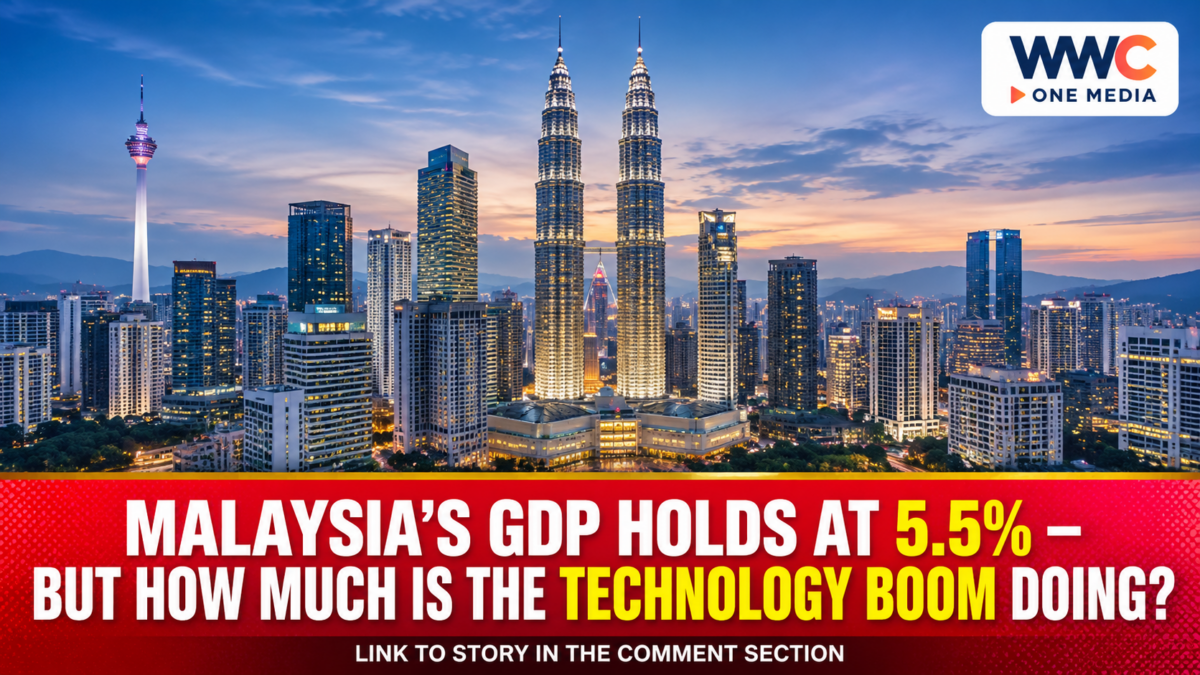
Malaysia’s economy expanded by 5.5% year on year in the third quarter of 2026, according to preliminary figures released by the Department of Statistics Malaysia on Nov. 18. The result followed 6% growth in the second quarter, while strong manufacturing and electronics exports continued to provide important support to the country’s economic activity. dosm.gov.my+1
The figures point to an economy benefiting from technology-related demand, but the story is broader than semiconductors. Services remained the main contributor to growth, domestic consumption and investment supported spending, and mining and quarrying was the exception among the major sectors.
For the Philippines and other ASEAN economies competing for manufacturing investment, Malaysia’s performance offers a useful comparison. It shows how global demand for electronics can support exports, while also highlighting the importance of a diversified economic base.
Malaysia GDP growth: What the latest figures show
The Department of Statistics Malaysia reported that GDP increased by 5.5% in the third quarter, compared with 6% in the previous quarter. On a seasonally adjusted quarter-on-quarter basis, the economy grew by 1.5%, slower than the 2.5% recorded in the second quarter.
Malaysia’s economy was valued at RM578.7 billion at current prices during the quarter. At constant prices, which adjust for price changes and are used to measure real economic output, GDP reached RM467.4 billion.
For the first nine months of 2026, the economy expanded by 5.6%, compared with 4.8% in the same period last year. That cumulative result suggests the country maintained a stronger pace of growth than in the comparable period of 2025.
The latest release also updates the earlier advance estimate. In October, the statistics department estimated third-quarter growth at 5.3%. The Nov. 18 preliminary release put the figure at 5.5%, illustrating why advance estimates should not be treated as final results.
Services remain the biggest support, while mining contracts
The services sector continued to be the main contributor to Malaysia’s economic growth. The statistics department identified private final consumption expenditure and gross fixed capital formation as the main drivers on the expenditure side.
That combination matters because it points to support from both household spending and investment. Consumer activity helps sustain demand for retail, transport, finance and other services, while investment can expand productive capacity through buildings, equipment and infrastructure.
However, growth was not uniform across the economy. Mining and quarrying was the only major sector identified as contracting in the third quarter.
The weakness in that sector is an important qualification to the headline number. A national growth rate can remain solid even when some industries face production or commodity-related difficulties.
For businesses, the sector-level picture is often more useful than the headline GDP figure alone. Companies tied to services, manufacturing or construction may experience very different conditions from those exposed to mining.
Electronics exports show why technology demand matters
Malaysia’s technology connection is particularly visible in its external trade figures.
The Ministry of Investment, Trade and Industry’s trade agency reported that total trade reached RM2.910 trillion during the first nine months of 2026, up 30.1% from the same period a year earlier. Exports rose 34% to RM1.571 trillion, while imports increased 25.7% to RM1.339 trillion. The resulting trade surplus was RM232.38 billion. MATRADE+1
Electrical and electronic products remained a major export driver. The agency said their export value increased by almost RM254 billion during the January-to-September period, supported by global semiconductor demand, investment in artificial intelligence and wider adoption of digital technologies. MATRADE
September’s figures showed the scale of that trade activity. Malaysia exported RM215.11 billion worth of goods during the month, with electrical and electronic products accounting for RM110.23 billion, or 51.2% of total exports. MATRADE
These figures do not mean that artificial intelligence alone caused Malaysia’s GDP growth. They do, however, show that demand for electronics and related products has become a significant source of export momentum.
The distinction is important. GDP measures economic activity across the entire economy, while export figures describe cross-border sales of goods and services. Strong electronics exports can support manufacturing and trade, but they do not represent the whole economy.
What Malaysia’s performance means for the Philippines
Malaysia and the Philippines compete for investment in several overlapping areas, including electronics manufacturing, semiconductor supply chains, digital infrastructure and technology-related services.
Malaysia’s latest figures underline the advantage of having an established export manufacturing base connected to global electronics demand. The Philippines also participates in international electronics supply chains, but attracting investment is only one part of the challenge.
WWC has examined the regional competition in its report on ASEAN supply-chain shifts and the Philippines’ opportunity to attract investment. The central issue is whether local firms and workers can take part in more valuable stages of production rather than relying only on basic assembly activities.
The technology boom also comes with regulatory considerations. Malaysia’s role in the regional semiconductor and data-centre landscape has brought greater attention to chip movements and export-control compliance, an issue explored in WWC’s coverage of new US licensing rules affecting advanced chip exports across Southeast Asia.
For the Philippines, the comparison is not simply about matching Malaysia’s export totals. It is about improving infrastructure, workforce skills, supplier networks and the conditions that allow local companies to move into higher-value activities.
WWC’s report on Philippine exports and the country’s exposure to the AI chip boom examines the other side of the opportunity: export growth can be substantial, but a country must also consider imported inputs and how much value remains in the domestic economy.
What happens next
The latest GDP release gives a clearer picture of Malaysia’s third-quarter performance than the earlier advance estimate. The next question is whether export momentum and domestic demand can remain strong through the final quarter of 2026.
The trade figures suggest that electronics and other manufactured goods are important parts of the growth story. However, continued reliance on global technology demand also exposes the economy to changes in international investment, semiconductor orders and trade conditions.
For businesses, the practical indicators to watch include manufacturing output, export orders, household spending, investment activity and the performance of the mining sector.
Malaysia’s 5.5% growth is a solid result, but it should not be read as proof that every industry is expanding at the same pace. The more revealing story is how services, investment and technology-linked exports are contributing differently to the economy.
Frequently asked questions
How fast did Malaysia’s economy grow in Q3 2026?
Malaysia’s GDP grew by 5.5% year on year in the third quarter of 2026, according to the preliminary figures released on Nov. 18.
What is driving Malaysia’s economic growth?
Services remained the main contributor. Private final consumption expenditure and gross fixed capital formation were the leading drivers on the expenditure side, while manufacturing and electronics exports also supported activity.
How important are electronics exports to Malaysia?
Electrical and electronic products were a major export driver. They accounted for RM110.23 billion, or 51.2% of Malaysia’s total exports in September 2026.
Did every major sector expand in Q3 2026?
No. The statistics department reported that mining and quarrying contracted, while the other major sectors recorded positive growth.
What can the Philippines learn from Malaysia’s growth?
The figures highlight the value of strong manufacturing links, technology-related exports, investment and domestic demand. For the Philippines, the challenge is to strengthen local suppliers, skills and infrastructure so more value from technology production stays in the country.