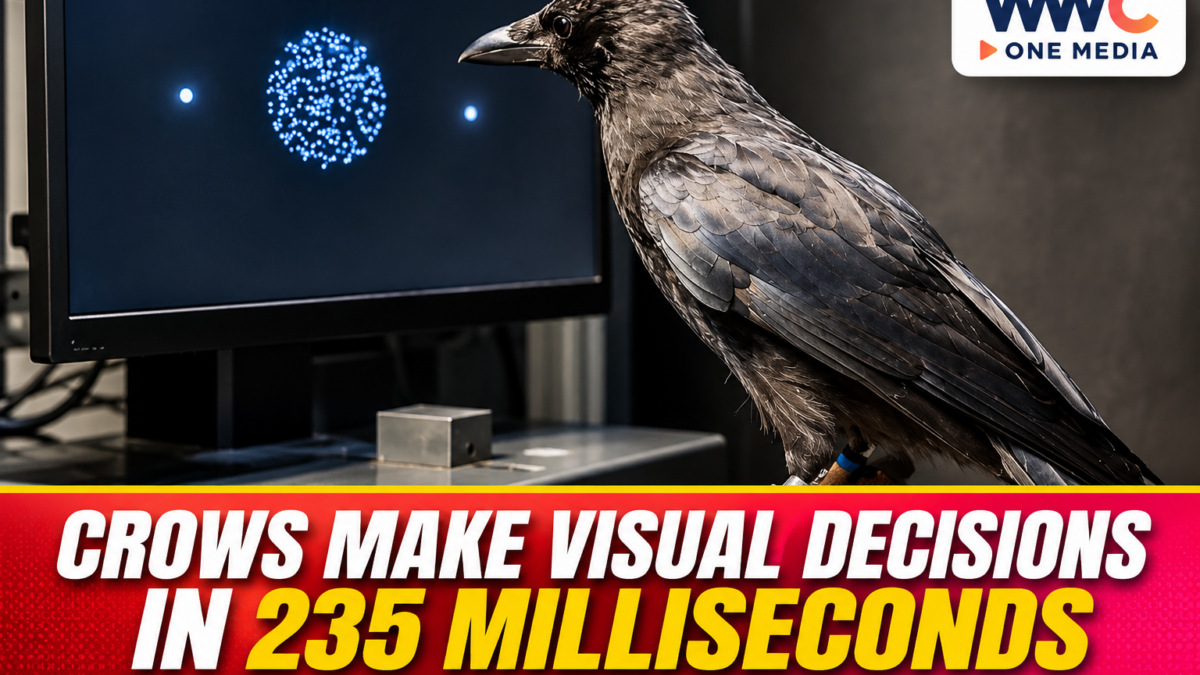
Two carrion crows completed a visual decision-making task in an average of approximately 235 milliseconds, a speed roughly twice as fast as previously observed in comparable tasks involving humans and monkeys. The findings, published in Science on Oct. 22, 2026, offer new evidence that sophisticated decision-making does not depend on having a mammal-like brain.
The result is striking, but it needs an important qualification: the experiment involved just two crows and a specific visual task. It does not establish that crows make every kind of decision faster than people, or that they are generally more intelligent.
The research instead offers a closer look at how a bird’s brain can rapidly interpret visual information, weigh evidence and prepare a response. It also challenges assumptions that complex cognitive processing must rely on the same brain structures found in humans.
A touchscreen task revealed how quickly crows process visual information
The experiment, led by Philipp Schmidbauer and Professor Andreas Nieder at the University of Tübingen’s Institute of Neurobiology, involved two carrion crows (Corvus corone). The researchers presented moving dots on a touchscreen and trained the birds to identify whether the overall movement was towards the left or right. PubMed+1
The crows indicated their answers by pecking a target on the corresponding side of the screen. Researchers varied the visual information available, making some patterns easier to interpret than others.
When the direction was difficult to identify, the birds still performed better than random guessing. When the visual signal was clear, their accuracy approached 100%, the university’s research announcement said.
The average decision time was approximately 235 milliseconds. That is less than a quarter of a second, demonstrating how quickly the birds could interpret the visual pattern and indicate a choice.
The comparison with humans and monkeys comes from previously observed results in comparable visual decision-making tasks. The researchers did not conduct a simultaneous experiment in which people, monkeys and crows completed precisely the same test under identical conditions. PubMed+1
That limitation matters. The findings demonstrate exceptional speed in one controlled task, not a universal ranking of intelligence across species.
Brain activity began signalling a choice within 70 milliseconds
The researchers also investigated what was happening inside the birds’ brains while they performed the task.
Their recordings identified activity in a region of the avian brain called the nidopallium caudolaterale, commonly abbreviated as NCL. The region is associated with higher-level processing and has functional similarities to the prefrontal cortex in humans and other primates.
Neural signals associated with the direction the birds would choose became distinguishable approximately 70 milliseconds after the visual stimulus appeared. This was around 170 milliseconds before the birds made their physical response. PubMed+1
In simpler terms, the researchers could detect information about the crows’ upcoming choice in their brain activity well before the birds pecked the screen.
The signals also changed as the birds processed the available visual evidence. Their activity increased during the decision process until it reached a level associated with the response.
This is important because the findings suggest that crows do not simply react automatically to whichever direction appears most obvious. Their brains appear to accumulate visual information before producing a choice.
Why the discovery challenges assumptions about bird intelligence
Birds and mammals have different evolutionary histories and differently organised brains.
Humans and other mammals have a layered cerebral cortex. Birds do not have the same layered cortical structure, yet the study found neural activity consistent with decision-making processes previously described in primates.
That does not mean a crow’s brain is simply a smaller version of a human brain. Instead, it suggests that different brain architectures can support comparable ways of processing information.
The research adds to a growing body of scientific work examining the cognitive abilities of birds, particularly members of the corvid family, which includes crows and ravens.
Other research has examined how birds solve problems, learn from their surroundings and respond to changing conditions. The new findings add a measurable neural dimension: how quickly a bird can process a visual signal and turn it into a deliberate response.
For readers interested in how birds interact with their environments, WWC has also covered the unusual gathering of nine Nicobar pigeons in Palawan and the rare yellow-bellied warbler recorded in Singapore. These are different stories, but they illustrate the range of questions that bird behaviour and observation can raise.
Does faster decision-making mean crows are more intelligent than humans?
Not necessarily.
Decision speed is only one component of cognition. Intelligence involves several abilities, including learning, memory, problem-solving, planning, communication and adapting to unfamiliar situations.
A bird that responds quickly to a moving visual pattern has demonstrated a particular strength. That result does not establish that it would outperform a human in mathematical reasoning, language, long-term planning or other complex activities.
The study also involved only two individual crows. While the findings provide detailed evidence about their performance and brain activity, a larger sample would help researchers determine how consistently the same results appear across the species.
The task itself was also tightly controlled. Identifying the predominant direction of moving dots on a screen is very different from making decisions in everyday situations involving social relationships, unfamiliar objects or competing long-term goals.
The careful conclusion is therefore not that crows are smarter than people. It is that their brains can perform a specific type of visual decision-making remarkably quickly while maintaining accuracy.
That distinction makes the discovery scientifically valuable without overstating what the experiment proves.
What happens next?
Further research will be needed to establish whether the same speed advantage appears in other types of decisions and whether it is shared widely among crows or other bird species.
Scientists will also need to investigate exactly which biological features allow avian neural circuits to process information so rapidly. The researchers have suggested that the demands of flight and precise visual coordination may have contributed to the evolution of fast processing, but the study does not establish a single explanation.
The findings could also encourage broader comparisons between the brains of birds and mammals. Studying different evolutionary solutions to similar cognitive challenges may help researchers understand which principles of decision-making are shared across animals.
For now, the strongest finding is also the most precise: two carrion crows identified a visual motion pattern and indicated their choices in an average of approximately 235 milliseconds.
That is a remarkable result. But the bigger scientific question is not simply how quickly a crow can choose left or right. It is how a differently organised brain can make a decision so efficiently.
Frequently Asked Questions
How fast can crows make decisions?
In the visual motion experiment, two carrion crows made and reported their choices in approximately 235 milliseconds on average.
Are crows faster than humans at making decisions?
The study found that the crows were roughly twice as fast as humans and monkeys in comparable visual decision-making tasks. It did not establish that crows are faster at every kind of decision.
What type of crows participated in the experiment?
The study involved carrion crows, scientifically known as Corvus corone.
Which part of the crow’s brain was studied?
Researchers recorded activity in the nidopallium caudolaterale, or NCL, a brain region involved in higher-level information processing and decision-making.
Does the research prove that crows are smarter than humans?
No. It demonstrates exceptional performance in one visual decision-making task. Intelligence involves many abilities, and the experiment does not compare overall intelligence between humans and crows.