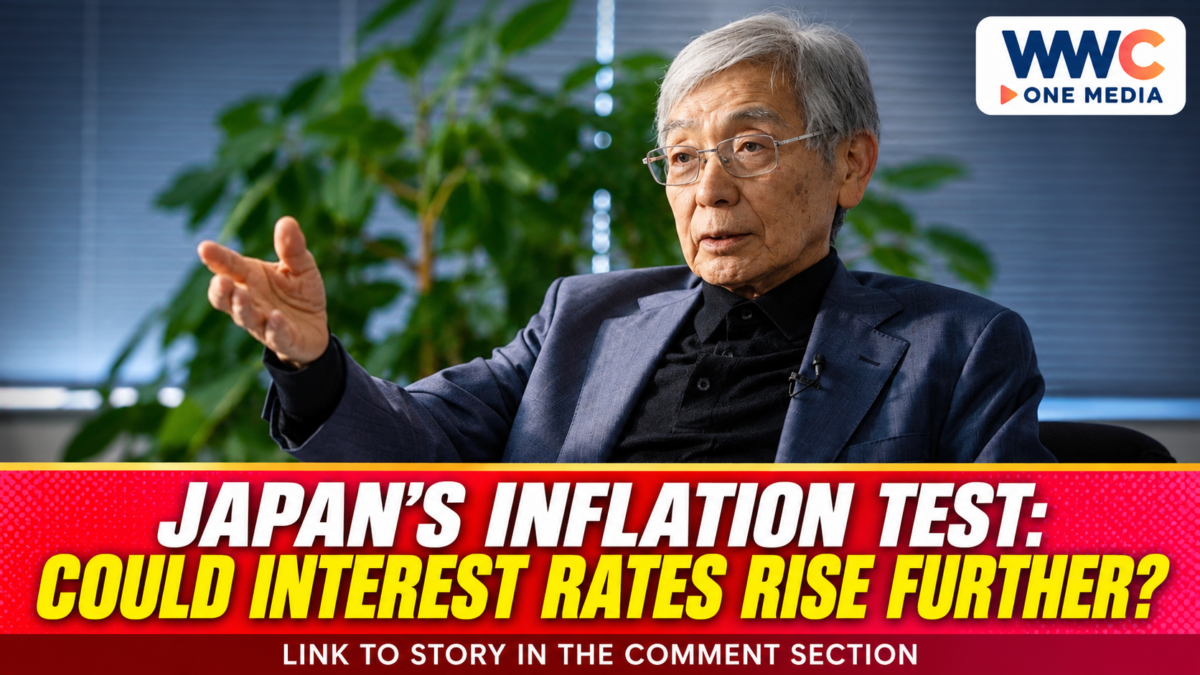
Japan’s central bank has kept the possibility of further interest-rate increases open as it assesses whether inflation can remain sustainably near its 2% target. Its October 2026 outlook, released in full on Nov. 2, shows why policymakers face a difficult decision: underlying inflation is broadly consistent with the target, but energy costs, artificial intelligence-related demand and currency movements could push prices higher.
The Bank of Japan’s assessment is important because it provides the official policy framework against which public comments by former governor Haruhiko Kuroda should be understood. Kuroda no longer sets monetary policy. Decisions remain with the current Policy Board under Governor Kazuo Ueda.
The BOJ sees inflation near its target, but risks remain
The central bank’s October outlook describes underlying consumer-price inflation as generally consistent with its 2% price-stability target.
However, it expects the year-on-year increase in the consumer price index excluding fresh food to remain clearly above 2% for a period. The BOJ identifies higher semiconductor prices, AI-related demand, the yen’s depreciation and crude-oil costs among the factors influencing prices.
Its projections put core CPI inflation at 2.5% for fiscal 2026, 2.6% for fiscal 2027 and 2.0% for fiscal 2028.
The bank also warns that inflation expectations could rise if businesses continue adjusting wages and prices in ways that push underlying inflation above the target. 日本銀行ホームページ+1
Why the central bank has not committed to a fixed rate path
The BOJ’s position is not an unconditional promise to increase rates at every meeting.
Its October outlook says the timing and pace of adjustments will depend on economic activity, prices and financial conditions. Policymakers will also assess risks surrounding the baseline economic forecast, including developments in the Middle East, AI-related demand and foreign-exchange markets.
That approach leaves room for the bank to respond if inflation accelerates, but it also allows policymakers to slow down if economic conditions deteriorate.
The distinction matters because a policy rate that is appropriate under persistent inflation may become too restrictive if household spending and business investment weaken significantly.
Policy-board discussions reveal the disagreement
The BOJ’s Nov. 10 Summary of Opinions from its Oct. 29–30 meeting provides a clearer view of the debate.
The document records concerns about persistent inflation, labour shortages and the relationship between wage increases and consumer prices. It also highlights weak momentum in private consumption, even as employment and income conditions have improved.
One policy-board opinion argued that Japan’s neutral interest rate was considerably above 1%. Other comments focused on the possible effects of another increase on business fixed investment and housing investment.
These are individual views recorded in the meeting summary, not a collective decision to raise rates to a particular level. 日本銀行ホームページ
What this means for households and businesses
Higher interest rates can increase borrowing costs for households with variable-rate mortgages and companies relying on loans to finance expansion.
They can also improve returns on some savings products and help moderate demand-driven inflation over time.
But the effects are not immediate or identical across the economy. Banks determine their own lending and deposit rates, while the impact on borrowers depends on loan terms, repricing schedules and financial circumstances.
For businesses, the central question is whether wage growth and consumer demand can remain strong enough to support investment while financing becomes more expensive.
What happens next?
The BOJ’s next policy decisions will depend on incoming inflation, wage, consumption and financial-market data. Its October outlook does not establish a fixed timetable or final destination for interest rates.
The December policy meeting will therefore be an important point for investors and borrowers watching Japan’s transition away from exceptionally accommodative monetary conditions.
For now, the official record supports a clear conclusion: the BOJ is prepared to continue adjusting monetary accommodation, but it intends to assess the economy and inflation risks before deciding how quickly to move.
The key question is no longer simply whether Japan can reach 2% inflation. It is whether the country can keep inflation stable without making the cost of borrowing too heavy for households and businesses.