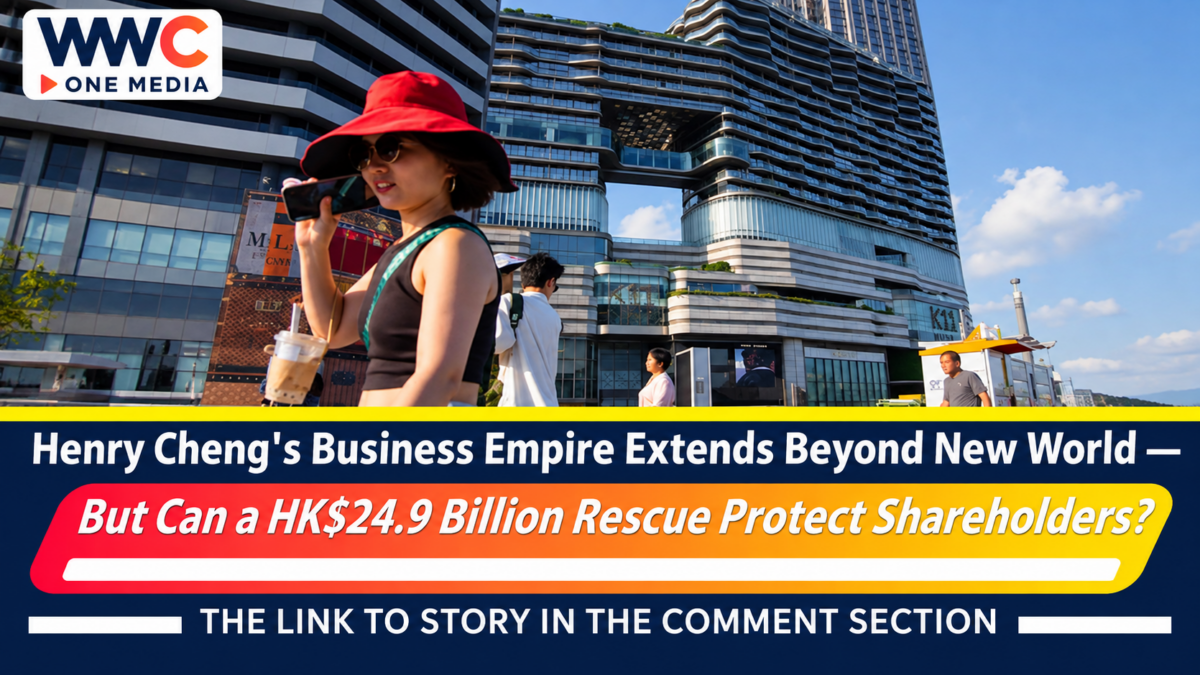
HONG KONG — New World Development, a property group controlled by the Cheng family’s Chow Tai Fook Enterprises, proposed raising approximately HK$24.9 billion on Nov. 15, 2026, through a heavily discounted rights issue. The Henry Cheng business empire also includes sizeable interests outside property development, but the listed company’s new financing plan shows why family wealth and cash available to a particular business are not interchangeable.
The public record provides a clearer way to examine the family’s commercial position than a headline estimate of personal wealth: who controls each company, what its accounts show and which investors must supply money when a business needs fresh capital.
Henry Cheng business empire: The ownership chain matters
New World’s Nov. 15 exchange filing names Chow Tai Fook Enterprises as its controlling shareholder. That company is indirectly owned through Chow Tai Fook Capital, which is in turn held principally by two Cheng family holding companies.
The filing shows Chow Tai Fook Enterprises directly holding approximately 41.14% of New World’s issued shares at the announcement date. The broader controlling-shareholder group and concert parties together held approximately 45.59%.
Neither percentage means Henry Cheng personally owns all the listed developer’s assets. New World has minority investors, lenders and obligations of its own. Its controlling shareholders may exert substantial influence, but that is distinct from a personal claim on every dollar reported on its balance sheet.
Earlier listed-company disclosures also document Chow Tai Fook Enterprises’ ownership relationship with the infrastructure business formerly known as NWS. The structure underscores why the family portfolio cannot be evaluated by observing just one property company’s share price.
The proposed rights issue could dramatically expand share capital
New World proposed issuing 27,682,964,881 new shares at HK$0.90 each, with eleven new shares offered for every existing share held by an eligible shareholder. Gross proceeds would be approximately HK$24.9 billion, with estimated net proceeds of HK$24.1 billion.
The announced subscription price represented an approximately 81.5% discount to the HK$4.87 closing share price used in the filing. But the relevant comparison for shareholders also includes the theoretical ex-rights price and the number of new shares being created.
The company said its existing 2,516,633,171 shares could expand to 30,199,598,052 if the transaction is completed on the proposed basis. This is why the financing has unusually large implications for ownership and dilution.
Analysis: Investors who do not participate may see their relative percentage ownership fall substantially. Participation requires paying for more shares; neither choice guarantees that the company’s share price or operating performance will improve.
How the new money is intended to be used
New World’s proposal covers approximately HK$82 billion in targeted bank facilities. It would use proceeds to prepay 10% of the outstanding principal, while the remaining 90% would have its final maturity extended by two years under the proposed lender arrangements.
The company allocated approximately HK$8.2 billion of expected net proceeds to that prepayment, HK$8.7 billion to debt servicing and liability management, and HK$7.2 billion to development projects. The amounts and proportions are intentions disclosed before completion, not expenditures already made.
New World also said that binding agreements from all affected lenders are a condition of the rights issue. Shareholder approvals and other conditions are required, so the transaction should not be described as completed.
The pressures echo the financing questions considered in WWC’s coverage of property-linked Chinese dollar bonds. That is sector context, not evidence that the two corporate borrowers share identical finances.
The property developer’s accounts show why funding is needed
New World’s financial highlights for the year ended June 30, 2026, show revenue of HK$19.99 billion and a reported annual loss of approximately HK$26.82 billion. The company attributed much of that loss to non-cash impairment and provisions relating to its 11 SKIES project.
It reported HK$126.31 billion in consolidated net debt, compared with approximately HK$120.11 billion a year earlier. Its net gearing ratio increased to 68.3% from 58.1%.
The company also reported approximately HK$17 billion in cash and bank balances, including restricted amounts, and around HK$16 billion in undrawn bank facilities. These items are not equivalent to freely available cash, and the total does not erase existing liabilities.
Analysis: Selling assets or raising equity can improve near-term liquidity, but a durable recovery would also require sufficient operating cash generation and manageable financing costs. Property-market conditions therefore remain important, as examined in WWC’s report on Hong Kong’s housing-market recovery.
Jewellery profits tell a different operating story
Chow Tai Fook Jewellery Group’s own June 11 release reported HK$94.40 billion in revenue for the financial year ended March 31, 2026, up 5.3%. Profit attributable to shareholders reached approximately HK$9.00 billion, up 52.2%.
Henry Cheng is chairman of the separately listed jewellery company. Its reported results demonstrate that businesses associated with the wider family network can perform differently from New World.
That contrast also connects with WWC’s coverage of Hong Kong’s jewellery retail market. Demand for jewellery and demand for new residential property are not the same market.
Crucially, profit at a separate company does not automatically become money New World may spend. Dividends, ownership arrangements and corporate decision-making determine how funds can move within a business network.
What happens next
New World’s filing provides a timetable for shareholder eligibility and a proposed extraordinary general meeting process, with the meeting record date falling around the turn of the year. The decisive questions are whether required approvals are obtained, lenders sign the relevant agreements and the rights issue completes on its announced terms.
The filing illustrates scenarios in which the family-linked group’s interest stays broadly unchanged if shareholders take up their allocations, or rises to approximately 72.55% if other shareholders do not participate and the underwriters take the remaining shares under the specified assumptions. These are scenarios, not a completed ownership change.
The public filings establish a diversified corporate network and an urgent financing proposal. They do not independently verify a US$27 billion personal-fortune estimate or show that family assets outside New World are available to settle its debts.
FAQ
What is New World’s proposed rights issue?
It proposes eleven new shares for every existing share at HK$0.90 each, seeking approximately HK$24.9 billion before expenses, subject to conditions and approvals.
Does Henry Cheng personally own all of New World Development?
No. The listed developer has public shareholders. Chow Tai Fook Enterprises is its controlling shareholder within a wider family-linked ownership structure.
How much net debt did New World report for June 2026?
Approximately HK$126.31 billion, according to its official full-year financial highlights.
Is Chow Tai Fook Jewellery the same company as New World?
No. They are separate listed businesses within a wider network of family-linked interests, with distinct finances and shareholder rights.
Is the Cheng family’s reported US$27 billion fortune verified?
Not by the primary corporate disclosures reviewed. An individual or family net-worth estimate requires valuation assumptions beyond listed-company financial statements.