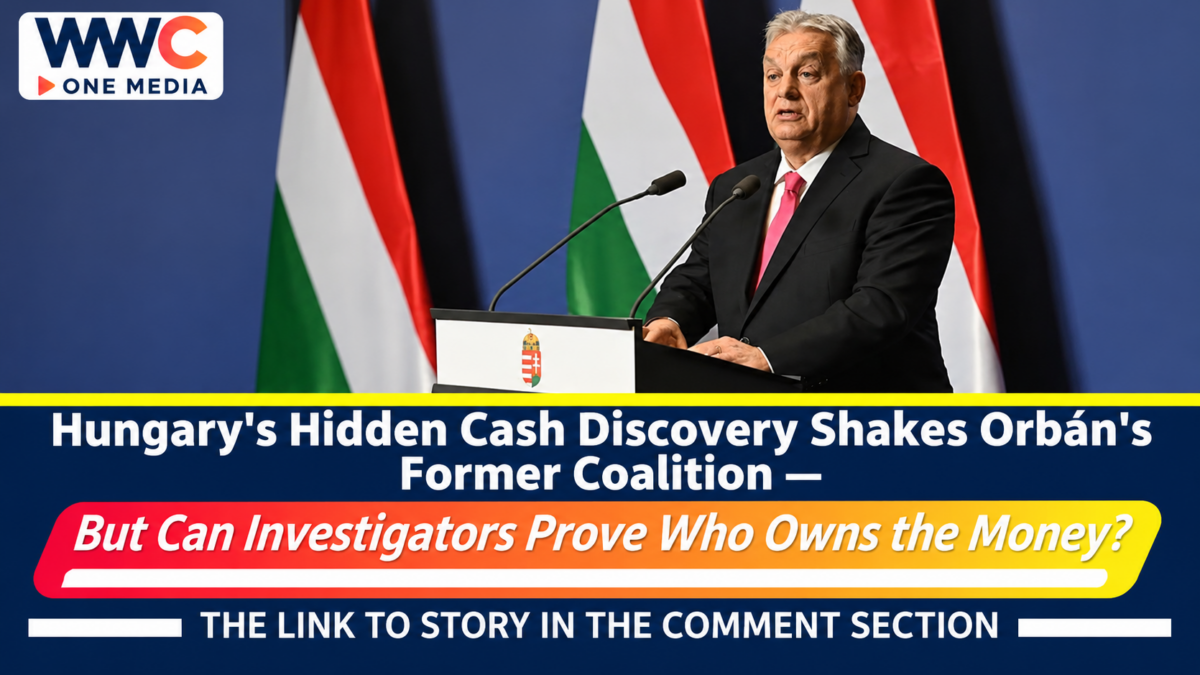
BUDAPEST, Hungary — Hungarian investigators recovered large quantities of concealed cash during searches on Nov. 12–13, 2026, as part of criminal proceedings involving former national development minister Miklós Seszták. Prime Minister Péter Magyar used a Nov. 16 parliamentary address to demand accountability from the former governing parties, while their leaders insisted that individual allegations must be decided through a fair legal process.
The Hungary hidden cash case now raises two separate questions: where the recovered funds came from, and whether the investigation will establish any person’s criminal responsibility. The recovery is documented in a formal investigative-office announcement. Ownership and guilt, however, cannot be inferred from the appearance of banknotes or the intensity of the political response.
Hungary hidden cash: What investigators actually recovered
Hungary’s National Asset Recovery and Protection Office announced that coordinated searches had taken place in Budapest and the counties of Pest, Békés and Nógrád. The searches were conducted on Nov. 12 and 13 in the course of proceedings concerning Seszták, who previously served as national development minister.
The office listed 5,071,632,000 Hungarian forints, €2,658,350 and US$1,257,100 in recovered cash. It described money found in forest locations, agricultural and storage buildings, residential premises and a concealed safe. The agency also said the funds had been deposited with the Hungarian State Treasury.
The announcement does not establish that all the cash belonged to Seszták or that the money represented proceeds of a particular proven crime. Such conclusions require the underlying financial evidence and the outcome of legal proceedings.
The underlying investigation concerns public contracts
The investigating authorities’ published account concerns alleged bribery connected to passenger transport services, bus procurement and other public projects. Prosecutors described suspected payments involving contracts associated with Volánbusz and companies doing business with public institutions.
Their account alleged that Seszták and a former state-asset-management executive received more than 11 billion forints in improper benefits through intermediaries between 2015 and 2018. This is an allegation arising from an investigation, not a court finding that those sums were received or that the recovered cash represents the same funds.
A separate official account records the suspension of Seszták’s parliamentary immunity on Sept. 28 and a court order for his detention on Sept. 30. Detention is a procedural measure; it is not a conviction. The official records reviewed do not include a full first-person response from Seszták or a final judgment on the alleged conduct.
Analysis: Investigators will need records showing where money originated, who controlled it and whether payments corresponded to any unlawful transaction.
Péter Magyar turns the case into a parliamentary challenge
In his Nov. 16 address to parliament, Prime Minister Péter Magyar argued that the recovered money should be considered in the context of unmet public needs. He called on lawmakers associated with the former government to accept political responsibility and relinquish their mandates.
His remarks are an official record of the prime minister’s political position. They are not a judicial determination that the former governing parties, their members or Viktor Orbán personally owned the money or directed any suspected offence.
The dispute comes after a change in government and amid wider scrutiny of decisions made under the previous administration. A distinct investigation involving Orbán’s younger brother and suspected residence-permit abuses has drawn similar arguments about accountability and political motivation.
Fidesz and Christian Democrats call for due process
The former governing coalition has not responded with one simple position. On Nov. 14, Fidesz parliamentary leader János Bóka called on Seszták to surrender his parliamentary mandate, while stressing that investigators and courts must establish what happened and who is responsible.
Christian Democratic parliamentary leader Bence Rétvári also urged Seszták to step down and clear his name through the authorities. He rejected portraying the entire political alliance as a criminal organisation because one of its members faces an investigation.
In a separate Nov. 15 party statement, Fidesz questioned the handling of the recovered-money case and alleged that the government’s public presentation was politically motivated.
Analysis: Calls for a resignation concern political confidence. Criminal guilt requires a different standard and process. A lawmaker can face pressure to leave office before a trial, but that pressure does not answer whether the legal accusations are true.
Why asset recovery requires more than discovering cash
The asset-recovery office’s announcement confirms physical recovery and transfer of funds to the Treasury. It does not establish that the government can permanently spend the money, that the funds have been forfeited following a judgment, or that particular public contracts have been legally invalidated.
A sound process must preserve relevant evidence and permit the courts to examine competing claims.
These challenges also appear in the government’s separate attempt to examine a long-term motorway concession agreed during the previous administration. Contract scrutiny, asset recovery and criminal liability involve different legal mechanisms even where debates over public spending overlap.
The change in political direction is also evident in Hungary’s stricter oversight of major battery-sector investors. Regulatory enforcement against businesses, however, should not be confused with the allegations in this criminal case.
What happens next
The critical next records would be formal charges or prosecutorial updates identifying alleged transactions, judicial decisions on detention and evidence, and any lawful decision about the disposition of seized assets. Documents establishing the money’s ownership would be particularly important.
The political dispute may continue independently. Magyar can press for resignations, and opposition parties can challenge his interpretation, but neither side’s rhetoric settles the criminal questions.
For now, the public record establishes the recovery of three precisely reported currency amounts during a named investigation. It does not establish that Fidesz possesses a secret party fund, that Orbán controlled the cash, or that Seszták has been convicted.
FAQ
How much cash did Hungarian investigators recover?
The official statement reports 5,071,632,000 forints, €2,658,350 and US$1,257,100 recovered during Nov. 12–13 searches.
Was the money proven to belong to Miklós Seszták?
No. The recovered money was identified during proceedings involving Seszták, but publicly reviewed primary records do not establish ownership or a final judicial finding of guilt.
What did Prime Minister Péter Magyar demand?
In his Nov. 16 parliamentary speech, he called for political accountability and the resignation of lawmakers associated with the former governing parties.
What was the response from Fidesz and the Christian Democrats?
Their parliamentary leaders urged Seszták to relinquish his seat while emphasising due process and rejecting collective guilt for the political alliance.
Does the recovery mean the government can spend the money?
The office said the funds were deposited with the State Treasury. Deposit and custody do not, by themselves, establish final forfeiture or permission to spend the funds.