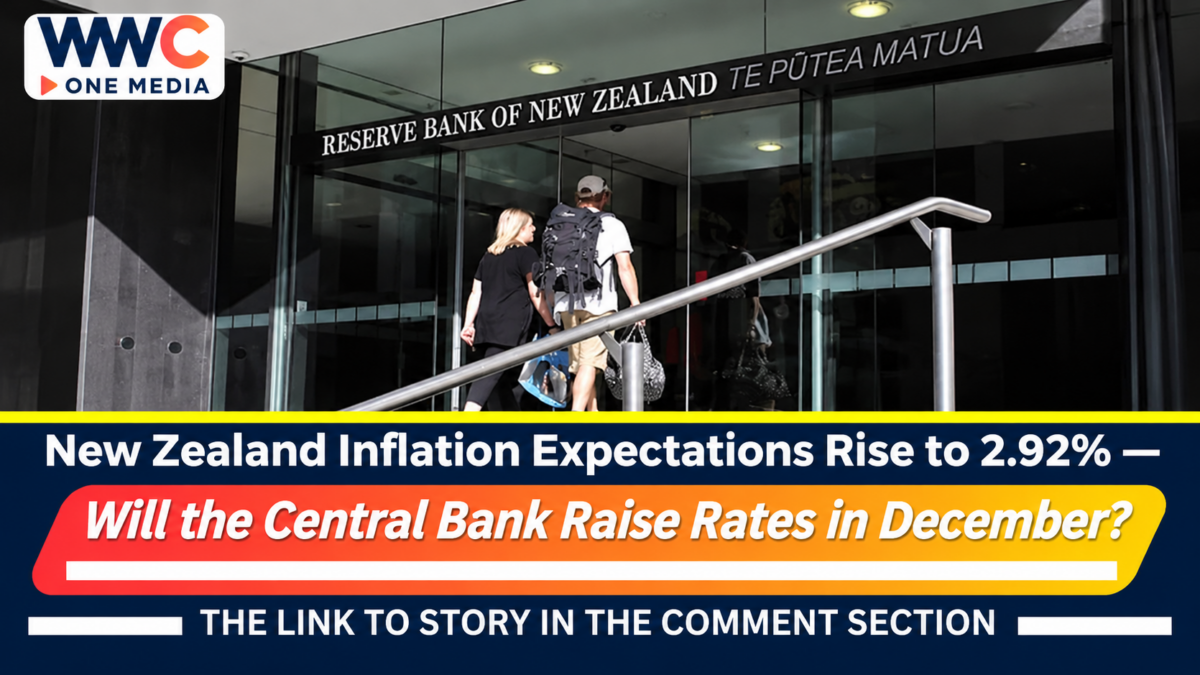
WELLINGTON, New Zealand — The Reserve Bank of New Zealand reported on Nov. 17, 2026, that one-year-ahead inflation expectations rose to 2.92%, while expectations over two years edged up to 2.36%. The latest New Zealand inflation expectations survey shows mounting concern about prices in the nearer term but more stable views of inflation five and ten years ahead.
The difference matters before the central bank’s next interest-rate decision. Survey responses do not determine policy by themselves, but they help reveal whether businesses and forecasters expect price increases to persist long enough to influence decisions about wages, investment and borrowing.
New Zealand inflation expectations: Four horizons, two stories
The quarterly survey reported that the mean one-year-ahead forecast increased by 32 basis points, from 2.60% in the previous survey to 2.92%. Two-year-ahead expectations increased only two basis points, from 2.34% to 2.36%.
The longer horizons moved in the opposite direction. Five-year-ahead expectations declined from 2.31% to 2.17%, while ten-year-ahead expectations slipped from 2.20% to 2.13%.
The survey received 44 responses after fieldwork began Oct. 23. These are average forecasts, not observed prices.
Analysis: The near-term increase matters because recent costs can influence expectations. But it would be misleading to describe the entire forecast horizon as deteriorating when the two longest measures declined.
Why being above 2% is not the same as losing control
New Zealand’s monetary-policy framework targets annual inflation between 1% and 3% over the medium term, with a 2% midpoint. A two-year expectation of 2.36% remains above the midpoint but inside the target range.
The longer horizons are also near the midpoint, although this survey does not represent every household.
The October monetary-policy decision described medium-term inflation expectations as remaining anchored. Today’s results provide a more detailed picture: the shortest horizon has moved upward, but there is no corresponding surge in the five- or ten-year averages.
WWC previously examined the central bank’s concern about inflation expectations. That earlier coverage used the preceding survey, making the Nov. 17 release a meaningful new data point rather than confirmation of a forecast made earlier.
Actual inflation remains above the target band
New Zealand’s September-quarter consumer-price data showed annual inflation of 3.7%, down from 4.1% in the June quarter. Annual tradables inflation was 4.3%, while non-tradables inflation was 3.3%.
Petrol prices rose 19.1% over the year, and electricity prices increased 9.3%.
These are measured price changes, not survey expectations. It is important to keep them separate: a recent 3.7% CPI reading can influence forecasts without implying that respondents expect inflation to remain at that level indefinitely.
Analysis: The challenge for policymakers is whether higher fuel and other costs will gradually fade or become embedded in broader pricing and wage decisions. Their response depends on the outlook, not simply on the largest monthly or quarterly price movement.
What respondents expect for interest rates and growth
The November survey put the mean expected Official Cash Rate at the end of the December 2026 quarter at 3.05%. Respondents’ mean one-year-ahead OCR expectation increased from 3.21% to 3.40%.
The same survey put one-year-ahead expected unemployment at 5.24%, unchanged from the previous round. Expected unemployment two years ahead dipped from 4.90% to 4.85%, while expected real production GDP growth was 2.34% one year ahead and 2.59% two years ahead.
These are respondents’ forecasts, not observed economic outcomes.
Higher rates could constrain demand while increasing debt-servicing costs.
Why December is a genuine policy decision, not a certainty
On Oct. 28, the Reserve Bank’s Monetary Policy Committee voted four to three to keep the Official Cash Rate at 2.75%. Three members preferred raising it by 25 basis points to 3%.
The committee concluded that further tightening was likely to be required but remained conditional on the economic outlook. It also projected that annual inflation could reach 4.4% in the December quarter, largely on the assumptions then used for fuel prices. That was a forecast, not an observed outcome.
The difference between a survey forecast of 3.05% for the OCR and today’s 2.75% policy setting cannot be treated as a binding policy announcement. The survey captures expectations; the committee makes the decision.
Global conditions also matter. WWC’s examination of US-dollar pressure and Australasian currencies provides useful context for how international rates can affect financial markets. However, currency movements and imported inflation do not mechanically dictate a New Zealand rate change.
What the data mean for Philippine readers
Analysis: Filipinos with New Zealand-related education, travel or business expenses should distinguish expectations of future inflation from current exchange rates and retail prices. None of the survey’s percentages is a direct forecast of the peso cost of a New Zealand purchase.
WWC’s coverage of a sharp New Zealand dollar rebound illustrates why currency moves should not be extrapolated into guaranteed trends.
The broader lesson is that central banks look for persistence, not simply a single alarming observation. The survey’s contrasting short- and long-term readings offer evidence for both caution about immediate inflation and some confidence in the longer-term framework.
What happens next
The next Reserve Bank monetary-policy decision is scheduled for Dec. 9, 2026. Officials will consider incoming evidence on prices, demand, employment and financial conditions before deciding whether to hold or tighten policy.
The next quarterly expectations survey is scheduled for Feb. 18, 2027. Its results will help show whether the latest increase in one-year forecasts was temporary or part of a longer-lasting change.
The strongest conclusion today is limited but useful: short-term inflation concerns have increased, while longer-term expectations remain relatively close to the 2% midpoint. The survey neither guarantees a December hike nor proves that price pressures have disappeared.
FAQ
What are New Zealand’s latest inflation expectations?
The November survey reported 2.92% one year ahead, 2.36% two years ahead, 2.17% five years ahead and 2.13% ten years ahead.
Are inflation expectations above the RBNZ target?
The surveyed averages are above the 2% midpoint, but each is within the bank’s 1%–3% medium-term target range. Expectations are not the same as actual CPI inflation.
What is New Zealand’s current inflation rate?
Annual CPI inflation measured 3.7% in the September 2026 quarter, down from 4.1% in June.
Will the RBNZ increase interest rates in December?
A decision is scheduled for Dec. 9. The committee held rates at 2.75% in October by a 4–3 vote; the November survey does not determine its next vote.
When will the next inflation expectations survey be released?
The central bank lists Feb. 18, 2027 as the next scheduled release.