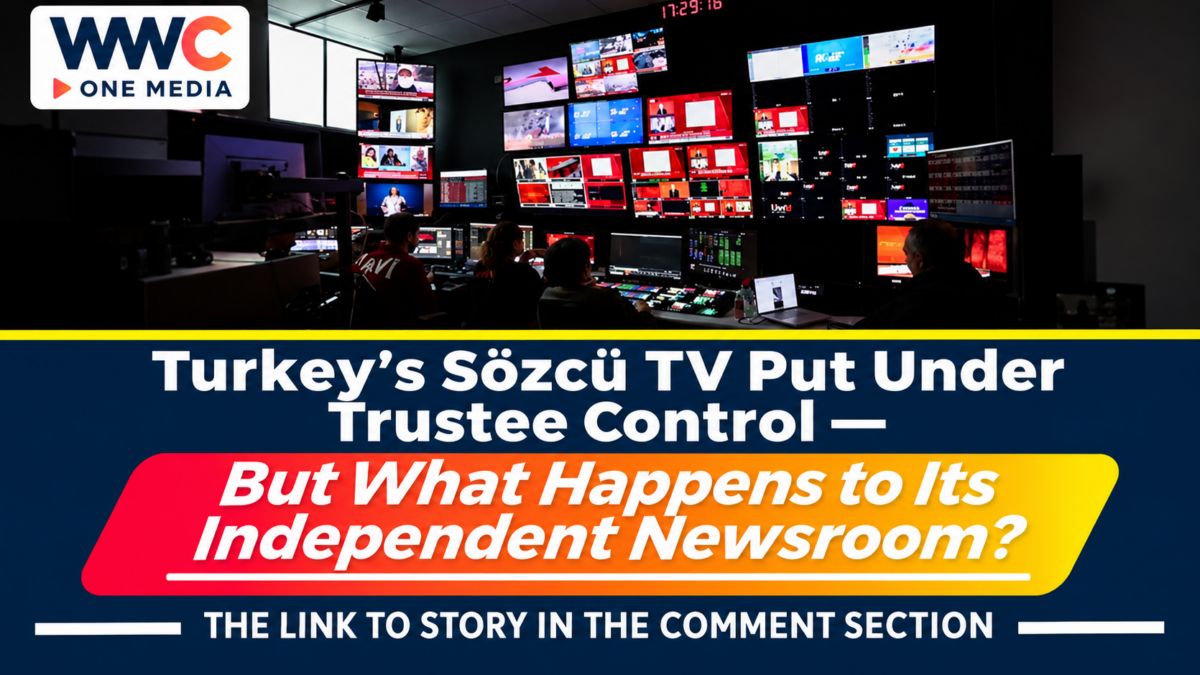
ISTANBUL, Turkey — Sözcü TV and the Sözcü news website were placed under trustee control on Tuesday, Nov. 17, 2026, the media group’s own published notice confirmed. Police searched the broadcaster’s premises, and the group reported that some managers had been detained.
The Sözcü TV trustee development raises an immediate question beyond the police operation: who will make editorial and business decisions at a newsroom whose work reaches audiences through television and online news? The public record establishes the intervention’s reported scope, but not yet the full legal reasoning or its consequences for daily coverage.
What the Sözcü TV trustee announcement confirms
The group’s Nov. 17 announcement identified two affected operations: Sözcü TV and Sözcü.com.tr. It also expressly distinguished those businesses from the Sözcü, Tavır and Korkusuz newspapers, which the announcement said had not been placed under trusteeship.
That distinction matters. A media group may operate across broadcasting, digital publishing and printed newspapers, but an action concerning one part of a group cannot automatically be described as taking control of every publication associated with it.
The announcement also described a police search at the television operation and detentions involving managers. It did not, in the accessible notice, reproduce the full court order, set out an exhaustive list of alleged offences or provide a final judicial finding against any individual.
Why trusteeship is different from a routine media dispute
A trusteeship affects corporate control. Unlike a disagreement about programme content or a regulatory warning, it creates questions about who is authorised to manage an organisation and exercise powers normally held by its existing leadership.
For a television channel, management decisions may affect budgets, contracts, staffing and the continuity of broadcasting. For a digital news operation, they can also affect publishing systems, operational oversight and the practical ability to distribute reporting. These are possible consequences of a change in control, not verified changes already made at Sözcü.
The central editorial issue is therefore practical as well as legal: can journalists continue selecting and reporting stories independently while the organisation’s management is under a trustee? The Nov. 17 notice does not establish what instructions, if any, have been issued to the newsroom.
That distinction between potential pressure and documented interference is vital. Debate about the chilling effect of legal rules on journalism is familiar to Philippine readers, but the Turkish proceedings must be judged on their own documents and facts.
Turkey’s parliament had already raised the wider issue
The question of trustee control over media companies did not begin with this week’s announcement. An entry on the Turkish Grand National Assembly’s official website records a parliamentary research proposal submitted on May 15, 2026, by Adana lawmaker Burhanettin Bulut and 19 other lawmakers.
The proposal called for an inquiry into the consequences of media organisations being taken over and placed under trusteeship by the Savings Deposit Insurance Fund, known by its Turkish abbreviation TMSF. The parliamentary record lists the proposal as on the agenda; it does not say that the proposed investigation had reached findings.
Still, the official record provides context for the latest intervention: the balance between legal enforcement, business management and the public’s access to different news voices was already an issue for lawmakers before Nov. 17.
What this could mean for press freedom
Analysis: A newsroom’s independence depends on more than whether its cameras remain on or its website can be reached. It also depends on whether editors can make professional decisions without improper pressure and whether staff can publish material of public interest.
Equally, a court-supervised corporate process should not be characterised as censorship solely because the organisation involved publishes critical journalism. Establishing that conclusion would require the order, the evidence relied upon, the applicable legal provisions and a documented account of how the measure is being implemented.
The public interest is served by both standards: meaningful scrutiny of state power and fair treatment of allegations that have not been tested to a final judgment. Readers deserve to know what is demonstrated by a document, what is claimed by a party and what remains unsettled.
For Philippine audiences, the episode also illustrates why debates over laws affecting freedom of expression must consider actual enforcement safeguards, not only stated intentions. Turkey’s legal system and the Philippines’ are different; the relevant comparison is the principle of protecting independent reporting while observing due process.
Why the distinction between business and editorial control matters
Business control and editorial control are related, but they are not identical. A trustee may be responsible for corporate administration; that fact alone does not establish that scripts have been rewritten, programmes cancelled or reporters ordered to avoid particular subjects.
Such developments would require their own evidence. The original announcement provides no complete public inventory of staffing changes, broadcast decisions, website restrictions or future management plans. It would therefore be premature to describe a comprehensive editorial shutdown.
These questions connect to the wider democratic principle discussed in WWC’s coverage of government commitments to defending press freedom: the measure of protection is not simply a public pledge, but whether institutions allow reporting and legitimate scrutiny to continue in practice.
What happens next
The next meaningful development would be publication or reliable public access to the relevant court order and its precise scope. That would allow observers to distinguish the legal powers actually granted from assumptions about what a trustee may do.
Official clarification of the allegations, the status of detained individuals and any available review or appeal process would also help establish where the case stands. Until such information is verified, neither wrongdoing nor political motive should be treated as a judicially established fact.
The immediate confirmed position remains narrower: the media group’s notice says Sözcü TV and its website were affected, while three named newspapers were not. Whether the intervention changes editorial decisions, staffing or the availability of news will require additional documentary evidence rather than inference.
FAQ
What happened to Sözcü TV on Nov. 17, 2026?
The media group’s own notice said Sözcü TV and Sözcü.com.tr were placed under trustee control. It also reported a police search and detentions involving managers.
Does the action include the Sözcü newspaper?
The group’s published announcement said the Sözcü, Tavır and Korkusuz newspapers were not included in the trustee appointment.
What is TMSF?
TMSF is Turkey’s Savings Deposit Insurance Fund. A Turkish parliamentary record specifically identifies the fund in a proposal examining the consequences of placing media organisations under trusteeship.
Does the appointment prove wrongdoing by Sözcü executives?
No. A trusteeship, search or detention is not a final determination of guilt. The full court reasoning and any proven offences were not established by the primary records verified for this article.
Will Sözcü TV continue independent reporting?
That remains an open question. The accessible primary notice does not document how the intervention will affect editorial authority, programming or the newsroom’s day-to-day work.