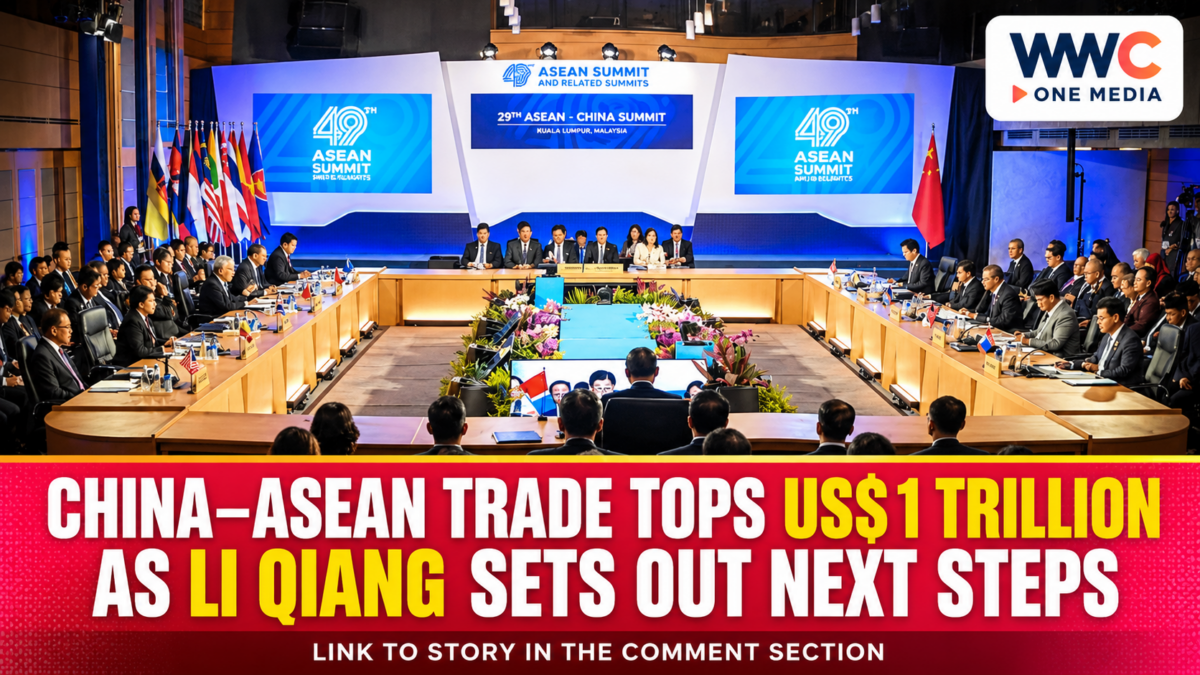
China’s trade with Southeast Asia exceeded US$1 trillion in 2025, Chinese Premier Li Qiang told regional leaders at the 29th China–ASEAN Summit in Manila on Nov. 16, while outlining Beijing’s priorities for the next phase of economic and diplomatic cooperation.
His published remarks set out a broader agenda covering the China–ASEAN Free Trade Area 3.0 Upgrade Protocol, regional supply chains, energy cooperation, artificial intelligence and the South China Sea Code of Conduct. The figures and policy positions were presented in Li’s official speech; their practical significance will depend on implementation by the governments involved.
The summit brought together ASEAN member-state leaders, Li and ASEAN Secretary-General Kao Kim Hourn. Its agenda included reviewing the ASEAN–China Comprehensive Strategic Partnership and discussing its future direction as the partnership marks its fifth anniversary.
For the Philippines, the developments matter because Manila is both an ASEAN member with substantial economic interests in regional trade and a claimant state involved in unresolved maritime disagreements with China. Economic cooperation and maritime security remain separate policy questions, even when both are discussed through the same diplomatic relationship.
China–ASEAN trade and investment: what the figures show
Li said trade between China and ASEAN exceeded US$1 trillion in 2025, representing a 20.1% increase compared with 2021. He also reported that trade increased by 29.6% during the first 10 months of 2026.
The Chinese premier said cumulative two-way investment had surpassed US$500 billion, more than 50% higher than five years earlier.
These figures describe the scale of the relationship presented by Beijing. They do not, by themselves, show how the benefits are distributed among ASEAN economies, how much investment has reached individual industries or whether smaller businesses have gained improved access to markets.
That distinction matters for Philippine companies. A large regional trade figure does not automatically translate into higher orders for local exporters, lower consumer prices or new jobs. Businesses still need competitive products, reliable logistics, financing and the ability to meet the rules governing cross-border trade.
The Philippines is also pursuing other market-access arrangements. WWC has examined the separate Philippines–Canada free trade negotiations and what their conclusion means for exporters. The comparison highlights a recurring point: the announcement of a trade framework is only an early step; businesses need the detailed rules and actual market access to use it.
FTA 3.0 moves the relationship beyond traditional goods trade
Li said China and ASEAN had signed the China–ASEAN Free Trade Area 3.0 Upgrade Protocol. The ASEAN Secretariat’s published economic overview records that the protocol was signed on Oct. 28, 2025, after negotiations were concluded earlier that year.
The upgrade broadens the agreement’s coverage beyond traditional trade. ASEAN identifies digital and green economies, supply-chain connectivity, competition and consumer protection among the areas included in the expanded framework.
That wider scope reflects how regional commerce now operates. Companies rely not only on tariffs and customs procedures but also on digital services, data-related systems, production networks, standards and competition rules.
For Philippine businesses, the potential relevance could extend to manufacturers, service providers and smaller firms participating in regional supply chains. But the existence of an upgraded agreement should not be mistaken for proof that every business can immediately claim new benefits.
The actual effect will depend on the protocol’s entry into force, implementation arrangements, domestic regulations and whether companies can satisfy the applicable requirements.
The 2026–2030 plan is the framework for the next phase
The Manila summit also reviewed progress in the ASEAN–China Comprehensive Strategic Partnership. The ASEAN Secretariat said leaders reaffirmed their commitment to strengthening the partnership, including through implementation of the ASEAN–China Plan of Action for 2026–2030.
The plan is not a newly created agreement announced at the Manila meeting. It is a guiding framework for cooperation across areas of shared interest, building on the previous five-year programme.
Li described the plan as a blueprint for cooperation over the next five years. He also pointed to regional connectivity projects, including the Jakarta–Bandung high-speed railway and the China–Laos railway, as examples of infrastructure cooperation.
For readers, the important distinction is between a framework and a completed outcome. A plan can identify priorities and mechanisms, but its value must be judged through projects delivered, trade processes improved and measurable benefits for participating economies.
WWC has also reported on ASEAN energy-security efforts and the Philippines’ regional power and fuel cooperation. Those initiatives illustrate why regional cooperation requires technical arrangements and operational capacity, not only summit declarations.
Energy and artificial intelligence enter the cooperation agenda
Li said China welcomed the establishment of a China–ASEAN energy cooperation partnership and a mechanism for energy-ministerial meetings.
He also said China would work with ASEAN to hold a Year of AI Cooperation in 2027, pursue what he called “AI plus” cooperation and explore alignment with ASEAN’s Digital Economy Framework Agreement.
These are stated areas of intended cooperation, not evidence that specific new energy projects or AI programmes have already been completed.
For ASEAN economies, energy cooperation can involve supply resilience, infrastructure and the ability to coordinate across national systems. AI cooperation raises a different set of practical questions, including skills development, digital infrastructure, standards and the capacity of businesses and public institutions to adopt new technologies.
Li’s speech also included proposed people-focused initiatives. He said the China–ASEAN Digital Academy would provide 100 full scholarships for ASEAN countries in 2027. He added that the China–ASEAN Women and Children’s Health Cooperation Center was ready to work with ASEAN countries to train 1,000 professionals over the next three years.
The speech establishes that these offers were announced by the Chinese premier. It does not provide a country-by-country allocation, selection rules or a detailed implementation timetable for the programmes.
Maritime disagreements remain a separate test
The economic agenda does not remove the political and security differences between China and some ASEAN members.
In his Manila remarks, Li said China looked forward to the early adoption of a Code of Conduct in the South China Sea. He also called for differences to be handled through dialogue and negotiation.
That statement is a position expressed by China’s premier. It does not establish that ASEAN and China have reached agreement on the code, resolved their maritime disputes or settled the legal positions of the parties.
For the Philippines, the wording and substance of any eventual code remain important. WWC’s earlier report on the South China Sea Code of Conduct negotiations and ASEAN’s 2026 objective explains why an announced diplomatic objective must not be confused with a completed agreement.
The challenge for regional governments is to maintain channels for economic cooperation while addressing maritime differences through established diplomatic processes and applicable international law.
What happens next
The next stage will be measured by implementation rather than the scale of the summit’s announcements.
ASEAN and China will need to advance the 2026–2030 Plan of Action, put the FTA 3.0 upgrade into practical effect and clarify how proposed cooperation in energy, AI and people-to-people programmes will operate.
For the Philippines, the test is whether regional arrangements create tangible opportunities for local businesses and communities while preserving Manila’s stated positions on maritime rights and international law.
Li’s speech provides a detailed account of Beijing’s priorities. The ASEAN summit record confirms that leaders reaffirmed the partnership and its next five-year framework. Whether those commitments produce balanced, measurable results across the region remains an open question.
Frequently asked questions
1. How much was China–ASEAN trade in 2025?
Chinese Premier Li Qiang said trade between China and ASEAN exceeded US$1 trillion in 2025. He also said it was 20.1% higher than in 2021.
2. What is the China–ASEAN Free Trade Area 3.0?
It is an upgraded trade framework signed in October 2025. Its expanded coverage includes areas such as the digital economy, green economy, supply-chain connectivity, competition and consumer protection.
3. What is the ASEAN–China Plan of Action 2026–2030?
It is a five-year guiding framework for cooperation between ASEAN and China. Leaders reaffirmed their commitment to implementing it at the 29th ASEAN–China Summit in Manila.
4. Did China and ASEAN settle the South China Sea dispute in Manila?
No. Li called for the early adoption of a Code of Conduct, but the published summit records do not establish that the dispute was settled or that a final code was adopted.
5. What AI cooperation did Li propose?
Li said China would work with ASEAN to hold a Year of AI Cooperation in 2027, pursue “AI plus” cooperation and explore alignment with ASEAN’s Digital Economy Framework Agreement.