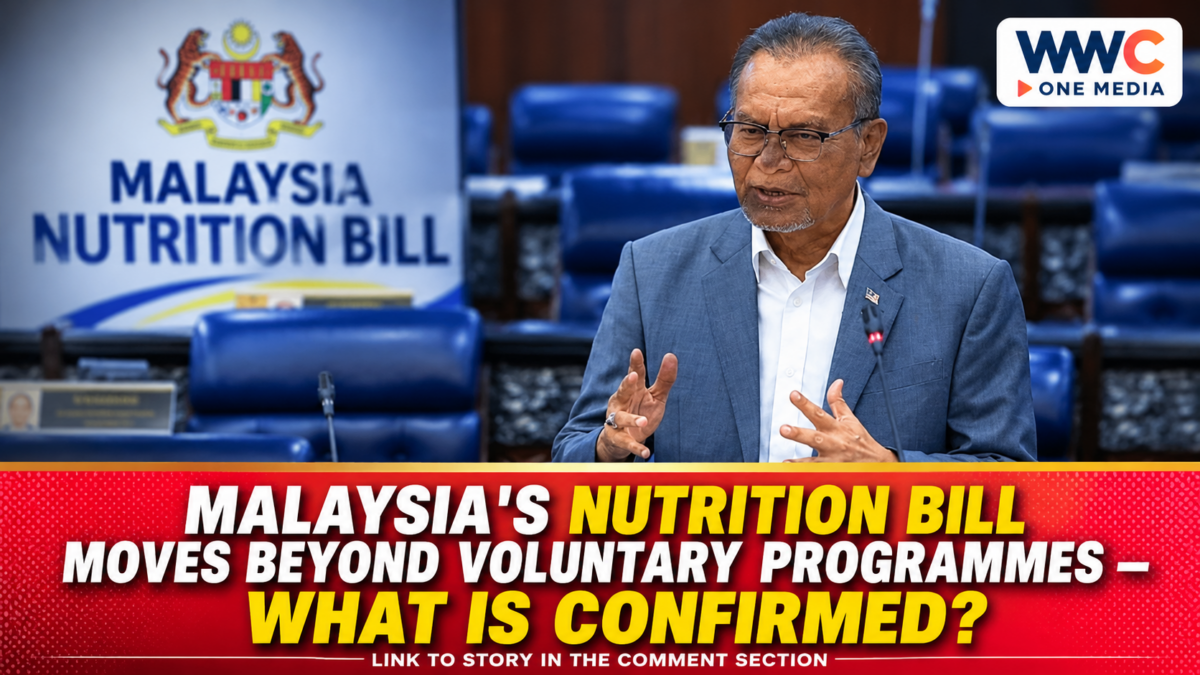
Malaysia’s Ministry of Health is developing a Nutrition Bill intended to establish a more structured legal framework for national nutrition activities, following Cabinet-level in-principle approval for the legislation’s memorandum in January 2025.
The proposed law forms part of a wider policy effort that includes sugar-reduction measures, nutrition education and initiatives to encourage healthier food environments. Its final provisions, however, should not be confused with existing food-safety regulations or treated as legislation already in force.
The distinction matters because Malaysia is pursuing two related but different objectives: ensuring food products meet safety requirements and shaping the wider environment in which people make food choices.
Malaysia’s Nutrition Bill Has Been in Development Since 2025
The Ministry of Health’s Annual Report 2025 records that the Cabinet granted in-principle approval for the Cabinet Memorandum on the Nutrition Bill on Jan. 8, 2025.
The report describes the proposed legislation as a framework intended to move national nutrition activities from voluntary implementation towards a mandatory regulatory mechanism, with stronger compliance and monitoring.
It also records strategic cooperation with UNICEF during 2025 to support preparation of the draft legislation under the Country Programme Document 2022–2025.
This is an important distinction: approval of the Cabinet Memorandum was not the same as Parliament passing a Nutrition Act. The Ministry’s report describes work on draft legislation, rather than an enacted law.
The official record therefore establishes that the project has progressed beyond a general policy discussion, but it does not establish that the proposed legislation is already enforceable.
Why the Proposed Law Is Different From Food-Safety Regulation
Malaysia already has a legal framework governing food safety.
The Food Act 1983 addresses matters involving food safety and public protection in the production, sale and consumption of food. The Ministry’s 2025 report separately describes the proposed Nutrition Bill as a framework for regulating national nutrition activities.
That distinction helps explain why a separate law is being developed.
Food-safety regulation and nutrition policy do not necessarily address the same questions. A product can meet applicable food-safety requirements while still raising broader questions about nutritional composition, marketing practices or the food environment in which consumers encounter it.
The proposed Bill’s significance lies in the possibility of creating a more formal regulatory structure for national nutrition initiatives.
For readers following international developments, WWC previously examined the World Health Organization’s proposed food-profiling framework and the debate over packaged-food regulation. That international discussion provides context, but it should not be mistaken for Malaysian law.
Malaysia Is Already Using Other Nutrition Policy Measures
The Nutrition Bill is not the only measure in Malaysia’s nutrition-policy programme.
During a Nov. 2, 2026, Dewan Rakyat sitting, Health Minister Datuk Seri Haji Dr. Dzulkefly bin Ahmad described a multi-pronged approach to addressing noncommunicable diseases and encouraging healthier choices.
The parliamentary record identifies fiscal measures, education and behavioural change, physical activity, screening and stronger legislation among the areas being pursued.
The minister also discussed the excise duty on sugar-sweetened beverages. He stated that the rate began at 40 sen per litre in July 2019, increased to 50 sen in 2024 and reached 90 sen in 2025.
The stated policy objective was to reduce sugar consumption and encourage manufacturers to reformulate products.
The same parliamentary discussion referred to the Ministry’s development of Nutri-Grade Malaysia, a system intended to help consumers make healthier food and beverage choices.
These measures show that nutrition policy already involves more than one instrument. The proposed Bill would sit within that wider policy environment rather than replace every existing programme.
Child Nutrition and the Food Environment Are Important Policy Areas
The Ministry’s annual report also places nutrition within a wider public-health framework.
Its Nutrition Division is responsible for developing policy and implementing national nutrition services. The report describes an integrated approach involving multiple sectors, evidence-based planning and coordination.
It also records the Ministry’s work on the National Plan of Action for Nutrition of Malaysia III and the National Nutrition Policy of Malaysia 2.0.
The importance of children’s nutrition is reflected in the Ministry’s wider programmes and international cooperation.
WWC has previously examined how school meals, safe drinking water and sanitation contribute to children’s nutrition and learning environments. Although that report concerns the Philippines, the broader policy lesson is relevant: nutrition outcomes are influenced by more than the food placed on a plate.
Infant and child nutrition also has a distinct policy dimension. WWC’s report on breastfeeding support and early-childhood nutrition in the Philippines provides additional regional context on why nutrition policy can involve families, workplaces, institutions and government.
These comparisons are context, not evidence of the contents of Malaysia’s proposed law.
What the Bill Could Mean for Government and Industry
Analysis: If Malaysia ultimately adopts a mandatory national nutrition framework, public institutions, businesses and other stakeholders may need to pay closer attention to the standards and obligations established under the final legislation.
For the food and beverage industry, the precise consequences would depend on the Bill’s actual provisions and any regulations issued after enactment.
It would be premature to assume that every food advertisement, product formulation or marketing channel will automatically face new restrictions. Those details must be established through the published draft, parliamentary proceedings and final legislation.
The same caution applies to consumers. A proposed regulatory framework does not immediately change the legal status of products already being sold.
The important issue is whether the final law creates clear responsibilities, practical enforcement mechanisms and a transparent process for implementation.
What Happens Next?
The Ministry of Health’s Annual Report 2025 establishes that the Nutrition Bill was under development following the Jan. 8, 2025, Cabinet-level approval for its memorandum.
The Nov. 2, 2026, parliamentary record also confirms that the Minister continued to identify development of a Malaysian nutrition law as part of the country’s wider nutrition-policy approach.
The next major documents to watch are the completed draft, any official consultation material, the Bill’s formal tabling in Parliament and the text of any legislation eventually passed.
Until those records are available, the Bill’s final scope, enforcement powers and implementation timetable should be treated as unresolved.
Frequently Asked Questions
Has Malaysia passed the Nutrition Bill?
The Ministry’s 2025 annual report describes the Bill as draft legislation under development. The report does not establish that Parliament has passed it.
When did the Cabinet approve the Nutrition Bill?
The Ministry’s Annual Report 2025 records in-principle approval for the Cabinet Memorandum on Jan. 8, 2025.
Is the Nutrition Bill the same as the Food Act 1983?
No. The Ministry describes the Nutrition Bill as a separate framework for national nutrition activities, while the Food Act 1983 addresses food safety and related public-protection matters.
Does Malaysia already have measures targeting sugary drinks?
Yes. The Health Minister told Parliament on Nov. 2, 2026, that the excise duty on sugar-sweetened beverages rose from 40 sen per litre in July 2019 to 50 sen in 2024 and 90 sen in 2025.
Will the proposed law immediately ban unhealthy food advertising?
That cannot be established from the primary records reviewed for this report. The final provisions must be checked against the published draft and any legislation passed by Parliament.