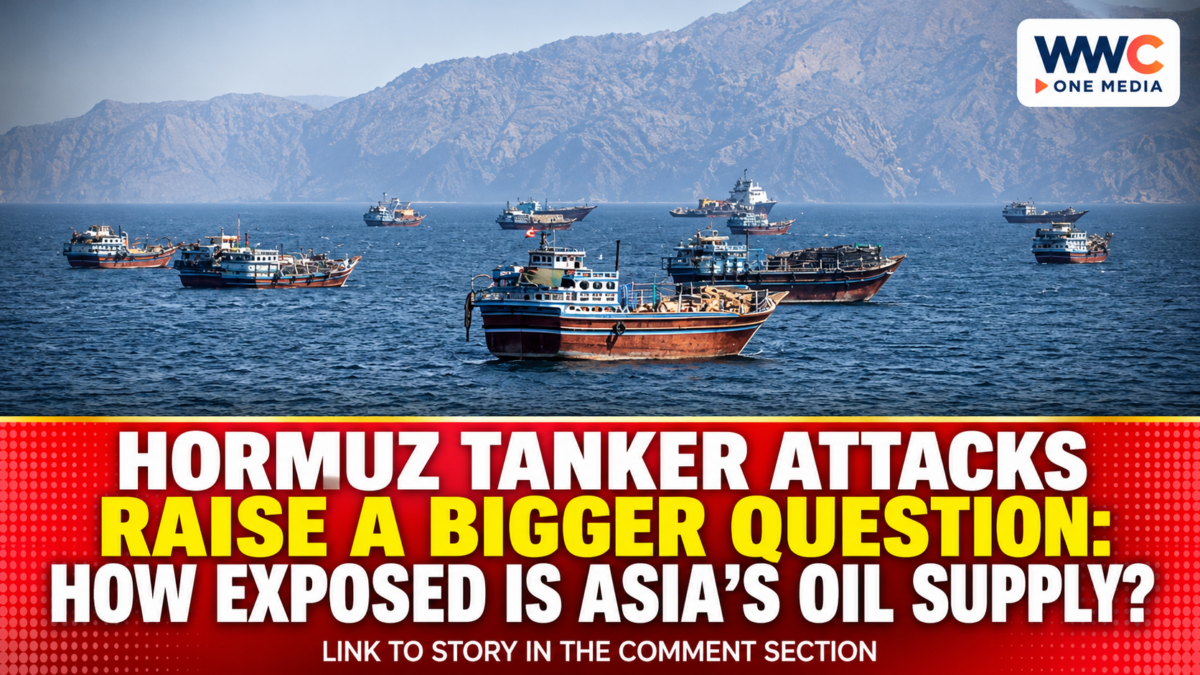
A tanker travelling outbound through the Strait of Hormuz was struck by an unidentified projectile on Monday, triggering an engine-room fire and renewing concerns over the safety of one of the world’s most important oil-shipping corridors. The United Kingdom Maritime Trade Operations (UKMTO) reported that all crew members were accounted for and no casualties had been reported, while damage and environmental impact remained unknown.
The incident adds to a series of maritime security reports in the Gulf region. Its importance extends beyond the vessel itself: the Strait of Hormuz remains a major passage for petroleum and liquefied natural gas moving from Middle Eastern producers to international buyers, particularly in Asia.
Hormuz tanker attacks put shipping security under renewed pressure
UKMTO Warning 207-26 records the November 16 incident at 0558 UTC, based on information from a company security officer. The report states that the tanker was hit by an unknown projectile while making an outbound transit through the Strait of Hormuz.
The impact caused a fire in the engine room. UKMTO said all crew had been accounted for and no casualties had been reported at the time of its warning. It did not provide a confirmed vessel name, flag, cargo volume or final damage assessment.
The maritime agency advised vessels to transit with caution and report suspicious activity while authorities investigate.
That wording is important. The warning identifies an attack report, but it does not identify who was responsible. Without an official attribution, the incident should not be used to accuse a government or armed group.
A growing record of damaged vessels
The latest report follows a series of incidents involving commercial ships in the wider Middle East maritime area.
The International Maritime Organization’s confirmed-incident register listed 136 incidents in the Strait of Hormuz and the wider Middle East as of November 11, 2026. It also recorded 25 confirmed seafarer fatalities.
Its incident table includes vessels damaged in different locations around the Gulf. Among the entries were DOMINICA PROSPERITY, damaged northwest of Ra’s al Khaymah on November 11; FUJAIRAH ENERGY, damaged in the Arabian Gulf on November 10, with one seafarer injured; and TARIF, damaged in the Strait of Hormuz on November 7.
The register also recorded a fatality involving VELOS SAPPHIRE after an incident on November 4 north of Madinat ash Shamal, Qatar.
These entries should not be treated as proof that every incident had the same cause or perpetrator. They do, however, show that commercial shipping has faced repeated security incidents across the region.
The human consequences are also relevant to the Philippines, a major supplier of seafarers to international shipping. WWC previously reported on the return of Filipino crew members following the deadly tanker incident involving the vessel Sidr, in which two Filipino seafarers died.
Why the Strait of Hormuz matters to global oil supply
The Strait of Hormuz connects the Persian Gulf with the Gulf of Oman and the Arabian Sea. Its geography makes it a critical route for energy exports from several major producers.
The US Energy Information Administration estimated that oil flows through the strait averaged 20.9 million barrels per day in the first half of 2025. That represented about 20 percent of global petroleum liquids consumption and roughly one-quarter of global maritime-traded oil.
The same analysis estimated that 89 percent of crude oil and condensate moving through Hormuz went to Asian markets during that period. China, India, Japan and South Korea were among the leading destinations.
These figures explain why a security incident in the waterway can attract attention well beyond the Gulf. The issue is not simply whether one ship is damaged. It is whether repeated threats make voyages more difficult, expensive or uncertain for operators moving energy cargoes.
The EIA also identified pipeline routes in Saudi Arabia and the United Arab Emirates that can bypass part of the strait. However, the agency estimated that the combined capacity of the Saudi East-West pipeline and the UAE’s Abu Dhabi pipeline was about 4.7 million barrels per day — substantially below the oil volumes that normally pass through Hormuz.
Alternative infrastructure therefore offers some flexibility, but it does not remove the strategic importance of the waterway.
Why Asian buyers and the Philippines should pay attention
For Asian economies, the Strait of Hormuz is not a distant maritime concern. It is part of the supply chain connecting Middle Eastern energy producers with refineries, power systems, transport networks and industrial users.
A prolonged disruption could affect shipping schedules and the availability of cargoes. If operators face higher insurance premiums, longer routes or additional security requirements, those costs may also influence the economics of transporting energy.
That does not mean every attack automatically produces an immediate increase in fuel prices. Oil markets respond to several factors, including available supply, inventories, demand expectations, shipping costs, currency movements and the perceived likelihood of future disruptions.
For the Philippines, the issue is especially relevant because the country relies heavily on imported petroleum. A sustained rise in international crude or refined-product costs can eventually place pressure on domestic fuel prices, although the timing and size of any adjustment depend on local pricing factors.
WWC has previously examined how volatile global oil markets can affect the country’s exposure to imported energy. The latest tanker incident adds a fresh maritime-security factor to that wider discussion.
The Philippines is also exploring regional arrangements that could improve emergency access to petroleum supplies. Recent proposed fuel-sharing pilots involving partners in Indonesia and Thailand are one example of efforts to strengthen supply resilience. These proposals are not a guarantee against higher prices or shipping interruptions, but they show why energy security involves both reliable transport routes and access to alternative supplies.
What happens next
UKMTO’s November 16 warning leaves several important questions unanswered. The vessel’s identity, the full extent of the damage, the cause of the projectile strike and any environmental consequences had not been confirmed in the report.
Authorities’ investigation and subsequent maritime advisories will help establish whether the incident creates additional navigational restrictions or changes to shipping guidance.
For oil buyers and ship operators, the immediate concern is the safety and predictability of transit. For Asian economies, the broader question is whether the region can maintain dependable energy access if security incidents continue.
The Strait of Hormuz remains open as a major international shipping route, but the latest report is another reminder that the security of energy supply depends not only on production capacity. It also depends on whether ships can safely carry those supplies to market.
Frequently asked questions
What happened to the tanker in the Strait of Hormuz on November 16, 2026?
UKMTO reported that a tanker was struck by an unidentified projectile while travelling outbound. The impact caused an engine-room fire. All crew were accounted for and no casualties had been reported.
Did the attack cause an oil spill?
The UKMTO warning said the environmental impact was unknown at the time of reporting. It did not confirm an oil spill.
Who was responsible for the tanker incident?
The warning did not identify the responsible party. The projectile was described as unknown, and authorities were investigating.
Why is the Strait of Hormuz important to oil markets?
The EIA estimated that about 20.9 million barrels of oil per day passed through the strait in the first half of 2025, equal to about one-fifth of global petroleum liquids consumption.
Could the incident increase Philippine fuel prices?
It could contribute to market concerns if shipping risks persist, but one incident does not establish that Philippine pump prices will rise. Local prices also depend on refined-product costs, exchange rates, taxes and pricing schedules.