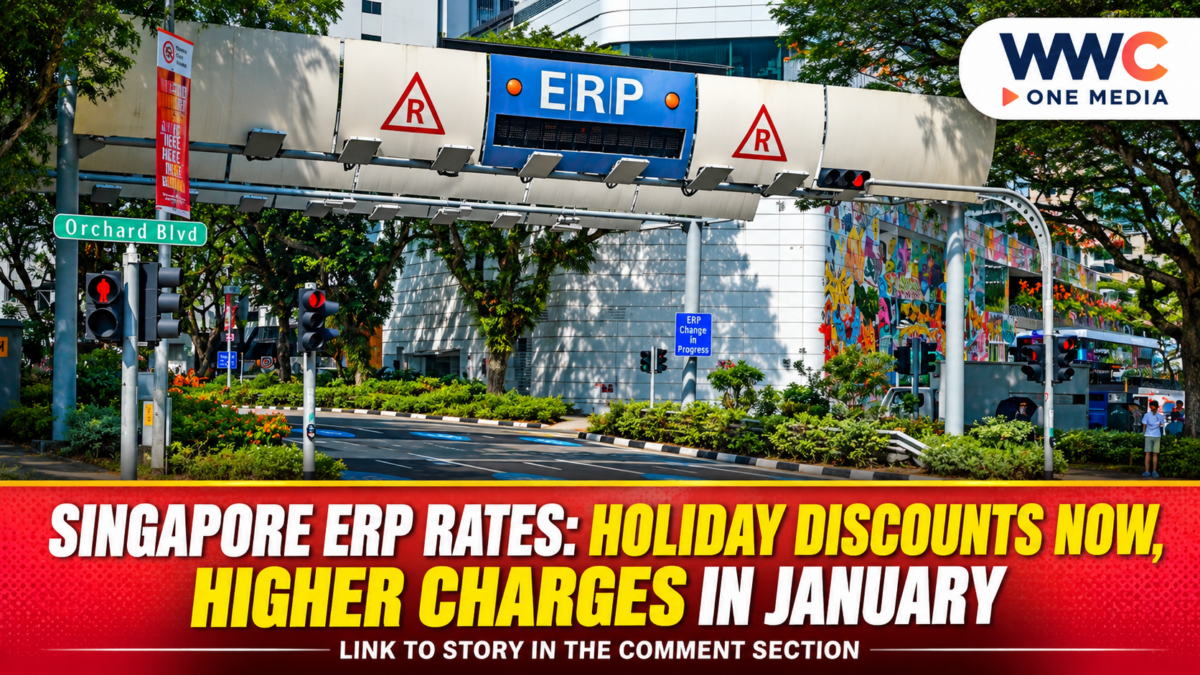
Singapore motorists will receive temporary Electronic Road Pricing (ERP) reductions at 12 locations during the December school holidays, with the revised charges taking effect on Nov. 23, 2026. However, the Land Transport Authority (LTA) will also raise rates by S$1 at two specific time periods from Jan. 4, 2027, creating a separate adjustment that drivers should factor into their travel plans.
The changes follow LTA’s latest review of traffic conditions in October and cover selected expressway and road sections where traffic demand is expected to vary. The schedule also includes locations on the Pan-Island Expressway (PIE) and Central Expressway (CTE), meaning motorists using routes around Kallang Bahru, Bendemeer and the CTE should pay particular attention to the time slots.
The important point is that the December reductions and January increases are not one blanket change. They apply to different locations or charging periods, and the rate depends on when a vehicle passes the relevant gantry.
Singapore ERP rates: What changes from November 23?
The temporary reductions will run from Nov. 23 through Dec. 31, 2026, inclusive. LTA identified 12 locations and 31 specified time periods for lower charges in anticipation of reduced traffic demand during the December school holidays.
The adjustments include several expressway approaches and selected arterial-road connections. At the PIE gantries covering Kallang Bahru and the slip road into Bendemeer, the 7am to 7:30am charge will fall from S$1 to zero.
The next half-hour period, from 7:30am to 8am, will drop from S$2 to S$1. These are temporary reductions; they do not mean that every morning period at those gantries becomes free.
Other reductions include selected periods on the Ayer Rajah Expressway (AYE), CTE, Kallang-Paya Lebar Expressway (KPE), Marina Coastal Expressway (MCE) and other PIE sections.
For example, the southbound CTE before Braddell Road will charge S$1 instead of S$2 during the 7am–7:30am and 7:30am–8am periods. At the KPE after Defu Flyover, selected morning charges will also be reduced by S$1.
Drivers should check the exact gantry and time rather than assume that a discount applies throughout an entire route.
Two ERP time periods become more expensive in January
The second part of the announcement concerns two charging periods that will rise by S$1 from Jan. 4, 2027.
The first is at the PIE gantries covering Kallang Bahru and the slip road into Bendemeer. Between 8:30am and 9am, the rate will increase from S$4 to S$5 per Passenger Car Unit (PCU).
The second adjustment applies to the northbound CTE before PIE. From 5pm to 5:30pm, the charge will move from zero to S$1 per PCU.
These increases are limited to the two listed time periods. LTA stated that rates for other previously announced gantries and time slots will remain unchanged unless separately adjusted.
This distinction matters because the same PIE location appears in both parts of the announcement. The early-morning periods receive temporary school-holiday discounts, while the 8:30am–9am period is scheduled for a higher charge in January.
Why LTA is adjusting the charges
ERP is designed to manage congestion by influencing when motorists travel and which routes they use. Singapore’s Ministry of Transport says the system was installed in 1998 and uses charges at roads where traffic congestion needs to be managed.
Rates are differentiated according to traffic conditions. The objective is to keep traffic moving within the relevant optimal speed ranges on arterial roads and expressways.
LTA said its October 2026 monitoring found that traffic had built up along various expressway stretches. The authority said the January increases are intended to manage congestion at the affected locations.
The school-holiday reductions follow a different assessment: LTA expects lower traffic demand during the December period and has temporarily adjusted charges accordingly.
The two decisions illustrate how ERP pricing is used as a traffic-management measure rather than as a fixed road toll. A lower rate does not necessarily mean a road has no congestion, just as a higher rate does not mean every driver will experience the same delay.
For more context on the technology behind Singapore’s road-pricing transition, WWC has examined how the new ERP 2 system may expand traffic enforcement capabilities.
The changes arrive as Singapore prepares for ERP 2
The January schedule also comes shortly after Singapore’s planned transition to its next-generation ERP system.
The Ministry of Transport says LTA will complete the rollout of ERP 2 on Jan. 1, 2027, and decommission the existing ERP 1 system. From that date, the ERP 2 On-Board Unit will be mandatory for all Singapore-registered vehicles.
The new system uses Global Navigation Satellite System technology. The ministry says it is intended to be more responsive in managing road traffic, less costly to build and maintain, and more space-efficient than the existing infrastructure.
The transition is a separate development from the latest rate review. Motorists should not assume that the new onboard equipment itself creates the S$1 increases. The published rate schedule identifies the specific locations, time periods and effective date for those adjustments.
WWC has also reported on the remaining installation and workshop issues involving ERP 2 equipment, an operational issue distinct from the charges announced for January.
What motorists should check before travelling
The revised schedule makes checking the exact time of travel more important than simply knowing the road name.
A driver using the PIE near Kallang Bahru before 8am may encounter a temporary discount during the school-holiday period. The same driver travelling through the specified gantries between 8:30am and 9am from Jan. 4 will face a higher charge.
Likewise, the northbound CTE before PIE will have a new S$1 charge during the 5pm–5:30pm period from January. Drivers who regularly use that section should include the change in their commuting calculations.
The wider road network also matters. Congestion at one expressway or checkpoint can affect journey times elsewhere, which is why motorists should check official traffic information before setting off. WWC previously covered how traffic queues at Woodlands Checkpoint can affect Singapore–Malaysia journeys.
What happens next
The temporary school-holiday reductions begin on Nov. 23 and continue through Dec. 31, 2026. The rates are scheduled to return to the prevailing charges from Jan. 4, 2027, when the two announced S$1 increases also take effect.
LTA said it will continue monitoring traffic speeds and congestion. It will assess whether Saturday ERP operations should resume for the Orchard Cordon in the next quarter, as speeds there have remained below optimal levels since October 2025.
The authority also identified heavy traffic at the CTE (SLE) near Braddell Road entry and KPE (MCE) near Airport Road entry. It said ERP charging could be introduced at those locations if congestion persists. No new charging start date or rate was announced for those potential locations.
For now, motorists should use the published schedule as the reference for the confirmed adjustments and monitor future LTA notices for further changes.
Frequently asked questions
When do the Singapore ERP discounts begin?
The temporary reductions begin on Nov. 23, 2026, and run through Dec. 31, 2026, inclusive.
Which PIE location will have lower ERP charges?
The PIE gantries at Kallang Bahru and the slip road into Bendemeer will have lower charges from 7am to 8am during the temporary school-holiday period.
Which ERP charges will increase in January 2027?
The PIE at Kallang Bahru and the slip road into Bendemeer will rise from S$4 to S$5 between 8:30am and 9am. The northbound CTE before PIE will rise from zero to S$1 between 5pm and 5:30pm.
Do all Singapore ERP rates increase on Jan. 4?
No. LTA announced increases for only two specified locations and time periods. Other previously announced rates remain unchanged unless separately revised.
Is ERP 2 responsible for the January rate increases?
The rate increases are part of LTA’s traffic-based rate review. ERP 2 is a separate system transition scheduled for Jan. 1, 2027.