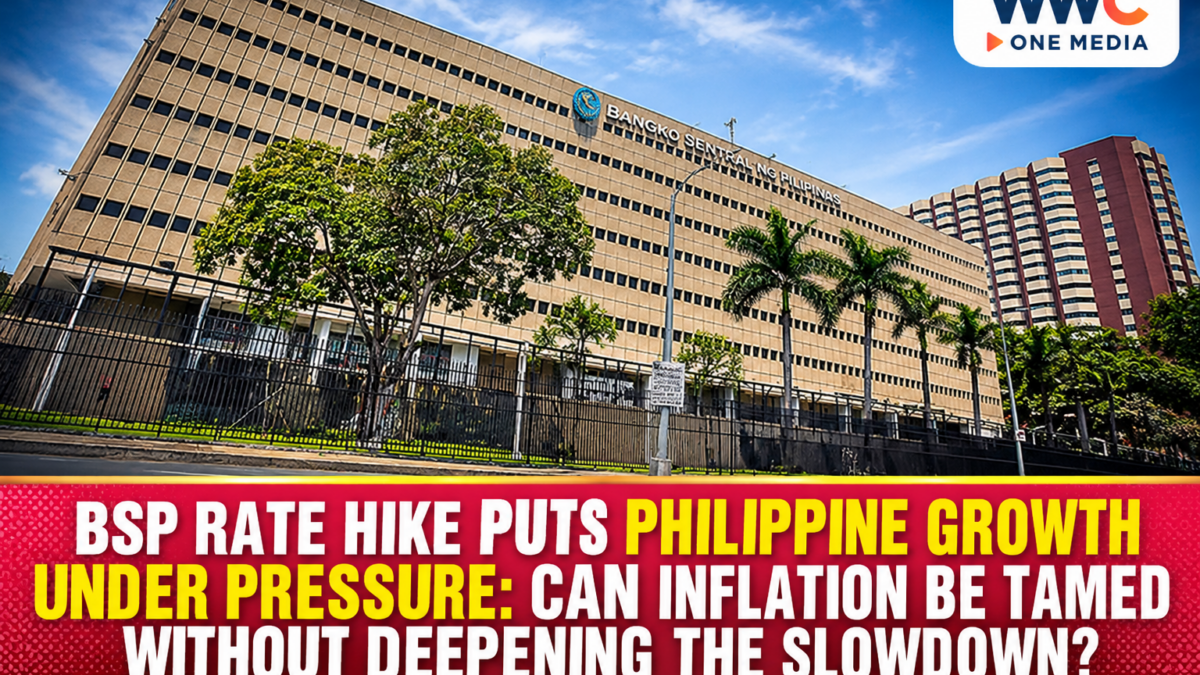
The Bangko Sentral ng Pilipinas (BSP) raised its benchmark policy rate to 5.50% on November 13, tightening monetary conditions as Philippine economic growth slowed to 2.1% in the third quarter and inflation accelerated to 7.8% in October.
The decision puts the central bank at the centre of a difficult economic balancing act: containing price increases without placing excessive pressure on households, businesses and an economy already struggling to regain momentum.
The latest figures show that the problem is not limited to one part of the economy. Household consumption remains positive but subdued, investment contracted, agricultural production declined and transportation costs became a major contributor to inflation.
For borrowers, businesses and ordinary consumers, the next phase will depend on how these pressures develop before the BSP’s next scheduled monetary-policy meeting in December.
BSP Raises Its Policy Rate to 5.50%
The Monetary Board increased the target reverse repurchase (RRP) rate by 50 basis points on November 13, bringing it to 5.50%.
The BSP also adjusted its overnight deposit facility rate to 5.00% and its overnight lending facility rate to 6.00%.
The central bank described the decision as a measure intended to tighten monetary conditions, contain spillover effects and anchor inflation expectations.
The latest increase means monetary policy remains restrictive even as economic growth has weakened. It also follows the October 22 decision, when the BSP had already raised its benchmark rate by 50 basis points to 5.50%. The November 13 adjustment therefore represents a further increase beyond that earlier level.
The decision is important because the policy rate influences the cost of money across the financial system. Banks make their own lending and deposit pricing decisions, but changes in the central bank’s policy settings can affect funding costs and the rates offered to customers.
WWC previously examined the earlier tightening decision in its report on the BSP’s October 50-basis-point rate increase.
GDP Growth Slows as Investment Contracts
The Philippine Statistics Authority reported that gross domestic product grew by 2.1% year on year in the third quarter of 2026.
The services sector expanded by 3.7%, but agriculture, forestry and fishing contracted by 4.8%. Industry also recorded a slight year-on-year decline of 0.003%.
The demand-side figures reveal another important weakness. Household final consumption expenditure grew by 2.4%, while government final consumption expenditure increased by 6.8%.
Exports of goods and services expanded by 8.6%, and imports rose by 7.7%. However, gross capital formation declined by 0.2%.
Gross capital formation broadly measures investment in assets such as buildings, equipment and other capital goods. Its decline suggests that investment did not provide an additional source of growth during the quarter.
The figures do not establish that higher interest rates caused the slowdown. Investment and consumption are influenced by several factors, including business confidence, public spending, production conditions, prices and financing costs.
Still, the combination of weak growth and tighter monetary conditions creates a challenge for companies considering expansion or borrowing.
The government’s infrastructure spending is another part of the wider investment discussion. WWC previously examined the proposed ₱644-billion DPWH budget for 2027, including the questions surrounding project priorities and public spending accountability.
October Inflation Reaches 7.8% as Transport Costs Accelerate
The pressure on the BSP becomes clearer in the latest consumer price figures.
The PSA reported that headline inflation accelerated to 7.8% in October from 7.2% in September. The average inflation rate from January to October reached 5.6%.
Core inflation, which excludes selected volatile food and energy items, increased to 5.4% from 4.8%.
Transportation was a major contributor to the increase. The transport index recorded annual inflation of 20.1% in October, compared with 14.6% in September.
Housing, water, electricity, gas and other fuels also recorded faster annual price increases, reaching 9.3% from 8.4%.
Food and non-alcoholic beverages accounted for 30.2% of the overall inflation rate’s contribution, equivalent to 2.4 percentage points. Housing-related costs contributed 1.9 percentage points, while transport contributed 1.8 percentage points.
The figures show why the inflation problem is difficult for households. Rising transport and housing expenses affect the money available for food, education, savings and other needs.
WWC has also examined the pressure on household purchasing power in its coverage of O!Save’s expansion amid rising grocery costs.
Why the BSP Cannot Focus on Growth Alone
A slowing economy normally strengthens the argument for monetary-policy caution. Lower interest rates can make borrowing more affordable and may encourage households and companies to spend or invest.
But the BSP also has to consider the consequences of allowing inflation to remain elevated.
If households and businesses begin expecting prices to keep rising rapidly, those expectations can influence wage demands, pricing decisions and spending behaviour. The central bank’s challenge is to prevent temporary shocks from turning into more persistent inflation.
Higher interest rates can help moderate demand and support the central bank’s effort to anchor expectations. However, they cannot directly increase agricultural output, lower international oil prices or resolve transport and supply disruptions.
Monetary policy also works with a lag. The full effects of a rate adjustment may take time to pass through bank lending, household spending and business investment.
This is why the latest decision should not be interpreted as a guarantee that inflation will quickly fall. Nor does the GDP slowdown alone prove that another rate increase would necessarily be inappropriate.
The policy question is how much restraint is needed to contain inflation while avoiding unnecessary damage to productive activity.
What the Latest Rate Increase Means for Borrowers and Businesses
The policy adjustment does not mean every bank loan will immediately become more expensive by 50 basis points.
The effect on an individual borrower depends on the lender, the loan agreement, the interest-rate structure and the next repricing date.
Borrowers with floating-rate or repricing loans should review their contracts and watch for notices from their banks. Those with fixed-rate loans may remain under their agreed rate during the applicable fixed period.
Businesses face a similar calculation. Companies that rely on credit to finance inventory, equipment or expansion may need to reassess financing costs. Firms with stronger cash flow may be better positioned to absorb tighter conditions, while highly leveraged businesses could face greater pressure.
For households, higher borrowing costs can affect decisions about housing, vehicles, personal loans and other major purchases. The actual impact will vary from one financial institution and contract to another.
The rate increase does not automatically mean deposit rates will rise by the same amount either. Banks determine their own product rates based on market conditions and business decisions.
What Happens Next?
The BSP’s published 2026 monetary-policy calendar schedules the next Monetary Board meeting for December 17.
Before that meeting, policymakers will have to assess incoming inflation data, economic activity, currency conditions and other developments that could affect price stability.
The next GDP and inflation releases will be important in determining whether the October price acceleration persists and whether economic activity shows signs of improvement.
The government also faces a separate challenge: supporting investment, improving infrastructure implementation and addressing supply-side weaknesses that monetary policy cannot directly fix.
For businesses, the key indicators will include borrowing costs, consumer demand and the reliability of supply chains. For households, the immediate concern remains the cost of transport, food, utilities and debt repayments.
The latest BSP decision shows that the central bank is prioritising the containment of inflation risks even as growth remains weak. Whether that approach can restore price stability without further slowing economic activity will become clearer as new data arrive.
FAQ: BSP Rate Hike and the Philippine Economy
1. What is the BSP’s current policy rate?
The BSP’s target reverse repurchase rate was raised to 5.50% on November 13, 2026.
2. Why did the BSP raise interest rates?
The BSP said the adjustment would tighten monetary conditions, contain spillover effects and help anchor inflation expectations.
3. How fast did the Philippine economy grow in the third quarter of 2026?
The Philippine economy grew by 2.1% year on year, based on the Philippine Statistics Authority’s November 9 release.
4. What was the Philippines’ inflation rate in October 2026?
Headline inflation reached 7.8%, up from 7.2% in September. Core inflation increased to 5.4%.
5. When is the BSP’s next scheduled monetary-policy meeting?
The BSP’s published 2026 calendar lists December 17, 2026, as the next Monetary Board policy meeting.