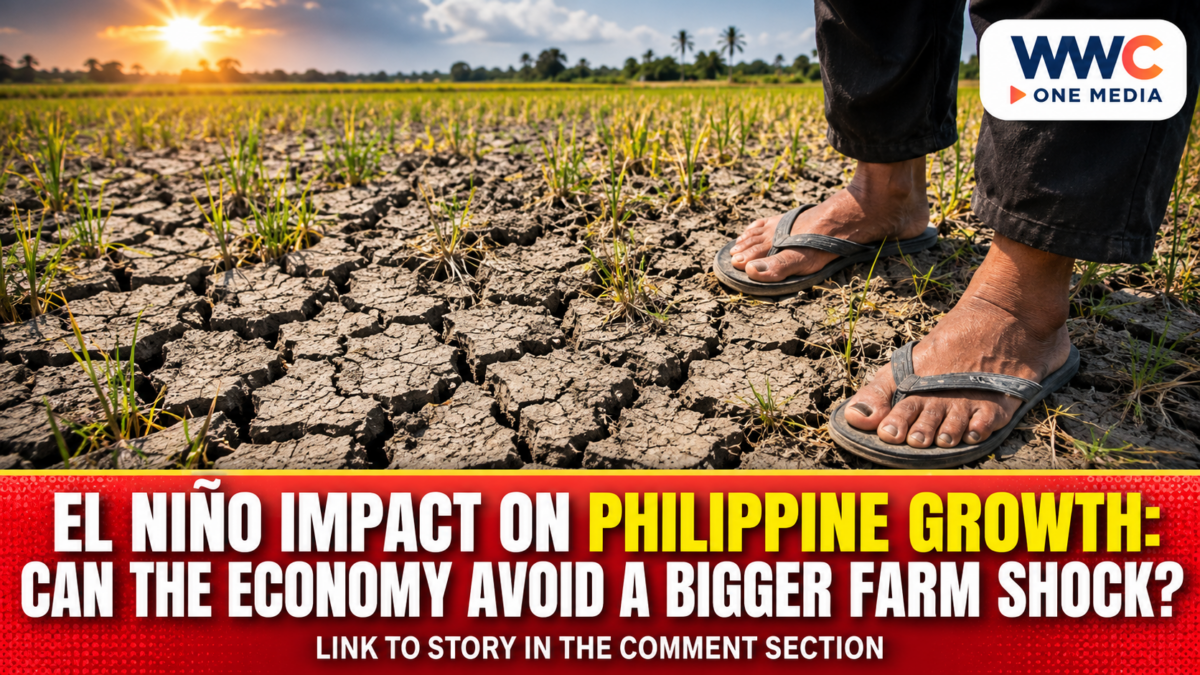
The Philippine economy faces a growing agricultural risk as a very strong El Niño is expected to persist into 2027, with official statistics showing sharp declines in third-quarter crop, rice and corn production.
The warning comes as the Philippine Atmospheric, Geophysical and Astronomical Services Administration (PAGASA) forecasts below-normal rainfall across much of the country in the months ahead. The figures raise a critical question for the next phase of the economic recovery: how much pressure can the agricultural sector absorb before weaker harvests begin affecting rural incomes, food supply and wider economic activity?
The available records do not establish that El Niño caused the entire third-quarter production decline. However, they show that the country is entering a prolonged dry-weather period with agricultural output already weaker than a year earlier.
El Niño Outlook Extends Into 2027
PAGASA’s October 21 climate outlook identified a strong to very strong El Niño in the tropical Pacific. Climate models indicated that the event could persist through at least the first half of 2027, with its peak expected before the end of 2026.
The rainfall outlook is particularly important for agriculture. PAGASA projected below-normal to way-below-normal rainfall over most parts of the Philippines in November 2026. Its outlook also projected below-normal to way-below-normal rainfall across the country in December 2026 and January 2027, followed by way-below-normal conditions over most areas from February to April 2027.
The agency’s forecast does not mean every province will experience the same conditions. Local rainfall, irrigation access, water storage and the timing of planting cycles will influence how individual farming communities are affected.
PAGASA’s November 4 advisory also reported that five provinces experienced meteorological drought in October, while 11 provinces were under dry spell conditions and 10 experienced dry conditions.
These are distinct classifications, not interchangeable descriptions. Their significance is that dry-weather stress is already being recorded in several areas while the broader climate outlook points to continued rainfall risks.
Rice and Corn Production Show the Scale of the Challenge
The Philippine Statistics Authority’s third-quarter agricultural production report recorded 14.05 million metric tons of crop production from July to September 2026. That was 7.8% lower than the 15.25 million metric tons recorded during the same quarter of 2025.
Several major crops registered declines. Palay production fell 17.8%, corn dropped 17.4%, sugarcane declined 48.4%, banana decreased 2.2%, and cassava was down 5.3%.
The separate PSA palay situation report provides a closer look at rice production. Palay output reached 3.08 million metric tons in the third quarter, down from 3.75 million metric tons a year earlier. It was the lowest third-quarter production level recorded since 2019.
The area harvested also contracted. PSA estimated that 755,370 hectares were harvested during the quarter, a 17.6% decline from 916,770 hectares in the same period of 2025.
The average palay yield was 4.08 metric tons per hectare, slightly below the 4.09 metric tons recorded a year earlier. This distinction matters: the production decline was accompanied by a substantial reduction in harvested area, while the average yield per hectare changed only marginally.
These figures show why agricultural resilience cannot be measured by yield alone. The amount of land successfully planted and harvested is also important.
For readers following the country’s supply position, WWC previously examined the possibility of Philippine rice imports reaching five million metric tons, a separate issue that highlights the relationship between local harvests, import requirements and food security.
Why the Economic Impact May Extend Beyond Farms
Agriculture’s contribution to the economy is larger than the value of crops sold at harvest. Farming supports rural employment, transport, storage, food processing, wholesale trade and other businesses that depend on a reliable supply of raw materials.
A weaker harvest can therefore affect several stages of the food chain. Farmers may earn less from reduced output, traders may have less local produce to purchase, and processors may face tighter supplies or higher sourcing costs.
The consequences will vary by commodity and location. A decline in one crop does not automatically mean every food price will increase by the same amount. Imports, inventories, substitution between products and changes in demand can influence market prices.
The Philippines also has exposure through agricultural trade. WWC’s earlier report on the widening Philippine agricultural trade deficit examined the country’s position in international food and agricultural markets. The latest production figures add another reason to monitor the balance between domestic output, imports and exports.
The broader economic risk is that prolonged weather stress could weaken farm incomes and make food supply planning more difficult at a time when households are already sensitive to living costs.
Livestock and Poultry Offer a Different Picture
Not every agricultural subsector contracted in the third quarter.
PSA recorded livestock production at 522,940 metric tons, an annual increase of 1.6%. Hog production, which rose 1.9%, was the main contributor to the increase.
Poultry production reached 823,140 metric tons, up 4.8% from the same quarter of 2025. Chicken production increased 3.5%.
These results show that the agricultural sector is not experiencing a uniform decline. Crop production and fisheries weakened, while livestock and poultry expanded.
That difference matters when assessing food availability. Stronger production in one subsector may help support supply, but it does not automatically replace reduced rice, corn or other crop output. The products serve different uses and markets, and substitution has limits.
The data also underline the need to examine agricultural performance by commodity rather than treating the entire sector as one block.
Preparedness Will Determine How Much Damage Can Be Limited
PAGASA’s forecasts provide advance information, but weather warnings alone cannot protect crops. The practical response depends on how well farmers and agencies use those forecasts.
Irrigation availability, water storage, planting schedules, drought-tolerant crop choices and timely access to farm assistance can influence the ability of communities to manage extended dry periods.
The government has also emphasised the need for accurate public information. In an October 5 release, the Presidential Communications Office said President Ferdinand Marcos Jr. directed agencies to intensify public information and accelerate preparations. DOST Secretary Renato Solidum cautioned that El Niño’s presence in the Pacific does not mean all Philippine areas will immediately experience drought; local impacts depend on rainfall received.
That distinction is important. Public communication should identify areas facing measurable risks without suggesting that every province will experience identical damage.
WWC has previously covered the effects of drought on farming households in its report on farmers receiving emergency assistance during the El Niño threat. The next test is whether preparedness and support can keep pace with the changing local conditions.
What Happens Next?
The next important indicators will be PAGASA’s updated rainfall and drought assessments, PSA’s succeeding agricultural production estimates and official reports on irrigation, farm damage and government interventions.
The October-to-December palay estimate based on standing crops as of October 1 was 6.47 million metric tons, 5.5% lower than the actual output in the same period of 2025. This remains an estimate, not the final harvest result.
That distinction will matter as the dry season develops. Actual production will depend on weather conditions, water availability, planting decisions and the ability of farms to complete their crop cycles.
For policymakers, the challenge is to protect food production while avoiding unnecessary alarm. For farmers, the immediate concern is access to water and practical support. For consumers and businesses, the key issue is whether local supply remains sufficient and predictable.
The El Niño outlook is a warning, not a final measure of economic damage. The size of its impact on Philippine growth will depend not only on the strength of the climate event, but also on how effectively the country manages the risks before the next harvests are completed.
Frequently Asked Questions
1. How long is El Niño expected to affect the Philippines?
PAGASA’s October 2026 outlook said the event could persist into the first half of 2027, with associated impacts potentially continuing during that period.
2. How much did Philippine crop production fall in the third quarter of 2026?
The PSA estimated crop production at 14.05 million metric tons, down 7.8% from the same quarter in 2025.
3. How much did rice production decline?
Palay production fell 17.8% year on year to 3.08 million metric tons in July to September 2026.
4. Did all agricultural sectors record lower production?
No. Livestock production increased by 1.6%, and poultry production rose by 4.8%, while crop and fisheries production declined.
5. Does El Niño mean every Philippine province will experience drought?
No. PAGASA and DOST have explained that local impacts depend on rainfall and local conditions. Some areas may experience more severe dry conditions than others.