
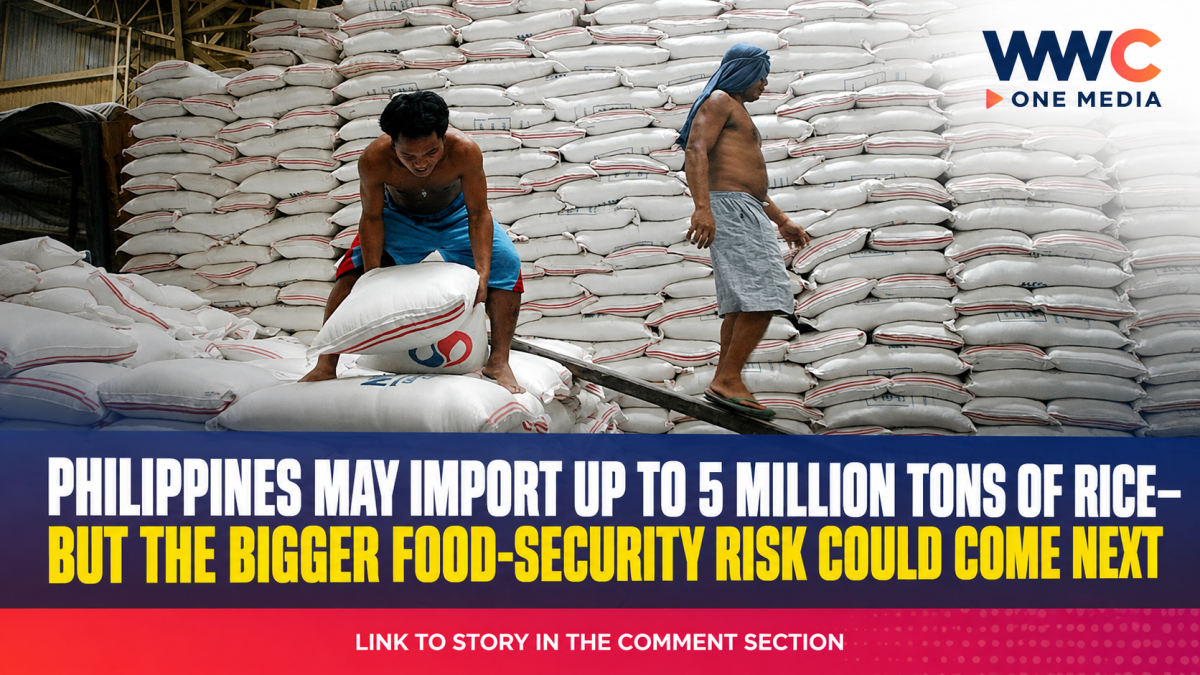
MANILA, Philippines — The Philippines could import as much as 5 million metric tons of rice this year as the government races to build up food reserves amid worsening weather risks, including a developing El Niño and damage from heavy monsoon rains and tropical cyclones.
Agriculture Secretary Francisco Tiu Laurel Jr. told lawmakers on Tuesday that additional rice imports may be needed after the country’s main harvest season to ensure sufficient stocks during the first quarter of 2027.
The strategy is largely precautionary: officials say the country currently has enough rice to meet requirements through the end of 2026, but the government wants to maintain a buffer of more than 60 days because increasingly unpredictable weather could affect domestic production.
“It’s better that we are prepared with enough supply rather than fall short,” Tiu Laurel told lawmakers.
The Agriculture Department said the Philippines had already imported roughly 4 million metric tons of rice by the time of the congressional briefing. A separate Bureau of Plant Industry tally cited by Philippine Star put imports at 3.46 million metric tons as of Aug. 13, while the DA subsequently reported around 3.8 million tons as of the final week of August.
The differing figures reflect different reporting dates and datasets, but they point to the same trend: rice imports are already running at exceptionally high levels.
Imports have already surpassed last year’s total
The country’s rice imports had already exceeded the 3.39 million metric tons imported during the entire year of 2025, according to Bureau of Plant Industry data.
Vietnam remained the Philippines’ dominant supplier, accounting for about 2.59 million metric tons of imports as of Aug. 13. Thailand followed with more than 378,000 metric tons, while Myanmar supplied more than 286,000 metric tons.
As of Aug. 12, the BPI had also issued sanitary and phytosanitary import clearances covering 5.35 million metric tons of rice, indicating that substantially more shipments could potentially enter the country depending on actual arrivals and market conditions.
The surge is significant because the Philippines has been trying to reduce excessive dependence on imported rice while simultaneously protecting farmers from weak palay prices.
Why is the government still importing?
The immediate concern is not simply today’s rice supply. It is what happens after the current harvest and heading into 2027.
The DA expects El Niño conditions to put additional pressure on domestic rice production. Earlier government projections indicated that the weather phenomenon could reduce palay production by roughly 700,000 to 750,000 metric tons, while higher fuel and fertilizer costs are also weighing on farmers.
That combination could widen the gap between domestic production and consumption.
The government therefore plans to continue bringing in rice instead of imposing another broad import suspension.
The DA previously announced that it would keep rice imports open this year because of the anticipated impact of a strong El Niño, particularly around the latter part of 2026 and the early months of 2027.
Monsoon damage adds another layer of risk
The rice-import decision also comes after weeks of severe monsoon rains and tropical cyclones damaged agricultural areas across the country.
The DA recently estimated that damage from the enhanced southwest monsoon and tropical cyclones Luis, Maymay and Neneng had reached about P2.32 billion, affecting more than 69,000 farmers and fishers.
Rice accounted for approximately P1.39 billion, or nearly 60 percent, of the reported agricultural losses.
More than 62,000 hectares of agricultural land were affected, although the DA said assessment and validation were still ongoing.
The weather picture is therefore unusually complicated: too much water in some areas now, followed potentially by too little water later.
DA says rice supply remains secure for 2026
Despite the record-level imports and weather concerns, the government is not warning of an immediate rice shortage.
Tiu Laurel told lawmakers that the Philippines is “quite secure” in meeting its rice requirements through the end of 2026, pointing to the combination of imported stocks and the ongoing harvest season.
He said the current harvest appears to be progressing well enough to carry the country through the remainder of the year.
The bigger concern is maintaining adequate stocks once the harvest season ends and the country enters the period when El Niño could have a stronger effect on agricultural production.
The deeper problem: domestic production is struggling to keep pace
The country’s growing reliance on imported rice is also tied to longer-term structural problems in agriculture.
Socioeconomic Planning Secretary Arsenio Balisacan recently pointed to limited expansion of irrigation as one factor restricting the country’s ability to increase rice production.
Data cited by BusinessMirror showed that rice imports reached 3.34 million metric tons from January to July, up nearly 30 percent from the same period in 2025.
At the same time, Philippine Statistics Authority data showed palay production during the first half of 2026 slipped slightly to about 9.02 million metric tons, from 9.08 million metric tons a year earlier.
Balisacan also noted that population growth has been outpacing the growth of rice production, keeping imports necessary to bridge the supply gap.
A record year could be approaching
The Philippines’ dependence on imported rice is not unique to the current weather crisis.
S&P Global estimated in July that Philippine rice imports could reach 5.6 million metric tons in the 2026/27 marketing year, potentially the highest level in a decade, as domestic production continues to lag behind demand.
That projection is higher than the DA’s current potential 5-million-ton calendar-year estimate, because the two figures use different time periods and should not be treated as interchangeable.
Still, both estimates highlight the same underlying issue: the Philippines is likely to remain heavily dependent on imported rice even as the government works to increase local production.
Government pushes irrigation and climate-resilient farming
The DA says it is not relying on imports alone.
The department is expanding irrigation, promoting drought-tolerant and climate-resilient rice varieties, improving mechanization and investing in post-harvest facilities.
Tiu Laurel also said the government is pursuing measures such as solar-powered irrigation, cloud seeding where appropriate, improved water management and the use of drought-resistant seeds.
The DA is also installing hundreds of drying facilities nationwide to reduce post-harvest losses and improve farmers’ ability to handle their crops efficiently.
Another proposed policy would require rice importers to invest in the domestic rice industry and purchase palay from Filipino farmers in order to qualify for import allocations.
What this means for consumers
For consumers, the immediate message from the government is reassuring: there is no declared rice shortage for the remainder of 2026.
But the unprecedented pace of imports reveals a more complicated food-security challenge.
The government is effectively buying time—building stocks now in anticipation of the possibility that El Niño will reduce production later.
If domestic harvests remain resilient, those stocks could provide an important cushion.
If drought significantly damages production, however, the Philippines could become even more dependent on foreign rice at a time when global supplies, prices and trade policies are also vulnerable to weather and geopolitical disruptions.
For now, the government’s approach is clear: secure the rice first, then deal with the longer-term dependence on imports.
The bigger question is whether the country can strengthen domestic production quickly enough to prevent another record import year from becoming the new normal.
WWC ONE MEDIA MJE

Leave a Reply