
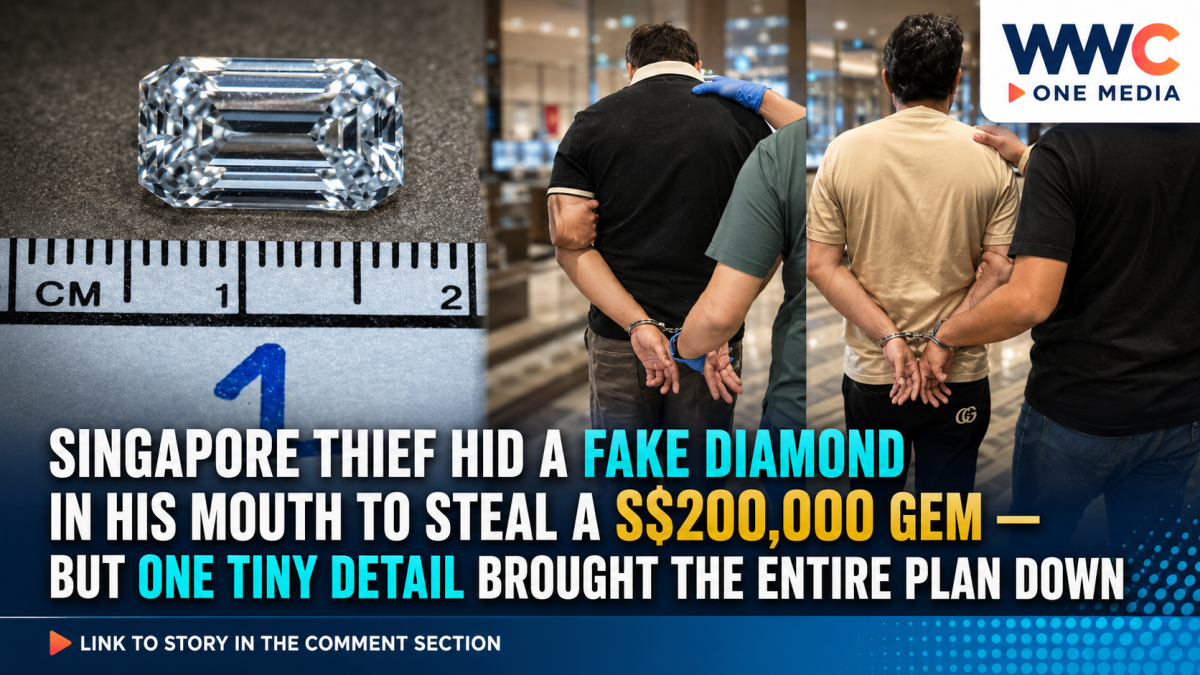
SINGAPORE — It had the ingredients of a carefully engineered international jewel heist: a targeted 4.95-carat diamond, a counterfeit specially manufactured overseas, a distraction inside a Chinatown jewellery store and an escape flight booked for the same evening.
But the plan ended at Changi Airport.
Serasiya Milan Ramnikbhai, a 30-year-old Indian national, was sentenced on Tuesday, September 1, to 26 months and two weeks in jail after pleading guilty to theft with common intention over the June 19 theft of a diamond from Dianoche Diamonds Jewelry in Singapore’s Chinatown.
His accomplice, Mangroliya Manojkumar Kurjibhai, 41, had already received the same prison sentence in July.
What makes the case particularly striking was not simply the value of the gemstone, but the amount of preparation that prosecutors said went into stealing it.
A Fake Diamond Made Before They Even Reached Singapore
According to court proceedings reported by Channel NewsAsia, the two men had a counterfeit diamond specially made in Surat, India, before travelling to Singapore.
It was not an ordinary imitation.
The counterfeit was manufactured to match the specifications and serial number of the genuine 4.95-carat diamond they intended to steal. Court documents cited in earlier reports did not explain how the pair obtained those details in advance.
Serasiya’s lawyer said Mangroliya, who had experience in the gem industry, conceived the scheme, identified the jewellery business, sourced the counterfeit stone and arranged their flights and accommodation.
The two men, who had been introduced through a mutual friend, entered Singapore on June 19 on social visit passes with the intention of taking the diamond, according to court evidence.
The Swap Took Place Inside a Chinatown Jewellery Store
At around 3pm on June 19, the pair entered Dianoche in the Kreta Ayer Road area and asked to inspect the 4.95-carat diamond.
The plan relied on distraction.
Mangroliya asked the sales manager to show him several other pieces, drawing the employee’s attention away from Serasiya.
Serasiya had entered the store with the counterfeit stone hidden inside his mouth.
When the opportunity came, prosecutors said he spat out the fake diamond, substituted it for the genuine stone and then concealed the real diamond in his mouth.
There was one problem: the manoeuvre was captured by the store’s CCTV cameras.
After the switch, Mangroliya reportedly told the manager that the pair would think about making the purchase, and the two men walked out without buying anything.
The Fake Passed Briefly — But Not for Long
Their departure apparently bought them only a short head start.
The sales manager later checked the stone with an optical gemstone identification machine and discovered that the diamond left behind was counterfeit.
Police were contacted at about 3.40pm.
The two men returned to their hotel, checked out ahead of schedule and arranged to leave Singapore for India that evening.
They would not make the flight.
Authorities identified the suspects using investigations, CCTV footage and police-camera images and intercepted them at Changi Airport Terminal 3 as they attempted to clear immigration.
The genuine diamond was ultimately recovered from Serasiya’s haversack.
Was the Diamond Worth S$200,000 or More Than S$235,000?
There is an important difference between the initial police valuation and the figure subsequently presented in court.
When Singapore Police first announced the arrests on June 20, the force said the stolen diamond was valued at more than S$235,000.
Later court documents cited by CNA and The Straits Times valued the 4.95-carat stone at US$154,000, equivalent to roughly S$199,000 at the time.
For that reason, describing it as a “nearly S$200,000 diamond” based on the court valuation is the most appropriate wording for the sentencing story, while acknowledging that police initially reported a higher figure.
Both Men Receive the Same Sentence
Mangroliya pleaded guilty earlier and was sentenced on July 17 to two years, two months and two weeks in jail.
When Serasiya appeared for sentencing on September 1, prosecutors sought the same punishment, arguing that there was no significant difference in culpability that justified treating him differently.
The defence also asked for parity with Mangroliya’s sentence.
Serasiya’s lawyers argued that Mangroliya had devised the plan and had knowledge of the diamond trade, while Serasiya did not. They said Serasiya had agreed to carry out the physical swap in exchange for money.
The court ultimately imposed the identical sentence: 26 months and two weeks’ imprisonment.
Under Singapore law, the theft offence involved could have resulted in up to seven years in prison and a fine.
The Bigger Warning for Singapore’s Luxury Retailers
Beyond the unusual detail of a diamond being hidden inside a suspect’s mouth, the case illustrates how sophisticated retail theft can involve preparation long before a suspect enters a shop.
This was not simply an opportunistic grab-and-run theft. Authorities said a replacement stone had been commissioned overseas, the genuine gemstone had apparently been identified beforehand, roles were assigned to the two participants and an exit from Singapore was planned for the same day.
Following the original arrests, Singapore Police specifically warned businesses selling luxury goods to remain vigilant against similar sleight-of-hand thefts.
In this case, the counterfeit stone may initially have looked convincing enough to allow the pair to walk out.
But specialised verification equipment, surveillance footage and the speed of the police investigation meant their carefully prepared escape ended before they could leave Singapore.
The diamond was recovered.
Both men are now behind bars.
And perhaps the most intriguing unanswered question remains the one court documents have not publicly explained: how did the pair obtain enough information about the targeted diamond beforehand to have a counterfeit made with matching specifications and serial number?
WWC ONE MEDIA MJE




Leave a Reply