
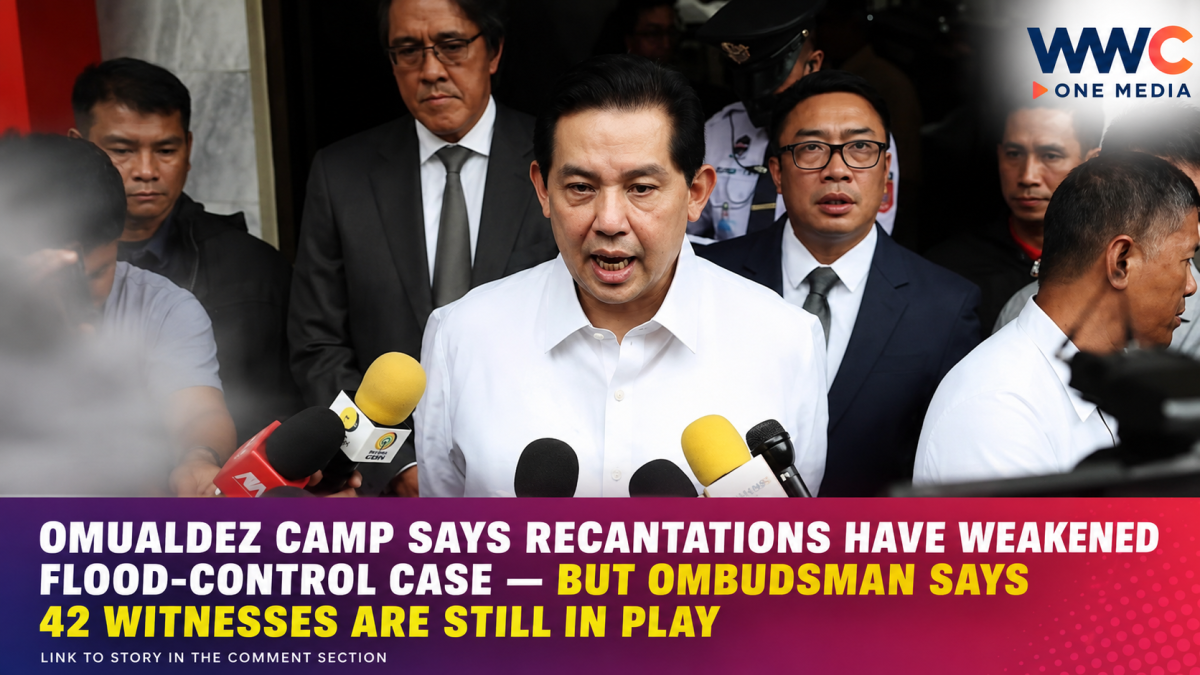
MANILA, Philippines — The legal battle surrounding former House Speaker and Leyte Rep. Ferdinand Martin Romualdez has entered a potentially decisive phase, with his lawyers arguing that a series of witness recantations has badly weakened the flood-control corruption case against him — while the Office of the Ombudsman insists the investigation is far from collapsing.
At the heart of the dispute is a simple but critical question: When a witness changes his story, does that destroy the original testimony — or give investigators another piece of evidence they must examine?
Romualdez’s lawyer and spokesperson, Ade Fajardo, accused the Ombudsman on September 1 of making public statements that appear intended to keep the case against the former Speaker alive despite contradictions and withdrawals among witnesses.
Fajardo said Romualdez’s camp disagrees with Assistant Ombudsman Mico Clavano’s position that recantations become additional evidence because investigators can compare the original affidavit with the later version to determine which account is credible.
The Ombudsman’s position has been blunt: “Recantation is not an eraser.”
Clavano has said investigators must examine both versions rather than automatically assuming that a later affidavit cancels an earlier sworn statement. Manila Bulletin and ABS-CBN separately reported the same position from the anti-graft office.
Romualdez camp: Conflicting stories weaken the case
Romualdez’s lawyers see the situation very differently.
Fajardo argued that a witness who initially claims personal knowledge of an alleged crime and later withdraws or contradicts that account creates a serious credibility problem that investigators must resolve before taking a criminal case to court.
His camp maintains that the Ombudsman cannot simply add the original testimony and the recantation together and describe the result as stronger evidence.
In its view, the conflicting statements should force investigators to determine which version — if either — can be independently verified.
Romualdez has repeatedly denied receiving kickbacks or participating in an illegal flood-control scheme.
His lawyers have also argued that there is insufficient documentary, financial or other independent evidence directly connecting him to the alleged cash deliveries described by some witnesses. Philstar reported that Fajardo has repeatedly questioned the reliance on testimonial evidence and pointed to inconsistencies in witness accounts.
But the Ombudsman says it now has 42 witnesses
The recantations have not prompted the Ombudsman to abandon its investigation.
Instead, Clavano said on August 28 that investigators were considering 42 witnesses in connection with the case.
That number consists of 28 additional witnesses identified by investigators and 14 of the original 18 individuals described as the “Maleta Boys,” according to the Ombudsman.
Four members of the original group had recanted previous statements concerning alleged suitcase deliveries.
Clavano stressed, however, that the investigation should not become a contest over who has the larger number of witnesses. What matters, he said, is the quality, credibility and material value of their accounts.
That distinction could ultimately become one of the most important issues in the case.
Forty-two witnesses may sound formidable, but prosecutors would still need evidence capable of establishing the alleged transactions and connecting particular individuals to them. Conversely, the existence of recantations does not automatically invalidate every earlier statement.
Investigators must determine what can actually be corroborated.
Guteza recantation dramatically changed the narrative
One of the most significant reversals came from retired Marine Orly Guteza, a former security aide of ex-Ako Bicol Rep. Zaldy Co.
Guteza had previously alleged that he participated in deliveries of suitcases containing cash connected to the flood-control controversy.
He later recanted key portions of his account and said he did not have personal knowledge of some of the alleged deliveries.
In his new affidavit, Guteza also alleged that Sen. Rodante Marcoleta and former lawmaker Mike Defensor had pushed him to fabricate accusations against Romualdez. Those claims remain allegations and have not been established by a court.
Guteza’s reversal came on top of recantations by several other former security personnel linked to Co.
Romualdez’s legal team subsequently submitted a supplemental counter-affidavit containing the recantation and sworn statements from 25 former drivers and security aides of Co who denied knowing about or participating in deliveries of money to Romualdez or other politicians and government officials.
The competing affidavits have transformed what was initially a story about alleged suitcase deliveries into a wider credibility battle over how those statements were obtained, why witnesses changed their accounts and whether independent evidence can confirm either version.
The case itself is much bigger than the recantation controversy
The underlying allegations are substantial.
A special panel of Ombudsman investigators filed a supplemental complaint-affidavit in July seeking a preliminary investigation involving Romualdez, former Ako Bicol Rep. Elizaldy “Zaldy” Co and other respondents.
Investigators alleged that Romualdez and Co participated in coordinated transactions through which approximately ₱56 billion in alleged ill-gotten wealth was accumulated from 2022 to 2025 in connection with government dealings and flood-control projects.
The complaints being investigated include allegations of plunder, graft, direct and indirect bribery, and money laundering.
Those are accusations contained in the Ombudsman proceedings — not findings of guilt. Romualdez has denied wrongdoing and continues to contest the evidence against him.
Romualdez camp now raises “prejudgment” issue
The dispute has also moved beyond the evidence itself.
Romualdez’s camp now argues that repeated public pronouncements by Ombudsman officials could create the impression that investigators have already decided the former Speaker’s role before completing the preliminary investigation.
Fajardo said on September 1 that the defense was concerned Romualdez had effectively been prejudged, particularly through public statements portraying him as a central figure in the alleged scheme.
The legal team said the case should instead be resolved on evidence formally presented, tested and weighed in the proceedings.
GMA News separately reported the same argument from Romualdez’s camp on September 1.
What happens next could matter more than the recantations
For now, the competing public statements do not determine whether Romualdez will ultimately face trial.
The case remains in the preliminary-investigation stage.
The Ombudsman must evaluate the complaint, counter-affidavits, witness statements, recantations and other available evidence before deciding whether sufficient grounds exist to pursue criminal charges in court.
Earlier, the Ombudsman directed Romualdez and other respondents to submit counter-affidavits, saying the case would be submitted for resolution after the parties completed their submissions.
That means the real turning point may not be whether there are 42 witnesses, 32 defense affidavits or another round of recantations.
It will be whether investigators can establish a credible, independently supported chain of evidence connecting the alleged flood-control transactions, money trail and cash deliveries to Romualdez — or whether the contradictions raised by his defense create too much doubt for the case to advance.
For Romualdez, the recantations are evidence that the accusations are unraveling.
For the Ombudsman, they are another set of statements that must be investigated rather than automatically accepted.
And with billions of pesos allegedly involved, dozens of witnesses giving competing accounts, and the credibility of key testimony now under attack, the biggest question is no longer who has more witnesses — but whose story the evidence can actually prove.
WWC ONE MEDIA MJE



Leave a Reply