
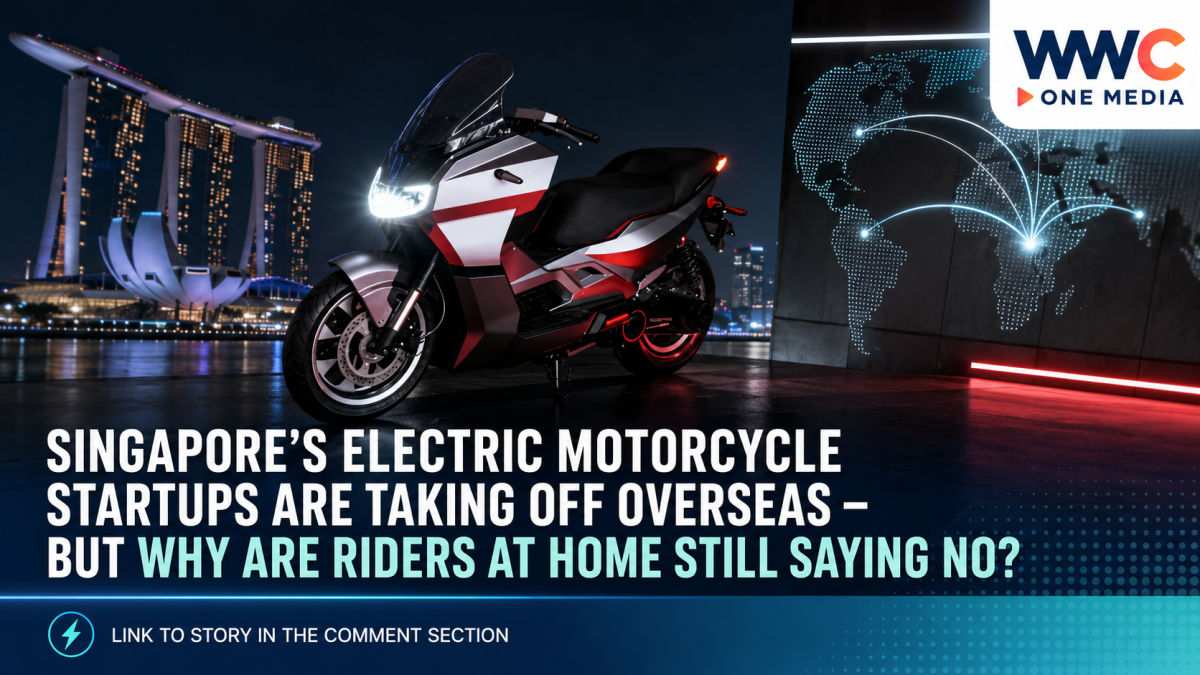
SINGAPORE — Singapore has spent years building one of Southeast Asia’s most ambitious electric-vehicle ecosystems. Yet when it comes to motorcycles, the electric revolution has barely left the starting line.
As of July 2026, just 433 electric motorcycles were registered on Singapore roads, representing roughly 0.2% of the country’s motorcycle population. By comparison, Singapore already has more than 69,000 electric cars, accounting for over 10% of its car population.
The striking difference is forcing Singapore-founded electric motorcycle companies to rethink where their biggest opportunities really are.
Instead of waiting for local riders to switch, several companies are expanding into Indonesia and other motorcycle-heavy markets across Southeast Asia — while using Singapore as a headquarters for capital, technology, management and regional expansion.
And ironically, some of Singapore’s electric motorcycle companies may have to become successful overseas before electric motorcycles become mainstream at home.
Singapore Firms Go Where the Motorcycles Are
The logic is largely about scale.
Indonesia has one of the world’s largest motorcycle populations, with estimates ranging from about 112 million to 139 million motorcycles. Two-wheelers dominate everyday transport in many Indonesian cities in a way they simply do not in Singapore.
That difference has made Indonesia an obvious testing ground for Singapore electric-mobility companies.
Singapore-founded Kilats, for example, has been operating in Indonesia since 2024.
The company has nearly 700 electric motorcycles rented to Grab operations in Bali and Bandung, supported by 44 battery-swapping stations, according to CNA.
Kilats is now looking beyond Indonesia. Its expansion plans include entering Thailand by the end of 2026, followed by Vietnam and the Philippines in 2027.
Co-founder Vincent Yap described Singapore less as the company’s primary riding market and more as the base from which regional expansion can be financed and managed.
That could become an increasingly common model for Singapore mobility startups: research, capital and headquarters at home — mass deployment elsewhere.
Charged Asia Is Following the Same Road
Another Singapore-founded company, Charged Asia, has already deployed more than 5,000 electric motorcycles in Indonesia.
Its chief executive Joel Chang told CNA that Indonesia currently generates all of the company’s revenue, while Malaysia is being considered as another expansion market.
The company has set an ambitious target of deploying more than 300,000 motorcycles across the region in the coming years.
Charged is not abandoning Singapore, however.
It plans to introduce an electric motorcycle locally that can plug into the existing EV charging network rather than depending entirely on dedicated motorcycle battery-swapping stations.
That distinction could be crucial.
Singapore has invested heavily in EV charging infrastructure primarily to support cars. If electric motorcycles can tap into that same network, manufacturers may be able to avoid the expensive chicken-and-egg problem of constructing an entirely separate charging ecosystem before there are enough riders to use it.
The Charging Problem May Be Bigger Than the Motorcycle
Singapore once appeared poised to embrace battery swapping.
Trials of motorcycle battery swap-and-charge stations began in 2022, allowing riders to exchange depleted batteries for charged ones instead of waiting for their motorcycles to recharge.
But the business model has proven difficult.
Mo Batteries, one of the companies involved in the early trials, eventually abandoned plans for a commercial swapping service after citing the investment and regulatory work required.
The company has since been deregistered.
Battery swapping has not disappeared entirely.
Cycle & Carriage continues operating Gogoro battery-swapping stations, with seven locations across Singapore. The company argues that swapping can solve one of electric motorcycles’ biggest weaknesses: charging time.
Where plugging in a motorcycle may take 30 minutes or considerably longer, exchanging a removable battery can take less than a minute.
The problem is scale.
A battery-swapping network becomes far more attractive when thousands of riders are using the same system. But operators may hesitate to invest in dozens of stations when the total electric-motorcycle population remains only a few hundred.
That leaves Singapore facing a familiar infrastructure dilemma: riders want convenient charging before buying electric motorcycles, while companies want more riders before investing heavily in charging infrastructure.
Government Says Electric Motorcycles Can Use Public EV Chargers
There is, however, one potentially important advantage for the next generation of electric motorcycles.
Singapore’s Ministry of Transport has confirmed that electric motorcycles with fixed batteries can use registered EV charging points across the island, including those at HDB car parks.
Direct charging from ordinary wall sockets is not permitted without appropriate power-management equipment because of fire-safety concerns.
That opens the door for manufacturers to design motorcycles around Singapore’s rapidly expanding public EV charging network rather than establishing proprietary swapping stations.
Singapore is targeting 60,000 EV charging points by 2030 as part of its wider electrification strategy.
For electric motorcycle manufacturers, gaining access to that infrastructure could dramatically change the economics of entering the Singapore market.
But Riders Still Face Range, Price and Battery Questions
Infrastructure is only one problem.
Motorcycles have much tighter physical limitations than cars when it comes to battery size.
A car can accommodate a large, heavy battery pack without fundamentally changing how the vehicle works. A motorcycle cannot easily do the same.
Adding more batteries increases weight and cost, while limiting battery size restricts range.
That leaves manufacturers balancing three things riders care deeply about: price, performance and how far they can travel between charges.
For commuters accustomed to refuelling a petrol motorcycle in minutes, even modest uncertainty over range or charging access can become a powerful reason not to switch.
The Singapore government itself acknowledged those obstacles in March 2026.
Responding to a parliamentary question about whether electric motorcycles should receive purchase incentives similar to those given to electric cars, Acting Transport Minister Jeffrey Siow said the government had no plans to introduce a dedicated electric-motorcycle purchase incentive.
The ministry said some electric motorcycles were already priced comparably with mass-market petrol models, while suggesting that limited range and insufficient fast-charging or battery-swapping infrastructure were more significant obstacles to adoption.
That means electric motorcycles currently do not enjoy an equivalent of the major Early Adoption Incentive offered to electric cars and taxis.
The First Big Buyers May Not Be Ordinary Riders
Industry players increasingly believe the breakthrough may therefore come from businesses rather than individual consumers.
Delivery companies, logistics firms, government-linked fleets and other organisations can calculate fuel and maintenance savings across hundreds or thousands of motorcycles.
That makes electric motorcycles easier to justify financially.
A delivery rider travelling long distances every day could also benefit more immediately from lower energy and maintenance costs than someone using a motorcycle occasionally.
Fleet deployment could create another benefit: visibility.
Once electric motorcycles become common among delivery fleets and commercial operators, ordinary riders will see how the machines perform in everyday conditions.
That could help answer questions about reliability, charging, battery lifespan and real-world range.
In other words, businesses may become the demonstration project that convinces consumers.
Singapore-Made Motorcycles Are Still Making Progress at Home
There are also signs that Singapore’s domestic electric motorcycle industry is finally moving forward.
In July 2026, home-grown manufacturer Scorpio Electric achieved road registration for its Lambda Scorpii, following conditional vehicle-type approval from the Land Transport Authority the previous month.
The Business Times reported that the motorcycle is now road-legal in Singapore and that Scorpio Electric plans a phased commercial rollout.
The model had previously secured European Union whole-vehicle type approval, underlining another trend in the industry: Singapore manufacturers are increasingly designing products to meet international standards from the beginning.
Other companies have also been eyeing the local market.
The Business Times previously reported that Singapore-founded Zion Mobility, which grew out of battery-swapping company Oyika, planned electric motorcycle launches across Singapore, Indonesia and the Philippines after beginning sales in Thailand.
Together, those developments suggest the local industry is not disappearing.
It may simply be globalising first.
The Bigger Question for Singapore
Singapore’s national ambition remains clear: the country wants all vehicles to run on cleaner energy by 2040.
Cars are already moving rapidly in that direction.
Motorcycles are another story.
With electric bikes accounting for only around 0.2% of the motorcycle population, convincing riders to abandon petrol will require more than simply introducing new models.
Manufacturers must prove that electric motorcycles can travel far enough, recharge conveniently, remain affordable and survive years of demanding daily use.
Singapore’s startups are attempting to prove exactly that — just not necessarily in Singapore.
Indonesia, Thailand, Malaysia, Vietnam and the Philippines may become the laboratories where Singapore’s electric motorcycle companies learn how to operate at scale.
And if those experiments work, the biggest irony may be this:
The technology that eventually electrifies Singapore’s motorcycle population could first have to prove itself on millions of kilometres of roads overseas.
WWC ONE MEDIA MJE

Leave a Reply