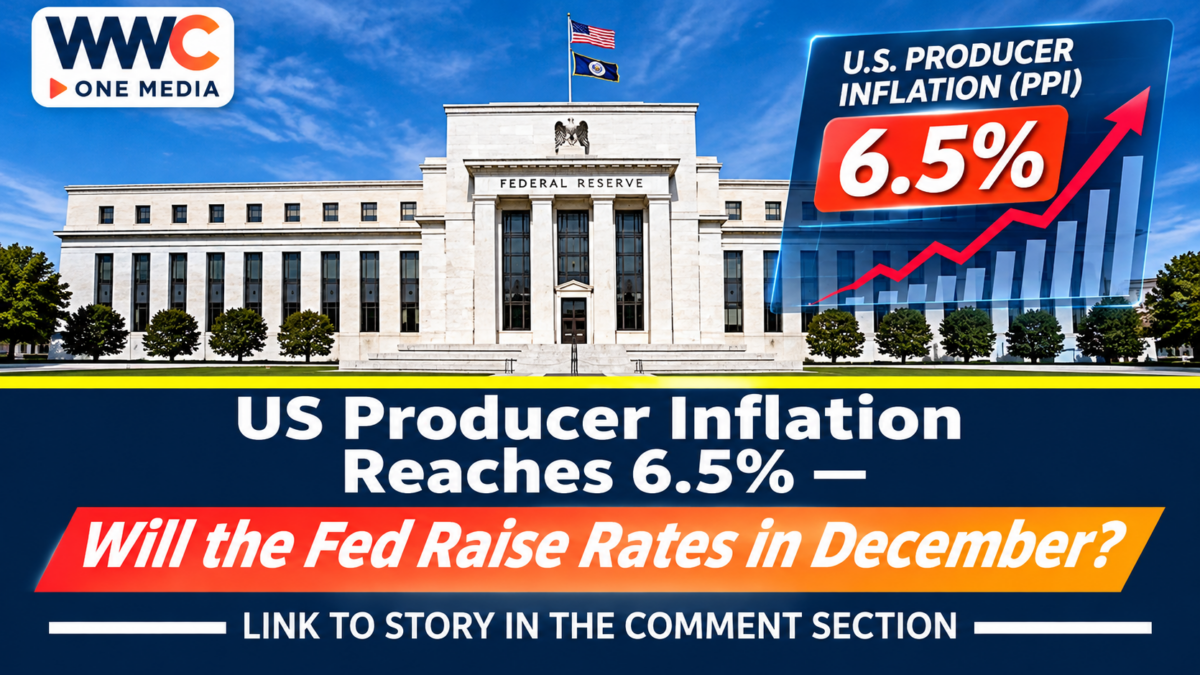
WASHINGTON, Nov. 15, 2026 — US producer prices rose 6.5% in the 12 months through October, the strongest annual increase since November 2022, government data released on Nov. 13 show. The Federal Reserve enters its next policy meeting in December with that factory-gate inflation signal alongside a 0.4% monthly rise in consumer prices, but without any official decision to increase borrowing costs again.
The figures create a difficult choice: higher input costs could eventually reach consumers, while another interest-rate increase could restrain demand and investment. How much pressure moves through the economy, and how the Fed weighs it against employment and activity, remain open questions.
US Producer Inflation Sends a Warning Beyond the Checkout
The Producer Price Index for final demand increased 0.3% in October on a seasonally adjusted basis, following a revised 1.4% gain in September. Over 12 months, the index rose 6.5%, up from 6.3% in September and the strongest year-on-year increase since the 7.4% reading in November 2022.
The monthly slowdown is important: a smaller October increase does not erase the preceding rise or imply that wholesale prices are falling. Producer inflation tracks prices received by domestic producers, not the exact prices every household pays at a supermarket.
Within October’s report, final-demand goods prices advanced 0.5%, while services prices rose 0.2%. Final-demand food prices increased 1.3%, although the energy component edged down 0.1%.
Another measure, final demand excluding food, energy and trade services, increased 0.5% for the month and 4.9% from a year earlier. This broader underlying measure provides a check against explanations based only on volatile energy prices.
Consumer Inflation Still Pressures Household Budgets
The separate Consumer Price Index increased 0.4% in October, down from the 0.6% monthly increase in September. Food prices rose 0.5%, energy 0.7% and shelter 0.3%. The index excluding food and energy advanced 0.3% for the third consecutive month.
Those figures show that slower month-to-month headline inflation is not the same as falling prices. Households can still face larger bills even when the pace of increases moderates.
There is an unusual limitation to the October data. Because the Bureau of Labor Statistics did not collect most October 2025 survey prices during a lapse in federal appropriations, it could not publish a standard 12-month October 2026 CPI change for many major categories, including the overall index. An annual consumer-inflation rate should not be invented from the available monthly figure.
WWC has already examined the individual expense categories in its October consumer-price report. This analysis instead asks what the subsequent producer-price release adds to the monetary-policy picture.
The Federal Reserve Has Not Approved Another Increase
At its Oct. 28 meeting, the Federal Open Market Committee voted 10–2 to maintain the federal funds target range at 3.75%–4.00%. Governors Lisa D. Cook and Beth M. Hammack dissented, preferring a quarter-percentage-point increase at that meeting.
The decision followed the Sept. 16 increase that set the current range. Taken together, the votes show policymakers are not unanimous about the timing of further tightening, but the October result remains an official hold, not a postponed hike that has already been approved.
The Fed’s latest statement described economic activity as expanding strongly, spending as resilient and inflation as elevated. It committed to evaluating additional information before deciding the policy stance required to return inflation towards its 2% goal.
WWC’s review of the October Fed hold explains why an individual official’s view, market speculation and a committee decision must be distinguished. Two dissents cannot establish how the committee will vote in December.
Why Higher Producer Prices Do Not Dictate the Next Vote
Analysis: Producers can respond to cost increases in several ways. Some raise selling prices, others accept narrower margins, change suppliers or reduce costs elsewhere. Accordingly, a high PPI reading creates potential pressure on consumer prices without establishing a one-for-one increase in CPI.
Similarly, an interest-rate increase affects borrowing and demand with a lag. It cannot directly manufacture more goods or reverse every supply disruption. A central bank therefore needs to assess whether elevated prices are spreading through the economy and becoming persistent.
The October producer report showed particularly firm goods inflation, but also differences among components. Diesel fuel prices fell 7.9% within the detailed producer indexes, while some chemical and transportation-related prices increased. A single headline number obscures such divergent cost changes.
Earlier WWC coverage of debate over additional US interest-rate increases offers political and financial-market context. None of those scenarios constitutes a guaranteed outcome for stocks, bonds or currencies.
Why the Philippines Should Follow the Decision
Analysis: US interest rates can affect global dollar financing and investors’ appetite for emerging-market assets. Changes in Treasury yields and demand for dollars may influence the peso, although the direction and size of any exchange-rate move depend on many other factors.
Imported commodities and dollar-denominated business costs can also respond to exchange rates. But a US producer-price increase is not automatically a Philippine consumer-price increase, and a Fed hike would not require the Bangko Sentral ng Pilipinas to make an identical move.
For Philippine companies, the useful approach is to assess several interest-rate and currency scenarios rather than base borrowing or pricing decisions on one predicted December outcome.
What Happens Next
The Fed’s published calendar schedules the minutes of its Oct. 27–28 meeting for Nov. 18 and its next policy meeting for Dec. 8–9. The November US employment report is scheduled for Dec. 4, while the next monthly CPI release, for November, is scheduled for Dec. 10—after the Fed’s December decision.
That timetable makes the information available before the meeting especially consequential. The newest producer-price figures strengthen the case for examining persistent inflation, but neither those data nor the two October dissenting votes settle the December outcome.
Frequently Asked Questions
What was US producer inflation in October 2026?
The Producer Price Index for final demand rose 0.3% over the month and 6.5% over 12 months, in the official Nov. 13 release.
What was the latest monthly US consumer inflation reading?
Consumer prices increased 0.4% in October. An overall 12-month October CPI rate was unavailable because of missing October 2025 comparison data.
Did the Federal Reserve raise interest rates in October?
No. On Oct. 28, the committee held its target range at 3.75%–4.00% by a 10–2 vote.
When is the next Federal Reserve interest-rate decision?
The Fed’s next scheduled policy meeting is Dec. 8–9, 2026. Another increase has not been announced.