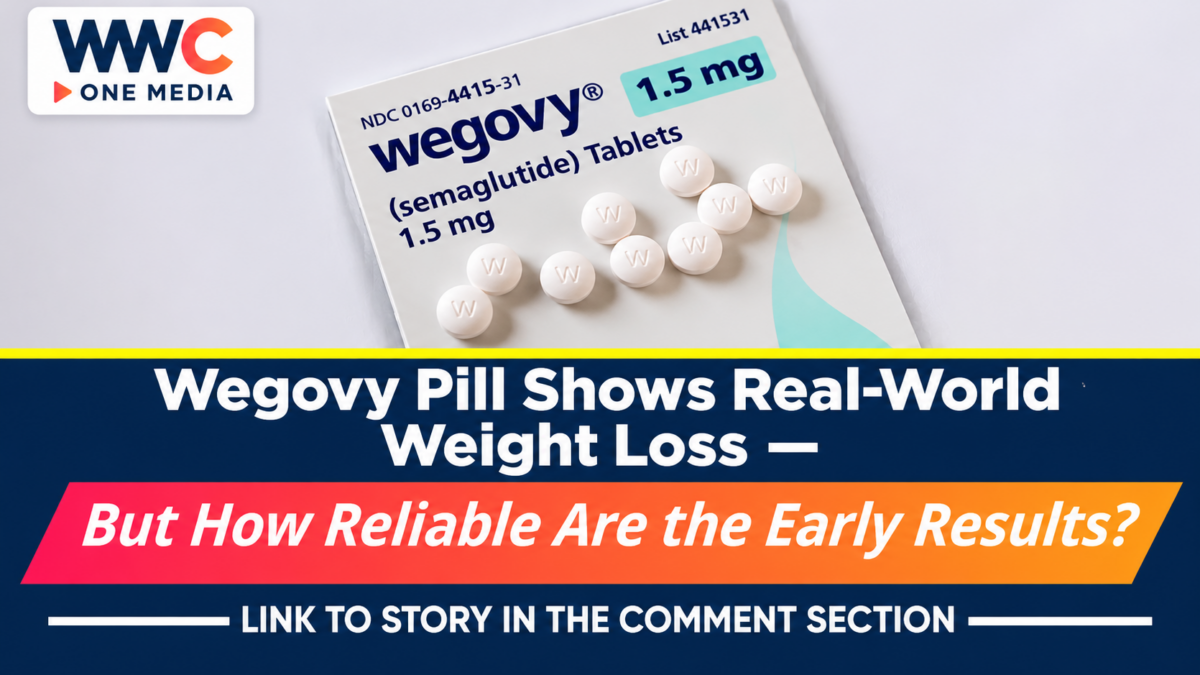
NEW YORK, Nov. 15, 2026 — Novo Nordisk’s Wegovy pill has been associated with weight reduction in real-world treatment programmes, with the drugmaker’s latest quarterly presentation showing average three-month reductions of 5.9% in a Ro telehealth cohort and 6.7% in its WeGoTogether support cohort. The figures offer an early view of how oral semaglutide is being used outside a controlled trial, but they are not proof that every patient will achieve the same result.
The findings come as new research on oral semaglutide is scheduled at the Nov. 14–17 ObesityWeek meeting. The distinction for patients, clinicians and investors is between an observed average in selected groups and a reliable expectation for everyone prescribed treatment.
Wegovy Pill Results: What the Company Actually Disclosed
A chart in Novo’s third-quarter 2026 investor presentation compares three sources of data at one, three and six months. At three months, the presentation reports average weight changes of minus 5.9% for Ro users, minus 6.7% for WeGoTogether users and minus 5.3% in the OASIS 4 clinical-trial comparison.
At six months, those figures are minus 11.8%, minus 11.5% and minus 10.4%, respectively. These are results reported for their respective datasets, not estimates that can be pooled into a single overall treatment effect.
The presentation does not establish that its groups were randomly assigned to different programmes. Their enrolment rules, follow-up and reasons for continuing treatment may differ, limiting direct comparisons. Nor does a company slide replace a complete peer-reviewed account of all methods and missing data.
A separately announced September analysis examined patients who switched from weight-loss injections to the pill. Its reported average loss over three months was 4.1%, or approximately 4.0 kilograms. That switching population is different from people starting an obesity medicine for the first time.
The New Conference Study Needs Its Own Scrutiny
The official ObesityWeek programme lists a poster titled 3-Month Weight Outcomes with Oral Semaglutide via Telehealth in Adults with Overweight or Obesity for Nov. 15. It identifies Ro researcher Lauren Broffman as a presenter.
The conference’s publicly accessible poster listing establishes the presentation’s title, presenter and scheduled session. It does not itself supply a fully verifiable numerical results table. Consequently, a separately reported 6.2% finding, its exact participant count and individual response rates are not presented here as independently confirmed study findings.
That distinction is important because the numerical claims may refer to a different cohort or analytic cut from those in the earlier investor presentation. Treating all of them as a single study could mislead readers about consistency and certainty.
Analysis: The useful next question is not whether one reported average exceeds another by a fraction of a percentage point. It is whether outcomes remain consistent when investigators account for patients who discontinue treatment, are lost to follow-up or have incomplete measurements.
An Approved Medicine Still Has Significant Risks
Wegovy tablets contain semaglutide, a GLP-1 receptor agonist. The US prescribing information authorises the tablets, alongside reduced-calorie eating and increased physical activity, for long-term weight reduction in specified adults with obesity or overweight and a weight-related condition.
The US label carries a boxed warning concerning thyroid C-cell tumours observed in rodents; whether the risk occurs in humans is unknown. It contraindicates use in people with a personal or family history of medullary thyroid carcinoma or multiple endocrine neoplasia syndrome type 2.
Other warnings include pancreatitis, gallbladder disease, kidney injury associated with volume depletion and severe gastrointestinal reactions. The label includes specific administration instructions for the oral product, reflecting the fact that a pill and an injection are not interchangeable simply because they contain the same active ingredient.
The safety information is essential context. A reduction in average weight does not establish that a particular patient is medically suited to the drug. Decisions on treatment require a licensed clinician’s assessment and follow-up.
WWC has separately examined safe needle disposal amid the growth of injectable weight-loss treatments. The oral option changes the method of administration, but it does not eliminate the medicine’s clinical precautions.
Why Novo Is Emphasising Real-World Evidence
Novo’s quarterly presentation says that approximately 80% of users represented in its US oral-obesity market profile were new to GLP-1 obesity medicines. It also reports more than seven million prescriptions year to date, with around 90% classified as self-pay in the data described on the slide.
Those commercial metrics show substantial uptake in the company’s reported market channels. They do not independently establish long-term adherence, broad insurance affordability, or the health outcomes of everyone receiving a prescription.
The commercial stakes are clear from the industry competition. WWC’s report on Eli Lilly’s revenue expansion and obesity medicines provides context on the rival product portfolio. Such business performance should not be interpreted as a head-to-head clinical comparison of the products.
Early Weight Loss Is Only One Measure of Success
Analysis: Short-term changes can be useful indicators, but sustained outcomes require longer observation. The significance of a three-month average depends on the starting population, adherence, side effects, missing measurements and what happens after treatment changes or ends.
Additional therapies are in development, including Novo’s investigational CagriSema. WWC’s coverage of CagriSema’s exploratory results describes a separate research programme. Results across products, doses and trial populations should not be ranked without appropriate controlled comparisons.
For Philippine readers, US approval is not evidence of identical authorisation, pricing or availability in the Philippines. Local regulatory status and prescribing rules must be checked separately.
What Happens Next
The next useful evidence will be the full ObesityWeek poster or research abstract with its participant definitions, data-completeness methods, safety findings and exact reported outcomes. Later peer-reviewed publications and longer follow-up would help establish how representative the initial real-world findings are.
Until those details can be checked, the defensible conclusion is measured: official company materials show meaningful average weight reductions among the groups they describe, but not guaranteed results for individual patients.
Frequently Asked Questions
How much weight did Wegovy pill users lose in three months?
Novo’s third-quarter presentation reported average reductions of 5.9% in a Ro dataset and 6.7% in its WeGoTogether dataset. These are separate cohorts, and individual outcomes vary.
Is Wegovy available as a pill in the United States?
Yes. US prescribing information includes Wegovy tablets for specified adult indications, alongside dietary changes and physical activity.
Are real-world results the same as clinical-trial results?
No. Real-world observational data and controlled trials can involve different patients, follow-up arrangements and sources of bias. Their results should not be treated as directly interchangeable.
Is Wegovy safe for everyone who wants to lose weight?
No. The US label includes contraindications, a boxed warning and other important precautions. Treatment suitability requires individual medical assessment.