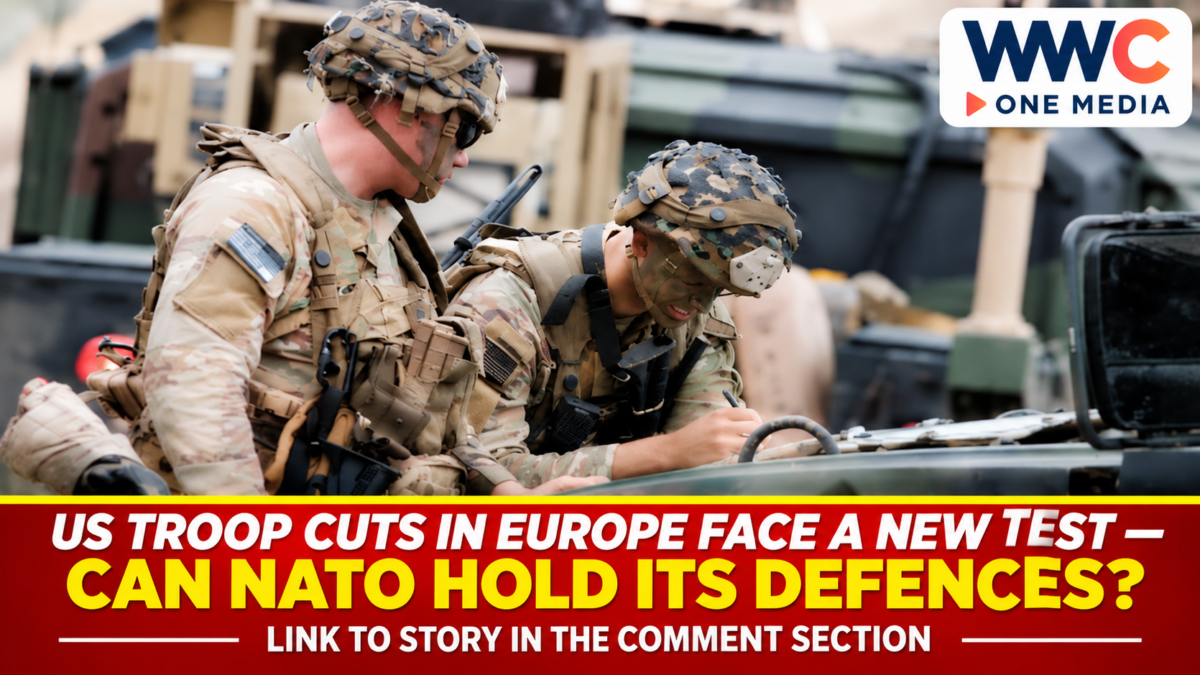
WASHINGTON, Nov. 15, 2026 — The United States had approximately 78,000 military personnel assigned to its European Command area at the end of September, a newly published government oversight report shows, as Washington continues reviewing its military posture across Europe. The figure puts American forces close to a congressional threshold requiring additional safeguards before a deeper reduction can proceed.
The debate is not simply about how many soldiers remain. NATO allies must consider what capabilities the United States retains, how European governments expand their own forces, and whether changes to the American presence preserve the alliance’s ability to respond to threats.
US Troop Cuts in Europe: What the Official Figures Show
The latest quarterly Operation Atlantic Resolve oversight report, published in November and covering July through September 2026, records approximately 78,000 US military personnel assigned to the US European Command area of responsibility. Of these, about 6,000 supported Operation Atlantic Resolve, the American effort associated with the response to Russia’s full-scale invasion of Ukraine.
The total is not the same as counting every civilian or contractor working with American forces. The report separately lists approximately 5,000 civilian personnel and 1,000 contractors, bringing its combined estimate to 84,000 people. These are rounded figures for the end of the reporting period, not a live headcount for Nov. 15.
The report’s military totals also show a decline from approximately 85,000 in the second quarter of fiscal 2026 and 81,000 in the third quarter to 78,000 in the fourth. That historical trend is established; an additional, newly approved November reduction is not.
WWC previously examined the Pentagon’s Europe deployment review and NATO leadership discussions. The new oversight figures provide a more concrete benchmark against which any future announcement can be judged.
A 5,000-Troop Decision Was Already Discussed Publicly
In a May 19 NATO press conference, General Alexus G. Grynkewich, Supreme Allied Commander Europe, explained a previously announced plan to remove 5,000 US troops from Europe. He said it included the return of an armoured brigade combat team without replacement and the cancellation of a planned deployment of a long-range fires battalion.
That earlier announcement matters for understanding fresh speculation. A 5,000-person figure appearing in discussion of a later posture review does not, without new official documentation, prove that Washington approved an additional 5,000 cuts on top of the measures already disclosed.
Grynkewich also pointed to greater ground-force capabilities among European allies, including multinational formations, as part of the military context for the announced adjustments. Whether the same balance holds after further changes would require a new assessment of forces, readiness and missions.
The September oversight report separately says US Army Europe and Africa had reduced its ground posture to three brigade combat teams, one rotational, and one rotational division headquarters. It describes the incremental reductions since late 2025 as part of a broader strategic shift.
Congress Put Conditions on Deeper Withdrawals
The fiscal 2026 defence authorisation framework limits reductions below 76,000 troops in the European Command area without a national-security certification and consultation with allies, along with congressional oversight requirements. The September estimate of 78,000 therefore leaves little room beneath the reported level before that statutory threshold becomes relevant.
Importantly, the threshold is not a blanket guarantee that the same number of troops must remain permanently in Europe. It is a safeguard that attaches conditions to certain decisions, including the need to examine consequences for US and NATO security.
Analysis: Congressional scrutiny can force a more explicit accounting of the risks and benefits of substantial changes. It does not, by itself, settle which deployment mix offers the strongest deterrence.
NATO Spending Is Rising, but Capability Takes Time
NATO’s 2025 Hague commitment sets a target of defence and security-related investment equivalent to 5% of members’ GDP annually by 2035. This includes at least 3.5% for core defence requirements and up to 1.5% for wider defence- and security-related investment.
NATO reports that European allies and Canada increased their combined defence expenditure by nearly 20% in real terms in 2025 compared with 2024. That investment supports Washington’s argument that Europeans can take greater responsibility for conventional defence.
Spending commitments, however, do not instantly create deployable brigades, ammunition reserves, air defences or transport capacity. Procurement, training and integration take time; the operational effect depends on what is bought and when it becomes usable.
WWC’s coverage of NATO partners’ efforts to fund weapons for Ukraine offers another view of the burden-sharing debate. More national spending and more collective purchasing can complement each other, but neither should be confused with an immediate replacement for every US capability.
Washington’s Strategy Still Calls for a European Lead
The US National Defense Strategy issued in January 2026 states that European NATO allies should take primary responsibility for the continent’s conventional defence, while American support becomes more limited but remains important. It also identifies cooperation on defence production and planning as part of that transition.
This policy does not amount to an official decision to abandon NATO. Nor does it specify the precise number of troops to be withdrawn in a new November order. Strategy expresses the direction of policy; individual deployment decisions require their own authorisation and implementation.
European security debates also extend to Ukraine’s longer-term position. WWC’s report on European objections to security negotiations without an end to the Ukraine war examines that diplomatic backdrop without implying that a troop review predetermines peace negotiations.
What Happens Next
The key next step is an attributable, final US government decision specifying troop numbers, locations, units and dates, together with any required certification and allied consultation. Until those details are public, projections about a smaller new withdrawal remain proposals or expectations rather than confirmed military orders.
The available primary records establish the current documented baseline, previously announced reductions, congressional safeguards and NATO’s spending commitments. They do not independently verify a fresh reversal in the Pentagon’s deliberations.
Frequently Asked Questions
How many US troops were in Europe in September 2026?
The official inspector-general report lists approximately 78,000 military personnel assigned to the US European Command area at the end of September. The rounded figure is not a real-time count.
Has the Pentagon confirmed another 5,000-troop withdrawal?
The reviewed NATO transcript confirms a 5,000-person reduction discussed in May. A separate, newly finalised November withdrawal of that size was not confirmed in the primary records reviewed.
What is the 76,000-troop limit?
US law imposes additional certification and oversight conditions on certain reductions that would bring American military force posture in the European Command area below 76,000.
Does NATO’s 5% target mean every country already spends that much?
No. The Hague commitment sets an annual 5%-of-GDP target for 2035, with specified categories of investment, rather than stating that all members have already reached it.