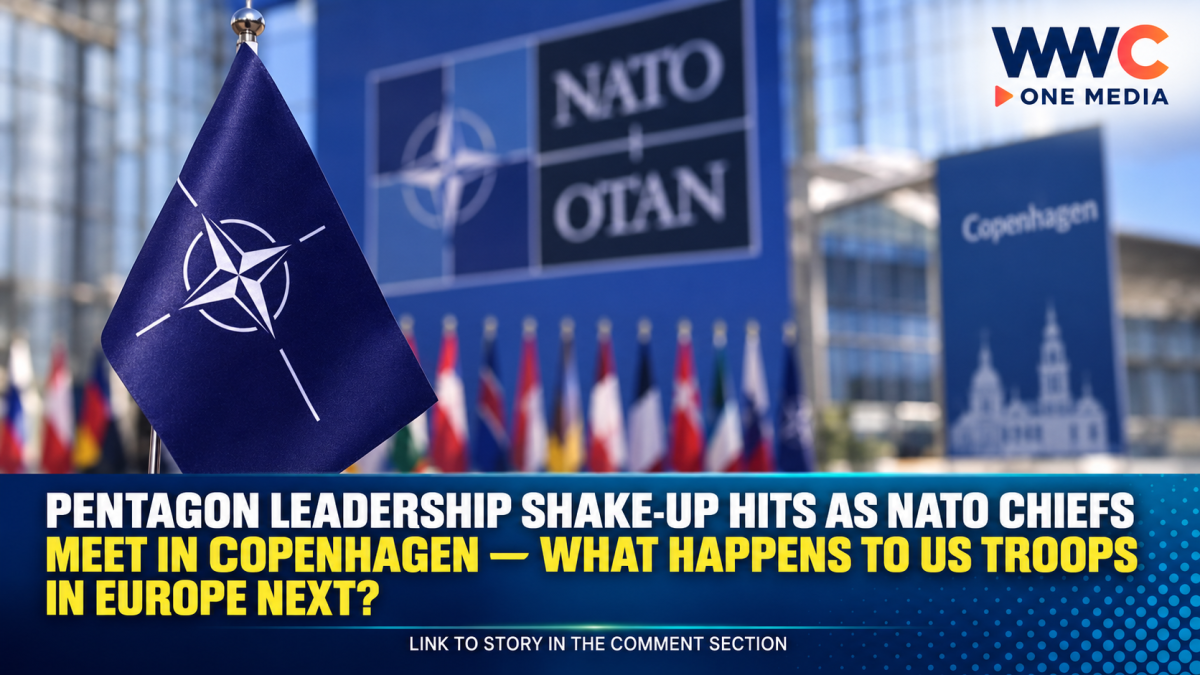
WASHINGTON/COPENHAGEN — A wave of senior leadership changes at the Pentagon is putting renewed attention on the United States’ military role in Europe just as NATO’s top military chiefs gather in Copenhagen for talks on collective defence, innovation and support for Ukraine.
The NATO Military Committee is meeting in Copenhagen on September 18 and 19, bringing together the chiefs of defence of all 32 NATO member countries. The meeting is also attended by NATO’s senior military commanders, including Supreme Allied Commander Europe General Alexus G. Grynkewich.
The timing is significant because Washington is simultaneously reviewing the size and structure of its military presence in Europe, while the Pentagon has experienced substantial turnover among senior civilian and military officials.
Pentagon leadership turnover draws attention
More than two dozen senior military officers have left or been removed from their positions since Pete Hegseth became defence secretary in 2025, according to CNA’s reporting. Among the departures were former Army Chief of Staff General Randy George and former Chairman of the Joint Chiefs of Staff General Charles Q. Brown Jr.
The latest high-profile departure involved Army Secretary Dan Driscoll, who submitted his resignation in late August. His exit came after reported tensions with Hegseth and left the Army facing vacancies in both its top civilian and uniformed leadership positions.
Reuters has separately reported that the White House had examined possible candidates to replace Deputy Defense Secretary Steve Feinberg, although the Pentagon and Hegseth denied that Feinberg was being pushed out and said he had the secretary’s support.
The succession of departures has prompted concern among some lawmakers about continuity inside the Pentagon. Roll Call reported that House Armed Services Committee Chairman Mike Rogers expressed concern about leadership vacancies following Driscoll’s resignation.
US troop presence in Europe under review
The leadership changes coincide with a Pentagon review of America’s military deployment across Europe.
Around 80,000 US personnel remain stationed in Europe, and the Pentagon is assessing possible changes to the force posture. Reuters reported in August that the review was expected to produce multiple options for Hegseth, with the process examining issues including bases, access, overflight rights, cyber capabilities, space infrastructure and intelligence assets.
Reuters reported on September 17 that the review could potentially involve the withdrawal of as many as 25,000 US troops, although that figure represents a possible option rather than a confirmed decision. Senator Jeanne Shaheen has urged US diplomats to play a greater role in the process because troop changes could have significant diplomatic consequences for NATO allies, particularly countries on the alliance’s eastern flank.
The State Department has said its officials are being consulted.
For European governments, the issue is not simply the number of American troops stationed on the continent. Changes to US forces could also affect air defence, intelligence, logistics, command structures and other capabilities that are difficult for individual European allies to replace quickly.
NATO meeting comes at a sensitive moment
The Copenhagen meeting itself is a regular NATO military gathering rather than an emergency summit.
According to NATO, the Military Committee’s agenda includes follow-up to the alliance’s Ankara summit, strengthening collective deterrence and defence, innovation and technology, and continued support for Ukraine.
But the broader strategic environment has made those discussions particularly consequential.
NATO members are dealing with continuing Russian military pressure against Ukraine, concerns about hybrid activity along the alliance’s eastern flank and uncertainty over the future scale of American military involvement in Europe.
NATO’s Article 5 remains the alliance’s collective-defence commitment: an armed attack against one member is treated as an attack against all. The practical military capability behind that commitment depends on the forces, command arrangements, logistics and defence systems available to the alliance.
Weapons stockpiles add another layer of pressure
The Pentagon is also dealing with questions about weapons inventories following the ongoing US conflict with Iran.
CNN reported in August that US military stockpiles of certain missile-defence interceptors had fallen sharply, including estimates that roughly 80 per cent of the pre-war THAAD interceptor inventory had been used and that more than half of the Patriot inventory had been expended. Defense Secretary Pete Hegseth disputed the reporting and said US stockpiles remained strong.
The issue has consequences beyond the Middle East.
Patriot interceptors are also important to Ukraine’s air-defence effort against Russian missile attacks. Reuters reported this week that Lockheed Martin had received its first batch of Patriot interceptor components from General Motors Defense as the US defence industry works to accelerate production.
That production push illustrates one of the Pentagon’s central challenges: replacing sophisticated weapons can take considerably longer than using them.
Europe is watching Washington’s next move
The combination of Pentagon personnel turnover, a review of US troop deployments and pressure on weapons inventories has created a closely watched moment for NATO allies.
European governments have spent years debating how much greater responsibility they should assume for the continent’s defence. At the same time, Washington under President Donald Trump has repeatedly pressed European allies to carry a larger share of the alliance’s defence burden.
The Trump administration’s approach does not necessarily mean the United States is leaving Europe. The outcome of the Pentagon’s force review remains unsettled, and the precise composition of any potential changes has not been publicly determined.
What is clear is that NATO’s military leadership is meeting while several major questions about America’s future role in European security remain open.
The Copenhagen discussions therefore provide an important forum for NATO’s military chiefs to assess how the alliance can maintain deterrence and defence capabilities while individual members adjust their military priorities.
For Washington’s allies, the key question is no longer simply who occupies senior positions at the Pentagon. It is how quickly the leadership changes, force-posture review and weapons-production pressures translate into decisions about America’s military commitments — and how NATO responds if they do.