DOHA / CARACAS — Nov. 15, 2026. Qatar-based UCC Holding has an officially announced participating interest in the Loran Phase 2 offshore gas project in Venezuela, with bp designated as operator and XRG joining the venture. The company’s latest public energy-industry update, dated Nov. 14, describes wider partnership discussions but does not announce an additional Venezuelan onshore field award.
That distinction matters as UCC Venezuela investment attracts attention. A granted interest in an offshore licence, a discussion about potential investments and an operating oilfield are three different milestones, each with separate technical, financial and regulatory implications.
What the UCC Venezuela investment announcement actually confirms
On Aug. 13, UCC Holding announced that its subsidiary UCC Oil and Gas had been granted a participating interest in the Phase 2 licence for Venezuela’s Loran offshore gas field. The company stated that Venezuela’s Minister of Hydrocarbons had executed the relevant licence documents.
UCC described a structure in which bp, XRG and UCC Oil and Gas each have an equal participating interest. It identified bp as operator, the partner responsible for leading the venture’s operational development under the agreed structure.
The release estimated around 4 trillion cubic feet of recoverable gas resources for Loran Phase 2. This is a technical estimate stated by the company, not a report of gas already produced or sold.
Loran lies in the Plataforma Deltana offshore area, northeast of the Orinoco Delta, near the maritime boundary with Trinidad and Tobago. Offshore location and resource size help explain the opportunity, but neither establishes the cost or schedule of commercial development.
Why a licence is not yet a producing gasfield
UCC’s announcement identifies subsurface evaluation, facilities engineering and assessment of possible routes to market as the consortium’s initial priorities. These are preparatory activities needed before partners can settle on a development concept.
The company expressly stated that any development decision would depend on the licence terms and required government and regulatory approvals. It did not announce a final investment decision, start date for production, committed construction budget or contracted sales volume.
The commercial question is how the project would convert recoverable resources into gas delivered to paying customers. That could require decisions about infrastructure, processing, transportation and commercial arrangements; the released document does not specify a completed route.
For context, WWC previously examined Venezuela’s oil export and transport constraints. Those crude-oil logistics issues are not evidence of any particular problem at Loran, but they illustrate why resource ownership and commercially dependable delivery should be assessed separately.
What UCC’s November update says — and leaves unanswered
A company announcement dated Nov. 14 described UCC Holding’s participation as an official partner and exhibitor at ADIPEC 2026 in Abu Dhabi. It said the group held discussions with international energy leaders covering potential investments and partnerships across oil, gas, power and infrastructure.
The announcement contained no identifiable Venezuelan onshore field name, counterparties for a new onshore contract, signed award, equity allocation or production schedule. It therefore cannot be used to confirm that a new onshore asset has been secured.
This is not evidence that negotiations are absent. It means the public corporate record inspected for this article does not establish their outcome or specific terms.
For any future onshore project, the crucial difference would be between a nonbinding expression of interest, a signed contingent agreement and an effective permission to commence operations. Describing all three as an acquisition would overstate the documentary record.
Why the US sanctions framework matters
The US Treasury amended several Venezuela-related general licences on Sept. 28. Among them, General License 49B addresses certain negotiations and contingent contracts for new investment in Venezuela’s oil, gas, petrochemical and electricity sectors.
The text authorises specified discussions and contingent agreements under US sanctions rules, subject to conditions and exclusions. Performance under such contracts must be expressly conditional on separate authorisation from the Treasury’s Office of Foreign Assets Control.
In practical terms, the permission to negotiate is not necessarily permission to drill, build or begin production. The licence also includes exclusions involving specified parties and transactions, and it does not remove the need to meet other applicable legal requirements.
This is a description of a US regulatory framework, not a determination that every activity of a Qatar-based company requires an OFAC licence. The necessary authorisations depend on the parties and transactions involved.
The distinction is relevant beyond UCC. WWC’s earlier examination of Chevron’s disclosed Venezuela expansion plans shows why readers must distinguish corporate ambitions from the permissions and physical investments required to deliver them.
What this could mean for Venezuela’s energy ambitions
Analysis: The confirmed Loran participation gives UCC exposure to an offshore resource alongside established energy partners. It does not, by itself, demonstrate an imminent increase in Venezuelan gas supply or prove that the company has entered onshore oil production.
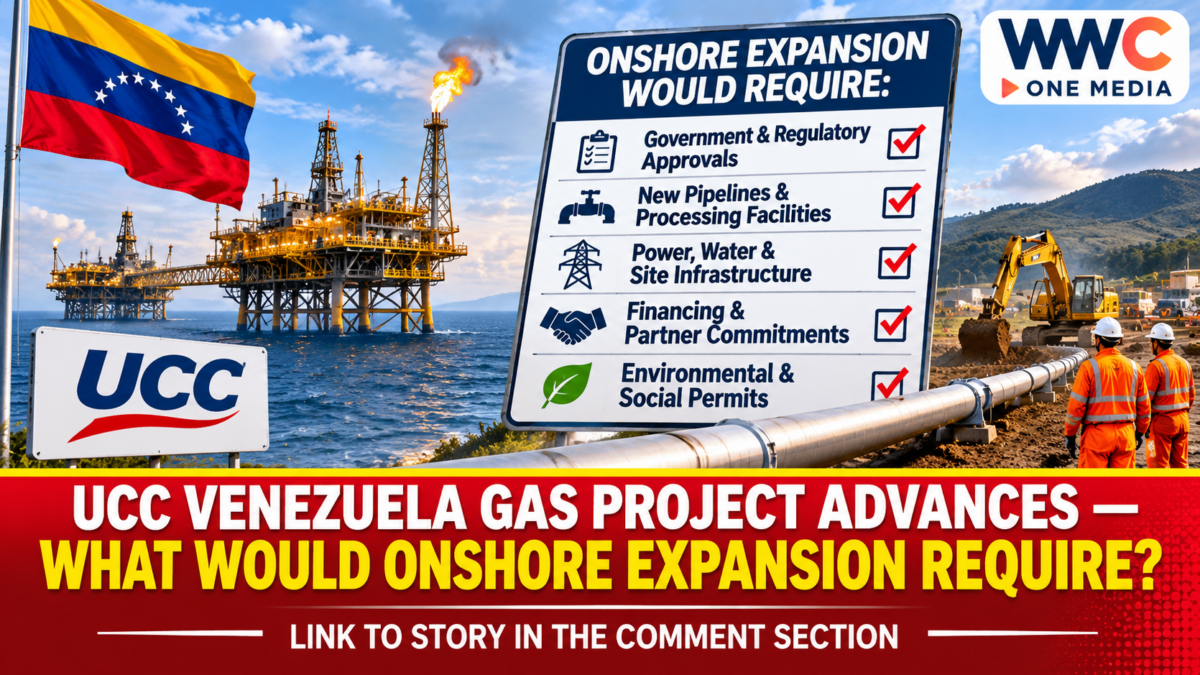
Any broader energy expansion would need to overcome familiar project hurdles: commercially viable development plans, equipment and services, infrastructure access, environmental assessments, financing and applicable approvals. The exact obstacles vary by asset and cannot be assumed to be identical across the country.
Power supply is one part of the broader operating context. WWC has also covered Venezuela’s electricity investment debate, an issue relevant to energy-intensive industrial development without proving anything about UCC’s specific facilities.
UCC’s public company description says it is a privately held subsidiary of Power International Holding operating across energy, mining, concessions and construction. That cross-sector capability may be commercially useful, but success in one project or market does not guarantee performance in another.
What happens next
The most useful next disclosure would identify any further Venezuelan assets by name, specify UCC’s precise rights and counterparties, and separate proposed investment from an executed operating agreement.
For Loran, the milestones to watch are a completed development concept, necessary regulatory decisions, a final investment decision and a credible route to commercial gas sales. None should be described as complete unless the partners or responsible authorities publish supporting records.
Until then, the verified story is an offshore participation agreement and continuing pursuit of partnerships — not proof of a completed onshore expansion.
Frequently asked questions
Does UCC already have a Venezuelan gas project?
UCC Holding announced on Aug. 13, 2026 that its UCC Oil and Gas subsidiary had received a participating interest in the Loran Phase 2 offshore gas licence. That does not mean commercial production has begun.
Who are UCC’s partners in Loran Phase 2?
UCC’s announcement names bp and XRG as partners with equal participating interests, and identifies bp as operator.
How much gas does the Loran Phase 2 project contain?
UCC’s published technical estimate is approximately 4 trillion cubic feet of recoverable gas resources for Phase 2. The estimate is not an output forecast.
Has UCC secured additional Venezuelan onshore fields?
No publicly inspected company or government announcement established a new onshore award, field-specific rights or completed onshore transaction as of Nov. 15, 2026.
Do US sanctions rules permit all new investment in Venezuela?
No. General License 49B permits specified negotiations and contingent agreements, subject to conditions. Performance requires separate OFAC authorisation where the licence applies.