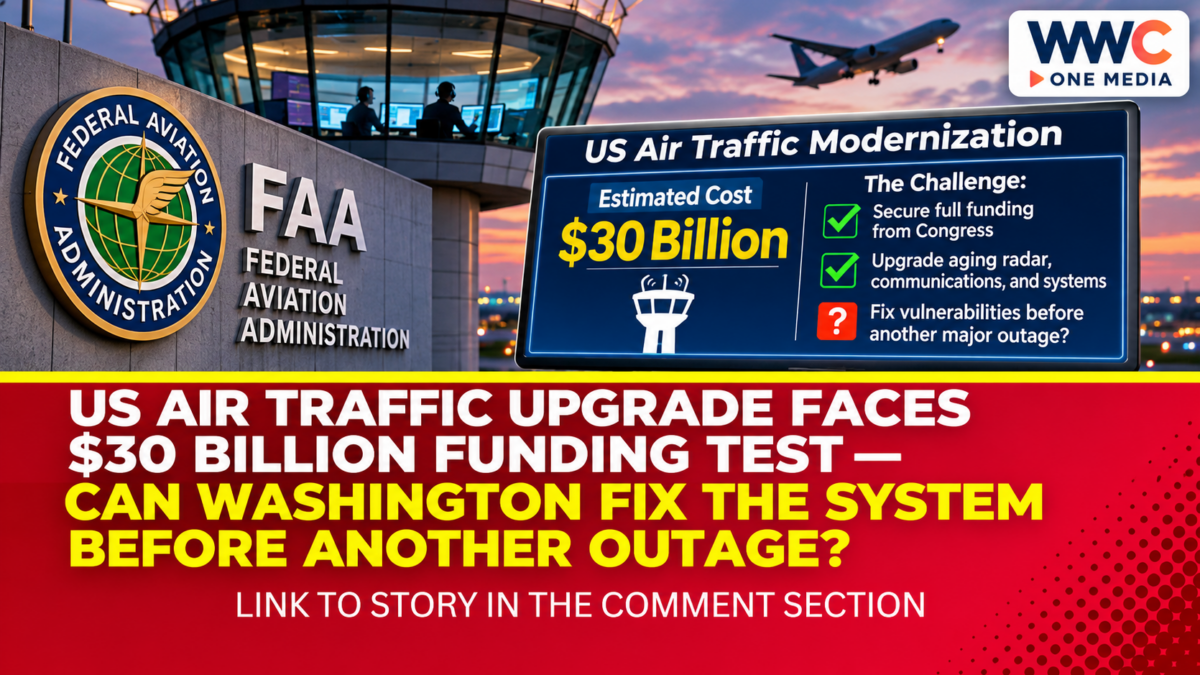
UNITED STATES — Nov. 14, 2026. The United States is confronting renewed questions about the reliability of its air traffic control network after a nationwide departure disruption on Nov. 13, while Transportation Secretary Sean Duffy continues to advocate major investment in replacement technology. The government had already backed a roughly US$30 billion modernisation proposal before the interruption, and a federal audit shows that funding is only one obstacle to delivering a dependable system.
The distinction matters to travellers and taxpayers. Congress previously provided US$12.5 billion for air traffic control improvements, but an additional spending proposal is not an appropriation. Nor does authorising billions of dollars guarantee that complex installations, communications equipment and operational backups will work together on schedule.
US Air Traffic Upgrade: What Congress Has Already Funded
A September 2026 FAA announcement identifies the earlier US$12.5 billion congressional allocation as a down payment on the Brand New Air Traffic Control System, or BNATCS. The federal audit confirms that the funding was appropriated in July 2025, with most of it intended for the programme’s first phase.
The first phase covers upgrades to communications, surveillance, weather information and training systems. FAA plans to finish it by December 2028. The second phase would expand automation for tracking aircraft and improving traffic management, but the audit said the agency had not established start or completion dates for that phase.
These distinctions matter in debates over emergency spending. Previously enacted funding, money requested in a new bill and the total projected cost of a programme are different financial measures. Adding them together without identifying overlaps would give readers an inaccurate picture of what taxpayers have committed.
What the Proposed $30 Billion Would Buy
On Sept. 29, Duffy joined Senator Eric Schmitt in supporting the Modern Skies Act, a proposed US$30 billion investment. The FAA’s published description divides the proposal into three US$10 billion components: digital air traffic architecture, replacement of ageing aviation infrastructure and improvements at airports lacking sufficient capital access.
The digital component includes telecommunications resilience, controller separation tools and traffic-flow management. The infrastructure portion covers towers and other airport facilities; the airport investment programme targets another set of capital needs. These are planned uses, not evidence that Congress has approved every proposed project.
A separate account of a Nov. 12 request places the figure at US$30.1 billion. That dated letter was not available for direct inspection during this review, so its precise allocation and any new emergency conditions are not treated as verified details. The independently documented September proposal establishes the broader funding debate without relying on the uninspected letter.
The Government Audit Exposes a Delivery Problem
The Government Accountability Office’s Sept. 14 review found that the FAA lacked a comprehensive, well-supported lifecycle cost estimate for BNATCS. The agency had supplied high-level programme estimates, but not the analysis needed to substantiate all costs, including significant government and future operating expenses.
More strikingly, the audit counted 11,389 individual project schedules that had not been combined into an integrated master schedule. That makes it harder to coordinate equipment installations at the same facilities, assess dependencies and reduce disruption to controllers while upgrades proceed.
GAO did acknowledge progress. As of May 2026, the FAA had replaced 2,560 of 5,170 ageing copper-wire connections with fibre-optic lines. But it warned that rushing implementation without reliable cost and scheduling controls could repeat past overruns and delays.
Analysis: This is the central test for lawmakers. A larger appropriation may accelerate purchases, but a credible programme also requires realistic cost estimates, prioritised installations and independent checks that replacement systems operate reliably alongside existing ones.
New Technology Is Already Reaching Control Facilities
On Nov. 5, the FAA announced the rollout of its Enterprise Information Display System, replacing four older information systems with one interface for controllers. The agency said the technologies being retired dated to the 1980s and operated across hundreds of facilities.
Five initial sites were identified, including Atlantic City, Nashville and Rochester airports and processing hubs in Atlanta and Salt Lake City. The FAA plans to install the system at 435 locations by the end of 2028. That is a deployment target, not evidence that all installations have already been completed.
Other FAA documentation describes work on voice-switching and recording systems, essential links between controllers and pilots. Communications, radar displays and data processing perform different tasks; a malfunction affecting one component should not automatically be attributed to every system under modernisation.
WWC’s separate report on the Changi Airport self-check-in outage illustrates this distinction. Passenger check-in systems are not the same as national air traffic control communications, even when both disruptions affect airline operations.
Why Philippine Travellers Should Pay Attention
Analysis: An interruption in a major international aviation network can delay aircraft and crews that are scheduled to operate later services. Restoring departure clearance does not automatically return every aircraft to its planned location or repair missed connections.
WWC’s reporting on flight adjustments for the ASEAN summit in the Philippines concerns planned security restrictions, not this US technical disruption. Both demonstrate why passengers should verify individual flight status rather than assume that a network-wide notice answers every itinerary question.
Similarly, volcanic-ash disruption affecting Singapore–Jakarta flights involved a different hazard, but it shows that clearing a restriction can precede the full recovery of airline schedules.
The Nov. 13 outage’s exact technical root cause, certified disruption totals and any new emergency appropriation require their own original documents. They should not be inferred from a general audit of ageing technology or from political statements about the need for upgrades.
What Happens Next
Congress must decide whether to authorise and appropriate more funding, while the FAA must demonstrate how its cost estimates, installation calendar and performance tests will improve. Publication of the signed November request, original outage investigation and updated GAO follow-up would allow more specific scrutiny.
The verified record establishes a major programme with substantial existing funding and measurable progress—but also unfinished planning controls. Whether more money prevents a future nationwide disruption depends on execution, resilience and evidence, not the size of the proposal alone.
Frequently Asked Questions
Has Congress already approved the additional US$30 billion?
The September Modern Skies Act was a proposed investment. The official records examined do not establish enactment of that additional amount.
How much money was previously provided for modernisation?
The FAA and GAO identify US$12.5 billion appropriated in July 2025 to support the air traffic control overhaul and related work.
What did the GAO find wrong with the project plan?
It identified missing comprehensive lifecycle cost documentation and 11,389 project schedules that were not incorporated into a single integrated master schedule.
Did the audit establish the cause of the November outage?
No. The September audit evaluated modernisation risks before the November event. A specific incident investigation is needed to determine the outage’s cause.